
How Intempt works
Intempt allows you to gather data from multiple data sources and apply an advanced profile merging logic to unify customer profiles.
Overview
Intempt allows you to gather data from multiple data sources and apply an advanced profile merging logic to unify customer profiles.
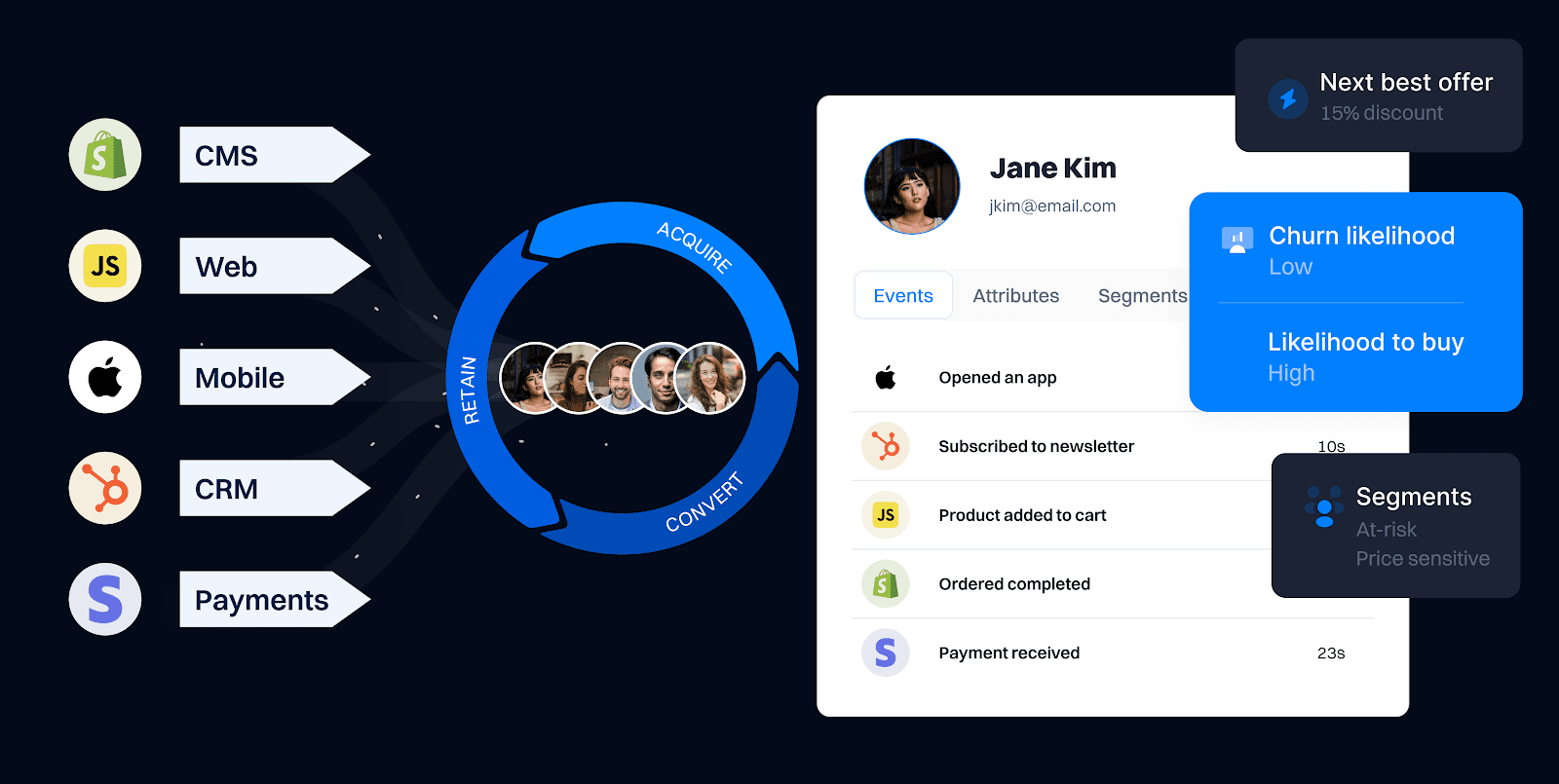
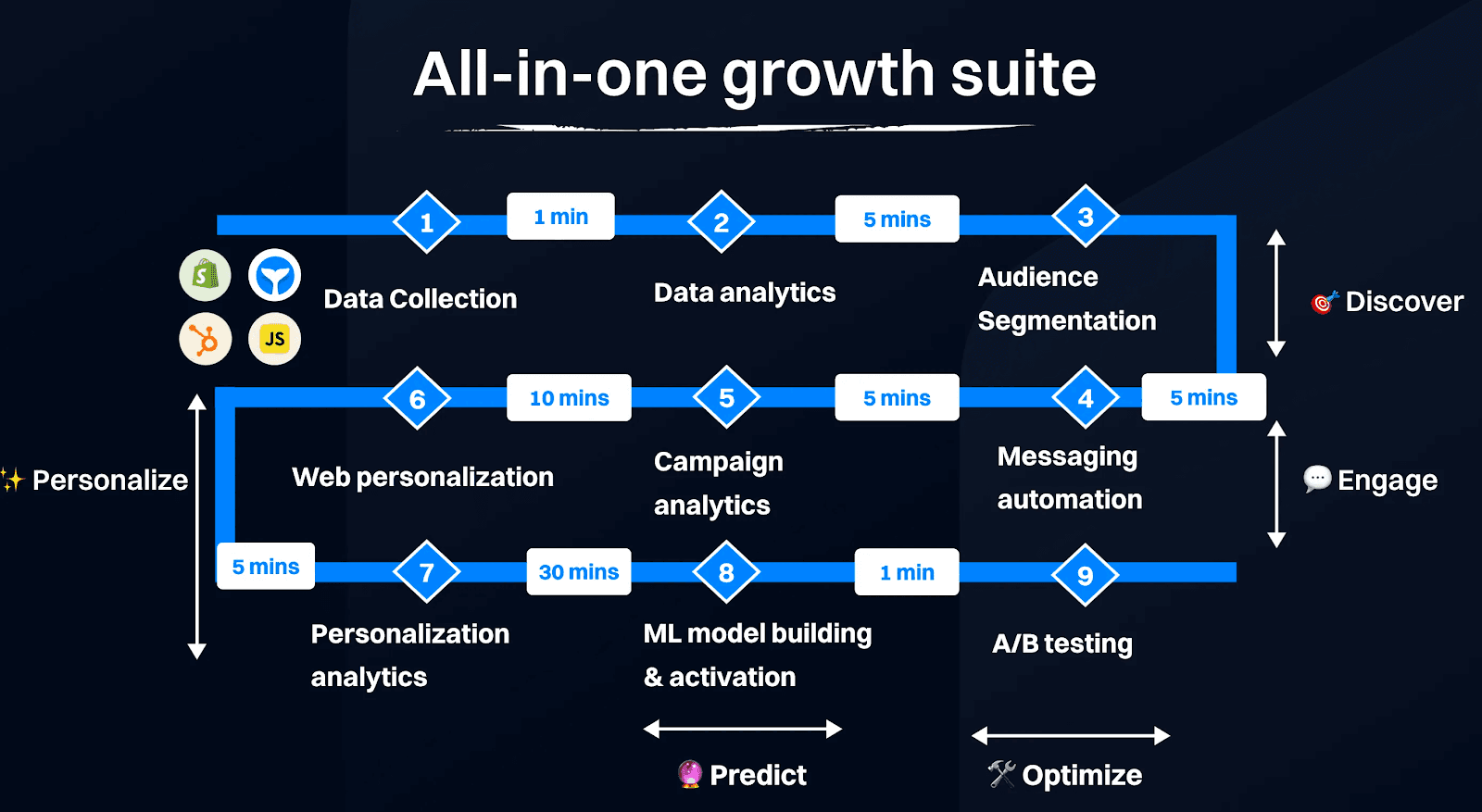
With unified customer data, Intempt powers five connected products under a single data model:
-
Data
Collect events, unify profiles, and manage attributes, integrations, and workflows. Every other product reads from this layer. -
Marketing
Build product catalogs, design customer journeys, and run experiments, all on the same unified customer profiles. -
Sales
Manage accounts and meetings using the same customer data your marketing team already sees. -
Analytics
Build boards on the same events and profiles the rest of the platform uses, so reporting never drifts from what marketing and sales are acting on. -
Design
Generate on-brand assets, from avatars and scenes to full design systems, using your catalog and customer data.
Infrastructure
Intempt is powered by the Clickhouse database, which is built for ingesting, storing, and querying trillions of events in real-time.
Event-centric
Intempt is built for ingesting, storing, and triggering events. Each event has a name, a timestamp, a unique identifier, a Master ID that identifies the entity that performed the event, and a JSON of properties. Events map cleanly to real-world actions. When something happens at a point in time to a user, you can track it with all the context you know about that event.
Real-time
Analytics. Events are available for analysis in Intempt within seconds of hitting our ingestion servers. Clickhouse uses an architecture to collect recent events in a row-oriented format while storing historical events in a time-partitioned columnar format. This enables fast, real-time analysis and efficient historical analysis.
Engagement. We use Flink pipelines to trigger real-time engagement sequences for our Journeys product - so each message gets to the customer at the precise time it was planned.
Personalization. We use advanced CDN techniques to apply real-time segmentation and serve personalized experiences in any part of the world under 500ms.
Data ingestion layer
You can collect data by implementing Intempt’s tracking libraries as your sources:
SDKs
-
Our JavaScript SDK is the most powerful way to track customer data from a website. We recommend it as the default installation for any website.
-
iOS SDK is the best way to simplify tracking in your iOS apps. We recommend them over server-side sources as the default installation for any mobile app.
-
Android SDK is the best way to simplify tracking in your Android apps. We recommend them over server-side sources as the default installation for any mobile app.
-
Node.js SDK lets you send analytics data directly from your servers when client-side tracking doesn’t work or when you’re sending mission-critical data like revenues.
-
Use the REST API if we don’t offer a library for your specific environment yet.
Cloud App Sources
We also offer cloud app sources to integrate data from your third-party tools:
-
Our cloud sources can import third-party tool data directly into your Intempt project based on the data recorded in the app, like Shopify and HubSpot.
-
Stripe Stripe integration allows you to sync your subscription and payment data to Intempt.
How you can track data
Intempt supports several ways to implement tracking. The two most common are to use client-based or server-based libraries. You can use Intempt’s client-based libraries, such as JavaScript SDK and iOS SDK, to make calls on users’ browsers or mobile devices. You can also track data with Intempt’s server-based libraries, such as Node.js SDK or REST API, where the calls are triggered on your own servers and then sent to the Intempt servers.
Although there are some tradeoffs between the two approaches, neither is better than the other, and we recommend that you implement a mix of both. In general, more direct interaction data is available using a client-based library, but the server-based collection is more secure, reliable, and can’t be blocked by ad blockers.
Where to go next
-
What is Intempt? for the product overview across all five products.
-
Basic Intempt installation to connect your first source and start sending events.
-
Data model for how events, users, and attributes fit together.
Asset Draft/Publish System
How saving works for content items in the Asset library: there's no separate draft state for most asset types, images land on the CDN as soon as they're generated or edited, and Brand Ads are the one type with an explicit publish step.
Data model
To effectively analyze your data, it’s important to understand how data is handled at Intempt.