


Marketers don't just want to test ideas; they want to turn those ideas into real customer experiences. Simple A/B tests and standard conversion lifts were once the gold standard, but now they have become the ghost of the past, because in 2025, growth teams demand more. They want to personalize in real time, orchestrate intelligently, and connect experiment results to revenue outcomes.
Why Compare Intempt and VWO?
Think of today's experience platforms as the control centers of customer growth. VWO and Intempt both help teams understand and improve user experiences, but they take radically different approaches.
VWO is built around testing, helping marketers optimize conversions and validate design hypotheses.
Intempt, on the other hand, is built around orchestration, helping teams understand user intent, run personalized experiments, and automate the next best experience across the lifecycle.
So why does this comparison matter?
Because modern growth teams are asking new questions:
- Which tool helps me move from testing to taking action on the results?
- Which connects experience optimization directly to revenue outcomes?
- Which platform empowers my team to run experiments, automate personalization, and measure business impact - all in one place?
That's why this comparison matters. In 2025, the experience market isn't just about running A/B tests; it's about building systems that predict, personalize, and decide what should happen next. Teams need platforms that bridge testing and action, hypotheses and outcomes, experiences and revenue.
Speaking of revenue, pricing is also a key part of this comparison. Intempt is priced per seat, with current prices on our pricing page, making it predictable, scalable, and aligned with lifecycle teams who want to personalize experiences across the entire funnel (Web, App, Hubspot, Stripe, Shopify).
VWO, on the other hand, prices based on traffic and testing volume. It works well for CRO and experimentation teams focused on web optimization, but costs can climb quickly as site traffic and test frequency increase.
How Is Intempt Different Than VWO?
At first glance, both Intempt and VWO help you improve user experiences and conversions. But they're built on two very different visions of what growth looks like.
Intempt
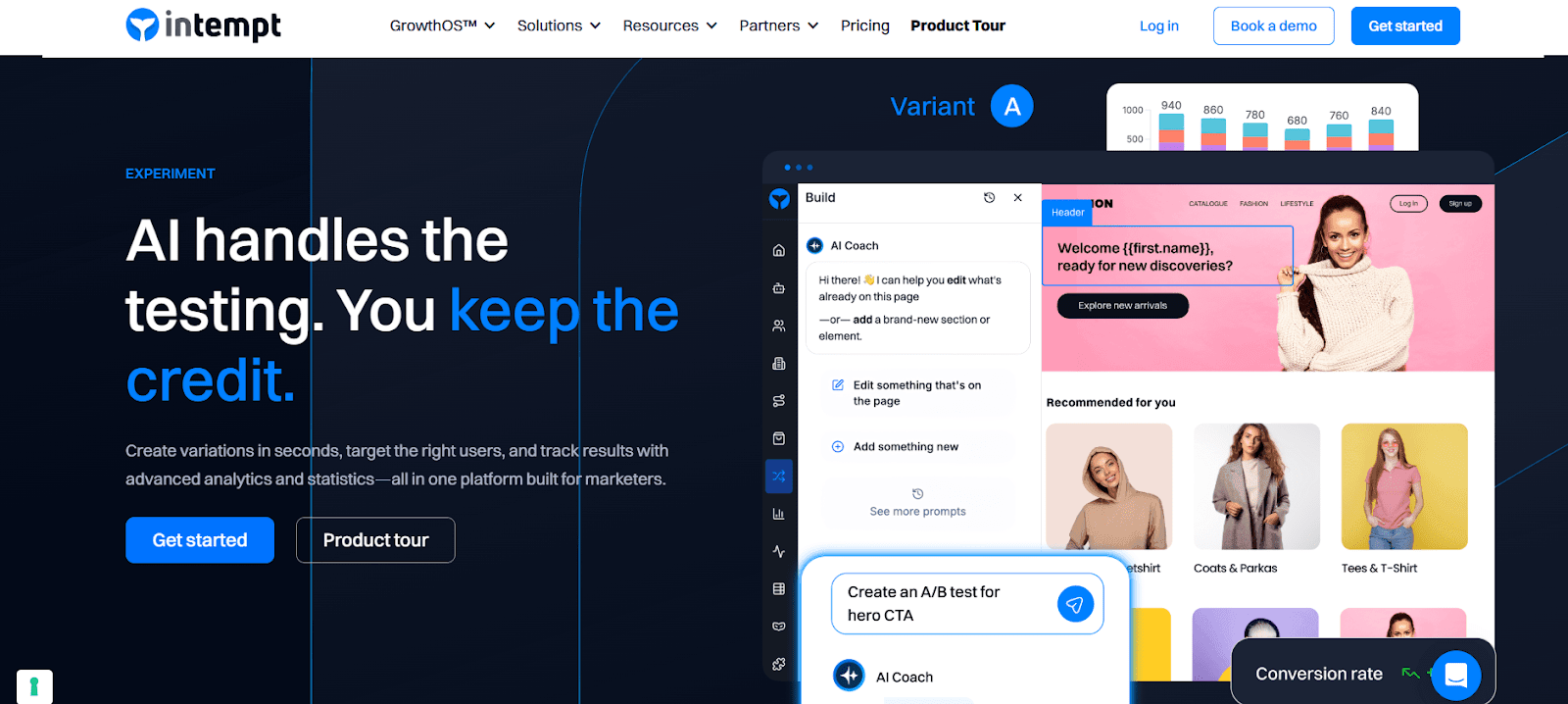
Intempt is designed for teams that want to move from static A/B testing to AI-powered orchestration. It's built to understand behavior, predict intent, and automatically adapt experiences across channels, empowering cross-channel growth.
With Intempt, teams can run experiments, personalize user journeys, and track revenue impact, all from one unified place. The platform connects analytics, personalization, and CRM data to ensure every experiment leads to measurable growth.
Intempt's experimentation tools allow you to run quick UI changes or deep logic tests, combine AI targeting, traffic control, and multi-page experiments, and drill into your experiment outcomes by applying filters or segment breakdowns, all in one place. It then helps you to create personalized experiences in web and app, adapt them for every user, and measure real impact, all without complexity or guesswork, using AI. It does all of this magic with no dev queue and no tool-switching, just experiments and personalization, you control end-to-end.
Intempt's AI doesn't just measure outcomes; it guides the next orchestration, ensuring every user sees the most relevant message, product, or offer in real time.
VWO
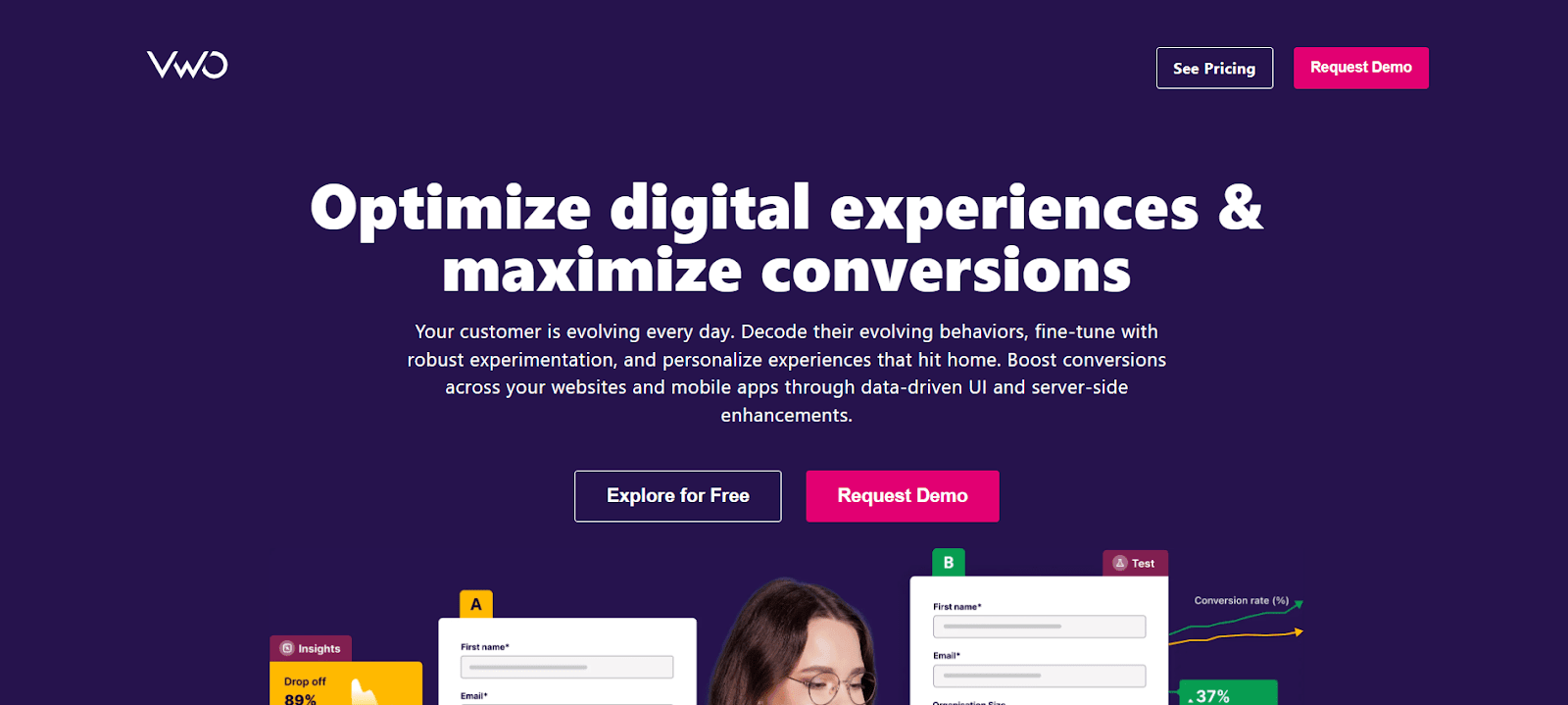
VWO (Visual Website Optimizer) is one of the most established experimentation platforms on the market. It offers full-featured A/B testing, multivariate testing, and split URL testing, with a visual editor that makes test setup simple for marketers. Our roundup of experimentation platforms places it among nine others, with prices checked in July 2026.
Over time, VWO has expanded into personalization, heatmaps, and CRO insights, helping teams test and optimize websites without developer dependencies.
However, while VWO excels at experimentation, it's primarily focused on "on-site optimization". It doesn't unify behavioral data across channels, nor does it natively connect experiments to revenue or CRM systems.
In-Depth Comparison: Intempt vs VWO
Intempt isn't just an alternative to VWO; it's a step-up from experimentation to orchestration. Modern growth teams don't just need to test different variations; they need connected, intelligent systems that turn insights into adaptive experiences.
Experiments alone don't drive growth unless you take action on the experiment results, make different campaigns to test and personalize according to the winner. That's where the comparison between Intempt and VWO becomes crucial.
Both platforms help you optimize user experiences, but the way they handle experimentation depth, personalization intelligence, and orchestration scalability differs significantly.
Below, we have compared both platforms feature by feature across experimentation, personalization, orchestration, experience insights, integrations, pricing, and more.
Experiences ( Experiment + Personalization )
| Feature | Description | Intempt | VWO |
|---|---|---|---|
| Experimentation | Design and analyze A/B, multivariate, and holdout tests. | Built-in experimentation module, A/B, multivariate, and split URL testing with a visual editor. It has CUPED variance reduction, confidence intervals, statistical significance, and revenue attribution. | A/B, multivariate, and split URL testing with a visual editor. |
| Personalization | Deliver dynamic content and offers based on behavior or attributes. | Real-time AI personalization across web and app with predictive segmentation. | Rule-based personalization with targeting conditions. |
| Orchestration | Automate multi-channel experiences across the user lifecycle. | No-code journey builder with adaptive triggers and conditions. Channels: SMS, push notification, and email | Limited to on-site personalization and campaign scheduling. |
| Experience Analytics | Analyze experience performance beyond conversion rates. | Combines web/app behavior and revenue data for unified reporting. | Heatmaps, session replays, and engagement metrics. |
| Feature | Description | Intempt | VWO |
|---|---|---|---|
| User Insights | Understand user behavior and intent across touchpoints. | AI-powered detailed user activity insight across web/app. | Behavior analytics within experiments. |
| Targeting & Segmentation | Define audiences for experiments or experiences. | Dynamic, AI-driven segmentation that updates in real time. | Audience creation via rules and attributes. |
| Recommendations | Suggest the next best content, offer, or product. | An AI recommendations engine is built into Intempt. | Product recommendations (add-on in VWO Personalize). |
| CDP | Collects, unifies, and activates user data across systems. | Full multi-channel: email, web, mobile, CRM, ads, and backend triggers. | Primarily web-based. Multi-channel requires integrations with other marketing automation tools. |
Experimentation
Both Intempt and VWO help teams test and optimize experiences, but the way they do it defines their philosophy.
Intempt integrates experimentation natively into its platform. Teams can create variations in seconds, target the right users, and track results with advanced analytics and statistics, all in one platform built for marketers. Intempt makes it easier for marketers to manage all tests in one place, run quick client-side tests with no code drag and drop freedom, and complete customization.
By combining AI-driven targeting, intelligent traffic control, and multi-page experimentation, marketers can pinpoint which changes truly fuel growth, leading to sharper insights and smarter, more impactful reporting.
VWO has long been one of the most trusted experimentation platforms in the CRO space. Its visual editor allows non-technical teams to create and launch A/B and multivariate tests, while its split URL and full-stack testing enable deeper experimentation for developers.
VWO's heatmaps, click maps, and session recordings provide clear visibility into how users interact with on-site elements. However, tests are typically limited to website-level optimization, and connecting experiment data to downstream metrics like CRM performance or revenue requires manual configuration or third-party integrations.
Personalization
Intempt
Personalization is one of Intempt's strongest pillars. Using AI-driven behavioral segmentation, the platform continuously learns from user actions to deliver real-time, context-aware content across web, app, and email.
Marketers can create personalized blocks or offers without code, and the system automatically adjusts based on predicted user intent or lifecycle stage, all without complexity or guesswork using AI.. Every personalization instance connects back to activation triggers, ensuring that no experience operates in isolation. From individual elements to entire experiences, Intempt's agents generate and customize personalized experiences instantly that help to reach the right audience every single time.
VWO
VWO Personalize allows marketers to tailor on-site content and experiences using rule-based targeting. Teams can define conditions like geography, browser type, referral source, or previous behavior to display different variants.
It also supports integration with data platforms for broader segmentation, making it great for on-site A/B personalization. However, personalization rules remain static; changes in user behavior don't automatically adjust segments or messaging in real time, limiting dynamic adaptability compared to Intempt's AI models.
Orchestration
Intempt
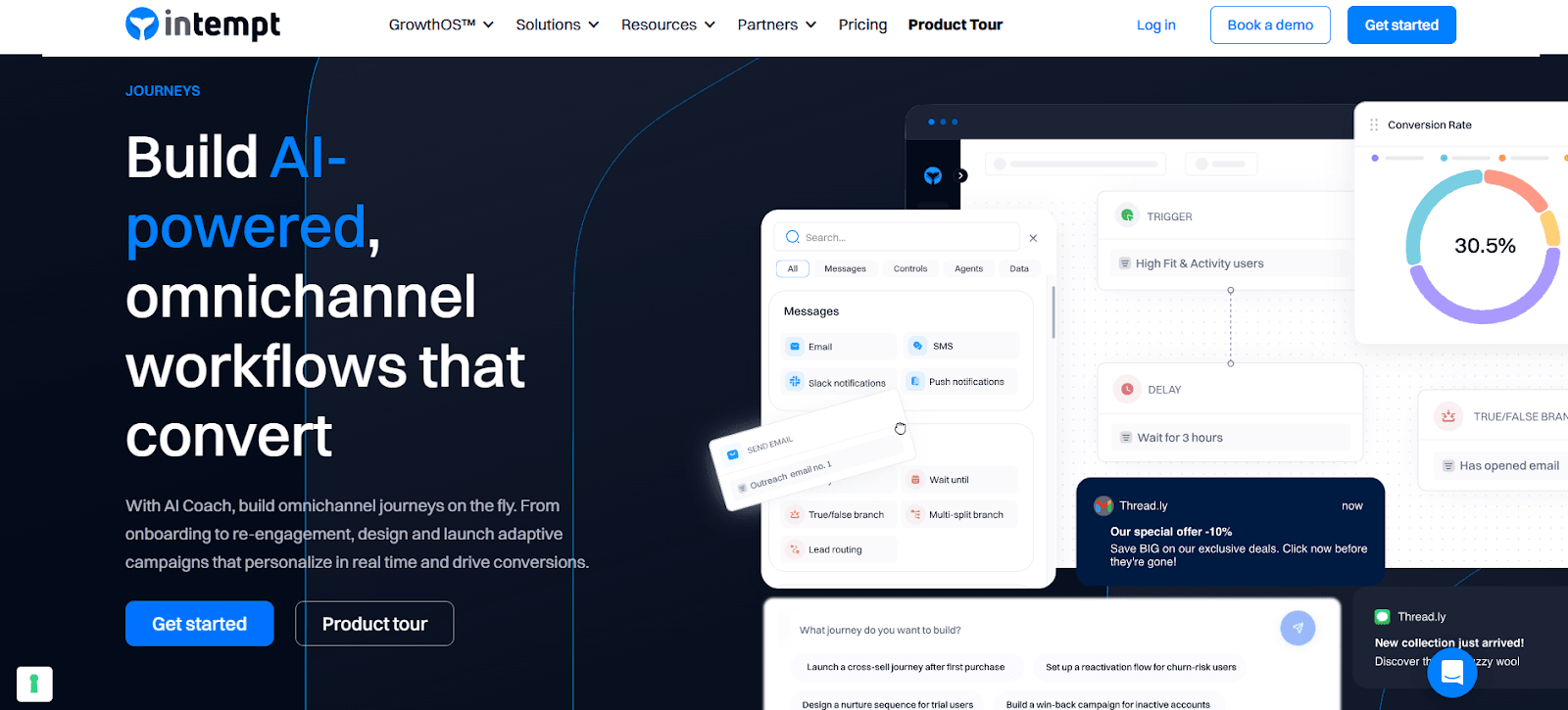
This is where Intempt truly separates itself. The platform doesn't just test and personalize; it orchestrates entire customer journeys across channels. Experiments and personalization connect to journeys, analytics, and revenue attribution, creating a unified growth system.
When a user shows high intent, Intempt can automatically trigger a personalized experiment, adjust their journey path, and measure the revenue impact-all without manual intervention. Intempt's agents continuously optimize these connections, ensuring every touchpoint drives toward conversion and retention.
VWO
VWO focuses on website optimization and testing. While it offers personalization, it doesn't orchestrate multi-channel journeys or connect experiences to lifecycle automation. Teams typically use VWO alongside other tools for email, CRM, or app personalization, creating fragmented experiences that don't adapt together.
Analytics + Revenue Attribution
Intempt
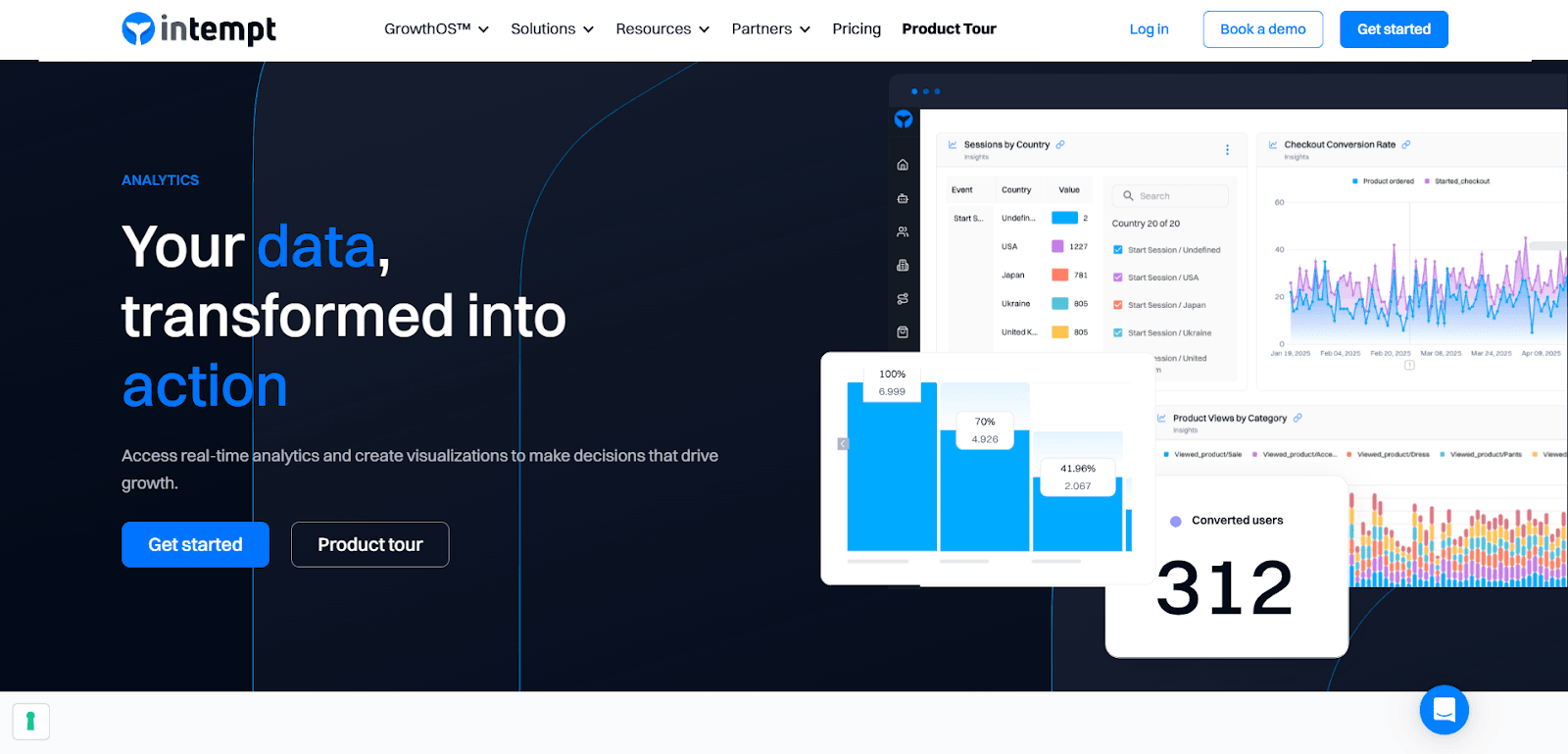
Intempt integrates behavioral analytics and revenue attribution directly into its experimentation and personalization engine. Every test, every personalization, and every journey step connects to revenue outcomes. Marketers can see which experiments drive activation, which personalizations increase AOV, and how each touchpoint contributes to lifetime value.
Analytics aren't just reports; they're decision-making tools that feed back into orchestration automatically. The AI uses this data to recommend next experiments, adjust targeting, and optimize outcomes continuously.
VWO
VWO provides solid experimentation analytics, showing conversion rates, statistical significance, and test performance. However, it doesn't natively connect to revenue attribution or lifecycle analytics. Teams often export data to separate analytics tools to understand business impact, creating gaps between testing and strategic decision-making.
Integrations
Intempt
Intempt integrates across the entire revenue stack with CRM, ecommerce, data warehouses, and marketing tools. Shopify, HubSpot, Stripe, Segment, and native SDKs all plug into the platform natively. But more importantly, Intempt's integrations are activation layers. A predictive score from Intempt can update a CRM record, trigger a personalized journey, or adjust an experiment without any manual intervention. Data moves both ways in real time.
VWO
VWO integrates with analytics tools, data platforms, and marketing automation systems. These integrations help sync test data and user segments, but they're primarily data pipes rather than activation layers. VWO doesn't natively orchestrate actions across CRM, email, or app channels based on experiment results.
Pricing
Intempt
Intempt uses per-seat pricing, with usage metered on top. Because the pricing is based on the number of users you personalize for, costs stay predictable as your business expands. You do not pay for event volume or sudden traffic spikes. More importantly, Intempt replaces multiple tools by bundling CDP, analytics with revenue attribution, recommendations, journeys, and experiments into one platform.
VWO
VWO's pricing scales with traffic volume and testing frequency. Plans start around $199 per month for basic testing, but costs increase as site traffic and test complexity grow. For teams running multiple experiments or high-traffic sites, pricing can climb significantly. VWO works well for CRO-focused teams, but brands seeking full lifecycle personalization usually end up layering it with more tools, increasing their total cost of ownership.
When to Choose What?
Choosing between Intempt and VWO doesn't have to be complicated. The real distinction is simple: one is built to optimize websites, the other is built to optimize entire customer lifecycles. Here's the marketer-friendly breakdown so you instantly know which platform fits your brand, your team, and your growth model.
Choose VWO If…
- You want a proven, established A/B testing platform focused on website optimization.
- Your primary goal is improving conversion rates on specific pages or user flows.
- You prefer rule-based personalization that you control manually.
- You're comfortable using separate tools for analytics, CRM, email, and app personalization.
- Your team is primarily focused on CRO and website experimentation, not full lifecycle orchestration.
- You don't need AI-driven journey adaptation or predictive intent scoring.
VWO: a website optimization engine built for CRO teams that want detailed control over testing and on-site personalization.
Choose Intempt If…
- You need experiments and personalization that connect to full lifecycle journeys, not just website pages.
- You want AI-driven orchestration that adapts experiences automatically based on behavior and intent.
- You need unified analytics with revenue attribution that directly influences experiment and personalization decisions.
- You want a full CDP that unifies behavioral, product, CRM, and revenue data into one evolving customer profile.
- You want to personalize across web, app, email, SMS, push, and CRM in one system.
- You prefer a platform that scales with your actual customer base rather than traffic volume, making it significantly more cost-efficient as you grow.
- You want an AI agent that recommends experiments, identifies friction points, and optimizes outcomes automatically.
Intempt: intelligent orchestration for teams that want adaptive growth loops, not just website tests. If your growth strategy depends on full lifecycle personalization, predictive AI, and real-time decisioning, Intempt is the smarter choice.
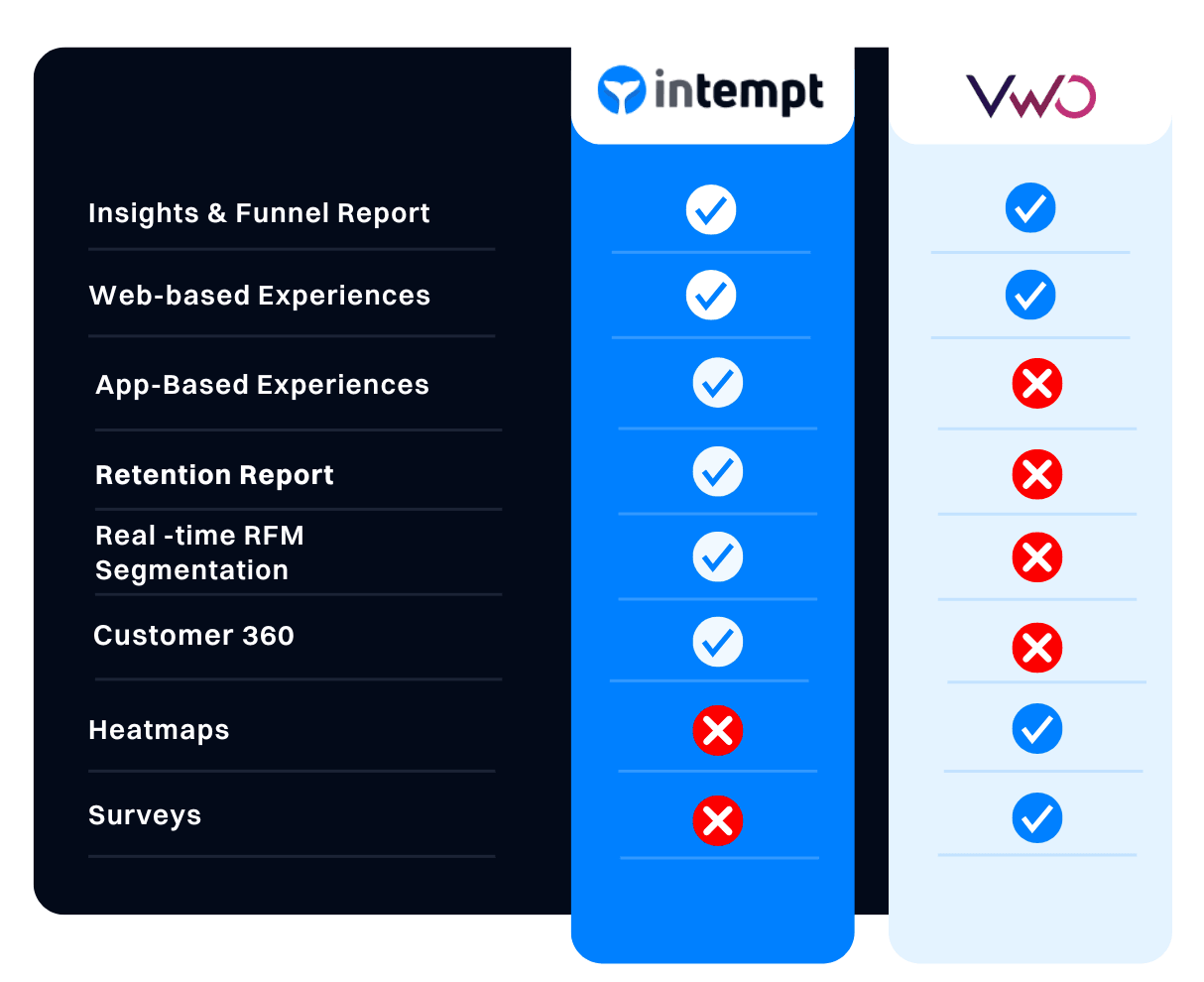
Quick summary
- Experimentation: VWO excels at website A/B testing with a visual editor; Intempt integrates experimentation into a full platform with AI-driven targeting and multi-page tests.
- Personalization: VWO offers rule-based on-site personalization; Intempt delivers AI-driven, real-time personalization across web, app, email, SMS, push, and CRM.
- Orchestration: VWO focuses on website optimization; Intempt orchestrates entire customer journeys across channels with predictive adaptation.
- Analytics + Revenue Attribution: VWO provides test performance metrics; Intempt connects every experiment and personalization to revenue impact and lifecycle outcomes.
- Integrations: VWO integrates with analytics and data tools; Intempt integrates deeply with real-time, two-way sync for cross-channel orchestration.
- Pricing: VWO charges based on traffic and testing volume, starting around $199/month. Intempt is priced per seat (see intempt.com/pricing), scaling with your team rather than traffic spikes.