


More tests. Fewer wrong bets.
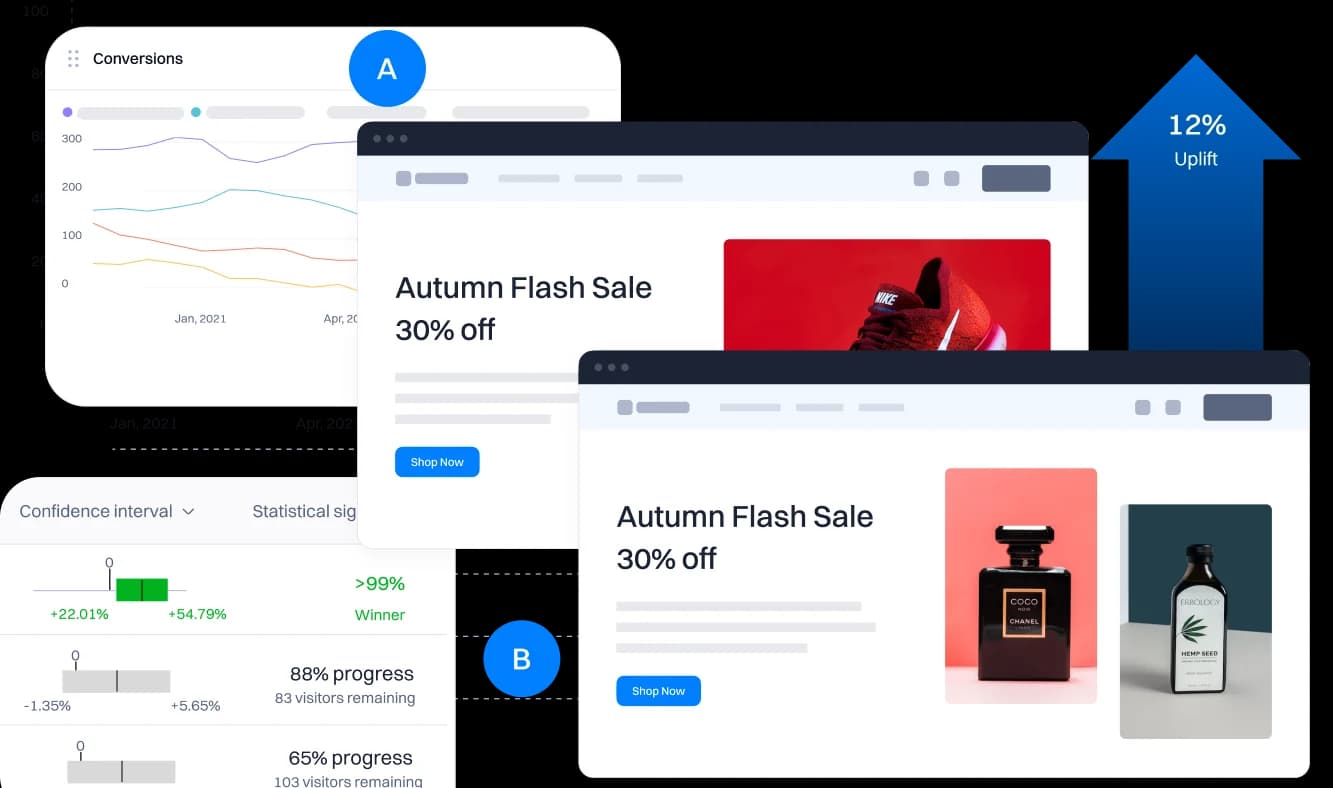
Run hypothesis-driven A/B tests on the same profiles that power your journeys and personalization. When a variant wins, ship it to the segment it won for no export, no rebuild, no separate testing tool.
No hypothesis defined means no experiment. Blu enforces this before you launch.
Most teams run tests without a clear success metric. They collect data, see mixed results, and argue about what to ship. Blu requires a primary metric, a guardrail metric, and a minimum detectable effect before a single user is split. The discipline forces clarity. The results become defensible.

Your test finishes weeks earlier. Same confidence. Fewer users.
CUPED removes variance already explained by each user's prior behaviour before the test runs. A 3% baseline usually needs 10,000 users per variant. With CUPED you reach the same confidence with 30 to 40 percent fewer users and call the result weeks sooner.

The winner ships to the segment it won for not everyone.
Every other testing tool ships the winner to 100% of traffic. A variant that wins for new users might actively hurt returning customers. Intempt rolls the winning variant into a personalized experience targeted at the exact segment where it performed. Users it never helped keep seeing what worked for them.

How A/B Testing Works
From hypothesis to segment-targeted personalization in four steps.
Define the hypothesis before touching the UI
Blu asks for the hypothesis, primary metric, guardrail metric, and minimum detectable effect before you build a single variant. Sample size is calculated upfront. You know exactly how long the test needs to run and what outcome constitutes a clear ship or hold decision before a single user is split.
Build variants and target the right users
Client-side variants ship with the no-code visual editor no engineering required for UI changes. Server-side variants test pricing logic, recommendation algorithms, or API responses. Traffic splits against the same behavioral segments that power your journeys, so test audiences are precise and never require a separate audience sync.

CUPED and sequential testing run automatically
CUPED removes variance already explained by each user's prior behaviour cutting required sample size by 30–40%. Sequential testing lets you monitor results daily without inflating false-positive risk. You're not waiting for a fixed runtime to check results. You're watching a live signal that gets cleaner as it runs.

Blu calls the result and the winner targets the right segment
When results reach significance, Blu recommends ship or hold with specific reasoning. The winning variant rolls directly into a personalized experience targeted at the segment where it won not broadcast to everyone. Segments, profiles, and experiments all share the same data layer, so there's no export or rebuild.

Real results, not just tech
We drive measurable outcomes in the first 90 days. Beyond the platform.

“We were losing visitors before they signed up. Intempt's personalized experiences changed that - we started meeting people where they were instead of guessing. Once they're in, Intempt's automated email takes over and keeps the relationship moving. Acquisition and retention finally feel like one connected motion instead of two separate problems.”
Jim Stromberg, CEO
StockInvest
Case Study
StockInvest needed to turn anonymous traffic into registered users before any retention strategy could work. With Intempt's Experiences, they personalized the anonymous visitor flow, surfacing the right content and CTAs to boost signup conversion. Once users signed up, automated Journeys nurtured them through onboarding and deeper engagement, steadily increasing lifetime value.
Explore more products
Everything else that turns your data into revenue.
Test more. Guess less.
Blu sets the hypothesis. You approve the winner. The result ships to the segment it won for.
Frequently asked questions
A/B testing and experimentation
Client-side experiments run in the browser using JavaScript they're fast to launch, require no backend changes, and work well for UI, copy, and layout tests. Server-side experiments run on your backend and test things like pricing logic, recommendation algorithms, API responses, or personalised content. Intempt supports both from the same experiment interface, so you don't need separate tools for front-end and back-end tests.
CUPED (Controlled-experiment Using Pre-Experiment Data) removes variance in your conversion metric that's already explained by each user's prior behaviour. Because some variance is removed before the test runs, the variant's true effect is isolated more cleanly and you reach statistical significance with 30–40% fewer users. That translates directly to shorter test durations, especially for low-traffic pages or low-baseline conversion rates.
Yes. Sequential testing (MSPRT) lets you monitor results continuously without inflating your false-positive rate. Standard A/B testing requires you to choose a sample size upfront, wait until it's reached, and look at results exactly once. Sequential testing removes that constraint you can check daily, and Blu will tell you when results are significant enough to call.
A guardrail metric is the thing you're not allowed to break in pursuit of your primary metric. For example, if you're optimising checkout conversion rate, revenue per visitor might be your guardrail a test that increases conversion by getting users to buy cheaper items might be a net loss. Blu tracks guardrail metrics in parallel with the primary metric and flags any test where the guardrail moves negatively, even if the primary metric wins.
Not necessarily. Intempt lets you roll a winning variant into a personalized experience targeted at the specific segment where it won. A variant that performed well for new users can become a personalization for new users while returning users keep the original experience. Because experiments and personalizations share the same unified profiles and segments, there's no export or rebuild required.