.svg)


Intempt v/s Clerk.io (2025): In-Depth Comparison
Every marketer knows the frustration: you work hard to acquire a customer… and then generic journeys send them straight to a competitor. A recommendation engine alone isn’t enough anymore. Clerk.io has long been one of the most popular tools for smart product recommendations, search, and on-site personalization. But in 2025, teams want more than a recommendation engine that reacts. They want to personalize the whole customer journey across email, sms, onsite, and in-app, and get for ltv our customers That is exactly where Intempt steps in. Intempt doesn’t behave like another vendor for product recommendations. It thinks ahead, runs personalized experiments, orchestrates journeys across every channel, and recommendations into one intelligent system that grows smarter with every user interaction. In this comparison, we’re putting Intempt vs Clerk.io under the microscope to help you identify which platform is the more future-ready growth engine for your brand.
%20In-Depth%20Comparison.png)


Why Compare Intempt and Clerk.io?
Most shoppers judge a brand in seconds, and strong product recommendations are often what determine whether they browse… or bounce. That’s why the first question in any Clerk.io vs. Intempt comparison should be simple: which platform delivers smarter, more adaptive recommendations?
- Which tool doesn’t just personalize products but also personalizes entire customer journeys?
- Which tool connects personalization directly to revenue attribution instead of showing isolated click reports?
- Which one doesn’t confine personalization to the storefront, but orchestrates it across email, push, web, app, and more?
It’s about AI-powered orchestration, predictive segmentation, and omnichannel personalization driven by a unified CDP. In other words, teams want more than a recommendation engine; they want a growth engine.
And this is where Intempt’s philosophy diverges sharply from Clerk.io.
Intempt uses a unified customer data foundation (events, attributes, cohorts, and predictive scores) to power real-time, intent-based recommendations that update dynamically as a shopper moves between email, SMS, onsite, and in-app. Instead of relying mainly on catalog and behavioral patterns, Intempt fuses journey context, user state, and predictive signals, creating recommendations that actually shift with the customer’s lifecycle.
But recommendations are just the start. Because Intempt’s engine sits inside a full platform, CDP, journeys, experiments, and revenue attribution, it doesn’t stop at suggesting the right product; it personalizes the entire path to conversion and repeat purchase. Teams get one system that understands why a person buys, not just what they click.
Clerk.io, by comparison, is for e-commerce merchandising teams who want plug-and-play upgrades to product discovery. Its recommendation and search tools are strong for improving onsite browsing, relevance, and conversion, especially for stores that don’t need deeper orchestration logic or cross-channel personalization.
Pricing also plays a major role in how these philosophies diverge. Clerk.io charges based on ecommerce modules and recommendation volume, starting at $119 per month for 100,000 recommendations. It works well for storefront-centric teams, but brands seeking full lifecycle personalization usually end up layering Clerk.io with additional tools for CDP, journeys, experiments, and analytics, increasing their total cost of ownership.
Intempt, however, follows a Monthly Tracked Users (MTU) model starting at $52.6 per 1,000 users, making recommendations and personalization predictable and scalable as your customer base grows. You pay for the users you track and personalize for, not for spikes in product views, clicks, or recommendation volumes. And because Intempt consolidates CDP, analytics with revenue attribution, journeys, experiments, and recommendations into one GrowthOS, teams often eliminate multiple tools while gaining far more intelligence.
How Is Intempt Different Than Clerk.io?
At first glance, Intempt and Clerk.io both promise smarter recommendations and personalization. But the moment you look beneath the surface, it becomes clear that they are built for two very different marketing realities.
Clerk.io has long been a favorite among ecommerce brands because it delivers fast, relevant recommendations, intelligent search results, and effortless catalog personalization. It helps you by getting the right product in front of the right shopper at the right moment, and its plug-and-play setup makes it easy to improve conversion rates on a website without needing developers. For storefront merchandising and on-site discovery, it’s a fairly powerful engine.
Intempt begins where most platforms stop: with smarter, more adaptive recommendations. Instead of relying only on catalog data or recent browsing behavior, Intempt’s recommendation engine uses unified customer profiles, predictive scores, and cross-channel context to decide what to show a user and when. Recommendations update in real time as customers move between email, SMS, onsite, and in-app, giving brands continuity that Clerk.io’s onsite-focused models don’t provide.
From there, Intempt extends personalization beyond the product tile. The same intelligence that powers recommendations also drives the entire customer journey. Intempt unifies identity, product usage, CRM activity, revenue, and behavioral events into a full CDP. That data then fuels journeys that adapt on their own, audiences that update automatically, and experiments that optimize what happens after someone engages with a recommendation.
In-depth Comparison: Intempt vs Clerk.io
When you compare Intempt and Clerk.io through a 2025 lens, the biggest difference comes into focus immediately: both platforms offer recommendations, but only one treats recommendations as part of a larger, intelligent growth engine. Clerk.io excels at ecommerce merchandising, delivering fast, accurate on-site recommendations that help shoppers discover products. Intempt takes the same types of recommendation models but connects them to a full CDP, predictive segmentation, analytics with revenue attribution, and AI-powered journeys. It doesn’t just recommend items. It recommends actions, next steps, and experiments.
Because recommendations are the core battleground in this comparison, let’s break down exactly how each platform handles the most widely used models in modern ecommerce.
Recommendations
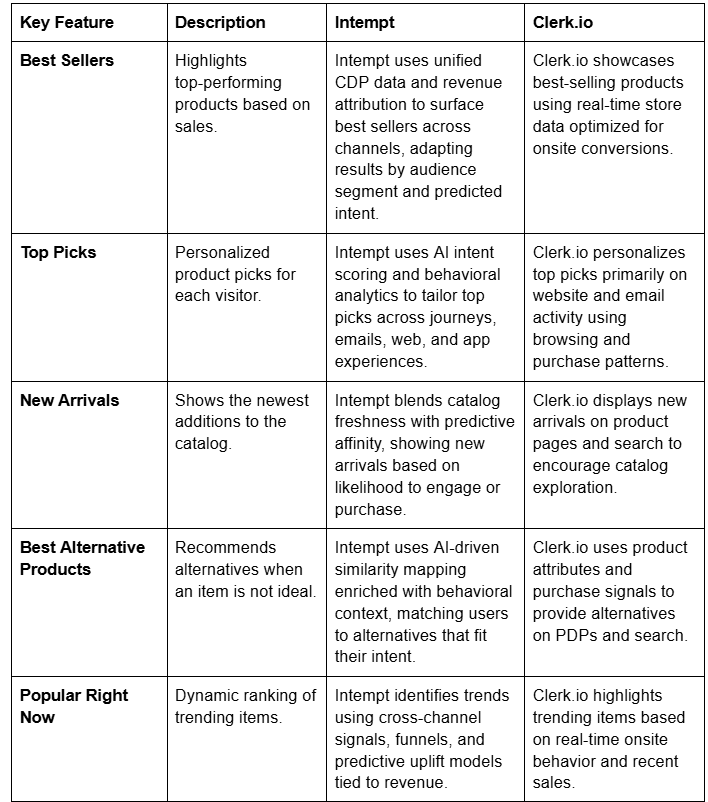
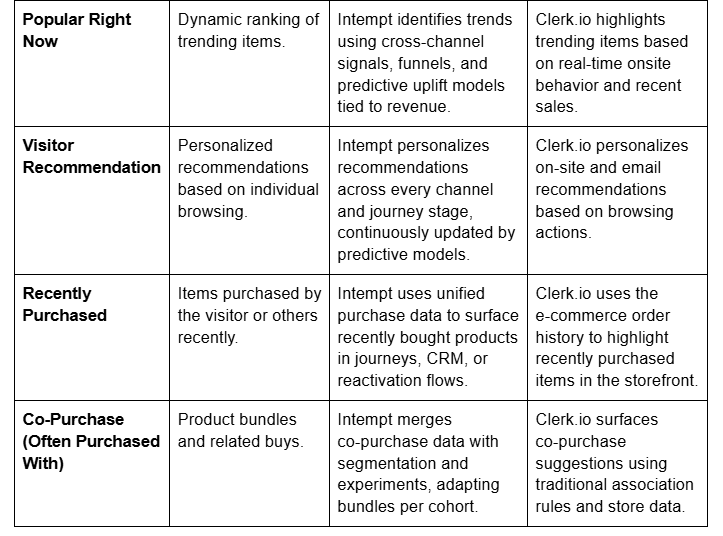
Best Sellers
Intempt
Intempt identifies best sellers not just by raw order volume but by tying purchase performance to revenue attribution and audience behavior. Because Intempt functions as a CDP, best sellers adapt to each segment, journey stage, and predictive score. A product might be a bestseller for a high-intent cohort but not for new visitors, and Intempt accounts for that immediately. These recommendations can appear across web, email, app, push, and CRM, ensuring the message meets users wherever they are.
Pro tip: Spotlight your best sellers on the homepage to boost engagement and conversions.
Clerk.io
Clerk.io delivers best sellers using store data and real-time sales velocity. It is excellent for surfacing top-performing items on PDPs, search pages, and category listings. These recommendations are effective for increasing onsite conversions and guiding shoppers toward the highest-demand products.
Top Picks
Intempt
Top picks in Intempt are generated by AI intent scoring, historical behavior, and unified profile data that spans the entire customer lifecycle. These aren’t just website recommendations; Intempt adapts top picks across journeys, experiments, and segmentation. The result is a deeply personalized set of suggestions that evolves dynamically with every user action.
Pro tip: Spotlight your top picks on the homepage, category pages, and screener for maximum visibility.
Clerk.io
Clerk.io creates personalized top picks based on browsing and purchase history. These recommendations appear primarily in the storefront and email templates. While highly relevant for onsite interactions, they do not extend to cross-channel personalization or lifecycle orchestration.
New Arrivals
Intempt
Intempt blends catalog updates with predictive affinity scoring, meaning users only see the new arrivals they are most likely to engage with. Because Intempt’s CDP tracks behavior across channels, these new arrival suggestions can be delivered through campaigns, journeys, or in-app experiences, not just the storefront.
Pro tip: Spotlight your new arrivals on the Homepage to grab the eyeballs.
Clerk.io
Clerk.io handles new arrivals through catalog detection, showcasing fresh inventory on PDPs, homepage blocks, and search. It is a fast, reliable feature that supports merchandising teams who want to promote new items immediately.
Best Alternative Products
Intempt
Intempt uses an AI-driven similarity model enriched with behavioral context. If a product is out of stock, poorly reviewed, or mismatched with the user’s intent, Intempt predicts the best alternative and adapts the logic for each user. Alternatives can be tested in experiments, optimized in journeys, and delivered across channels.
Pro tip: Spotlight your best alternative products on the product detail and watchlist to guide smarter choices.
Clerk.io
Clerk.io provides product alternatives based on catalog attributes, tags, and purchase signals. These recommendations appear on product detail pages to prevent drop-offs by guiding users to similar items.
Popular Right Now
Intempt
Intempt identifies trending items by analyzing cross-channel engagement, funnels, and predictive uplift models linked to revenue attribution. This helps the AI co-marketer adapt recommendations in real time during peak trends or campaigns.
Pro tip: Spotlight your popular products on the homepage, category page, and trending page for maximum reach.
Clerk.io
Clerk.io identifies and showcases trending items by analyzing real-time product interactions, browsing behavior, and the latest sales activity. By tapping into what shoppers are engaging with right now, it automatically surfaces products that are gaining momentum.
Visitor Recommendations
Intempt
Visitor recommendations inside Intempt reflect the full user identity across web, email, app, CRM, and product interactions. They evolve automatically as predictive models update intent scores. Because these recommendations flow through journeys and experiments, each user receives the right message at the right touchpoint.
Pro tip: Spotlight your visitor recommendations on the homepage and product page to deliver a personalized experience to the customers.
Clerk.io
Clerk.io personalizes recommendations on the website and in email campaigns based on browsing and purchase actions. These recommendations are highly relevant onsite, but they do not factor into wider lifecycle experiences.
Recently Purchased
Intempt
Intempt uses unified purchase history across Shopify, Stripe, and CRM to surface recently purchased items in re-engagement campaigns, journey branches, or retention experiments. These recommendations help brands reinforce loyalty, run refill campaigns, or reactivate customers.
Pro tip: Spotlight your recently purchased items on the homepage and product page to help shoppers see what others are loving.
Clerk.io
Clerk.io identifies and surfaces recently purchased products by analyzing your store’s real-time order data. By tapping into what customers are actually buying, it generates recommendations that reflect current demand and genuine shopper interest. These insights can be showcased directly on your storefront, such as the homepage or product pages, to build trust and highlight what’s resonating right now.
Co-Purchase (Often Purchased With)
Intempt
Intempt enhances co-purchase models by combining association rules with audience segmentation and experiments. Marketers can adapt bundles to different cohorts or use predictive scoring to serve smarter upsells. Because co-purchase models connect to revenue attribution, Intempt shows which bundles actually drive higher order value and retention.
Pro tip: Spotlight your “People also search for” items on the homepage and product page to guide shoppers toward relevant alternatives.
Clerk.io
Clerk.io uses powerful association logic built from your store’s historical order data to identify products that are frequently purchased together. By understanding real buying patterns, it can surface highly relevant “Frequently Bought Together” or “Complete the Look” suggestions that are helpful to shoppers.
Beyond Recommendations
Even though recommendations are where the comparison starts, the real difference between Intempt and Clerk.io becomes unmistakable the moment you look beyond them. Clerk.io’s personalization capabilities are laser-focused on the storefront: search, carousels, PDP suggestions, and email content for ecommerce teams.
Intempt, on the other hand, treats recommendations as one piece of a much larger growth engine. Once recommendations connect to journeys, experiments, analytics with revenue attribution, a unified CDP, and predictive users and audiences, they stop being blocks on a page and start becoming adaptive, intelligent levers of lifecycle orchestration.
To see how deeply the two platforms diverge, let’s explore the core systems that sit around recommendations.
Journeys
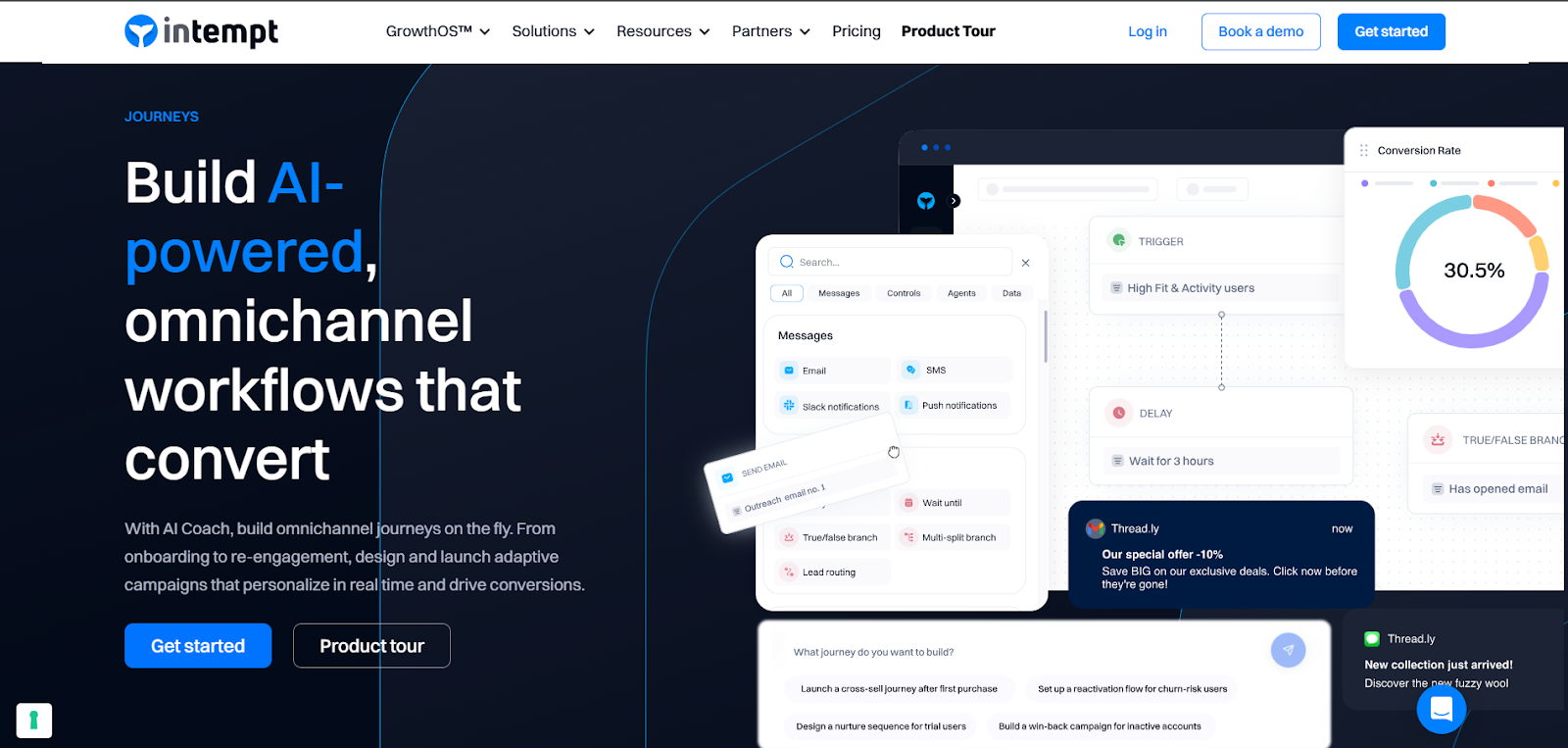
Journeys are where Intempt breaks out of the traditional e-commerce mold entirely. Intempt doesn’t just deliver recommendations; it orchestrates when, where, and why those recommendations appear. Journeys adapt in real time as predictive scores shift, user intent changes, or behavior indicates movement into a new lifecycle stage. A user showing high purchase intent might be served a personalized experiment or a tailored recommendation across email, in-app, and web at the exact moment it matters.
Clerk.io also offers email in its journey builder, making it possible to trigger follow-ups based on browsing and purchase activity. However, there is no AI branching and no multi-channel orchestration. Clerk.io informs immediate browsing, while Intempt orchestrates long-term behavior.
Analytics
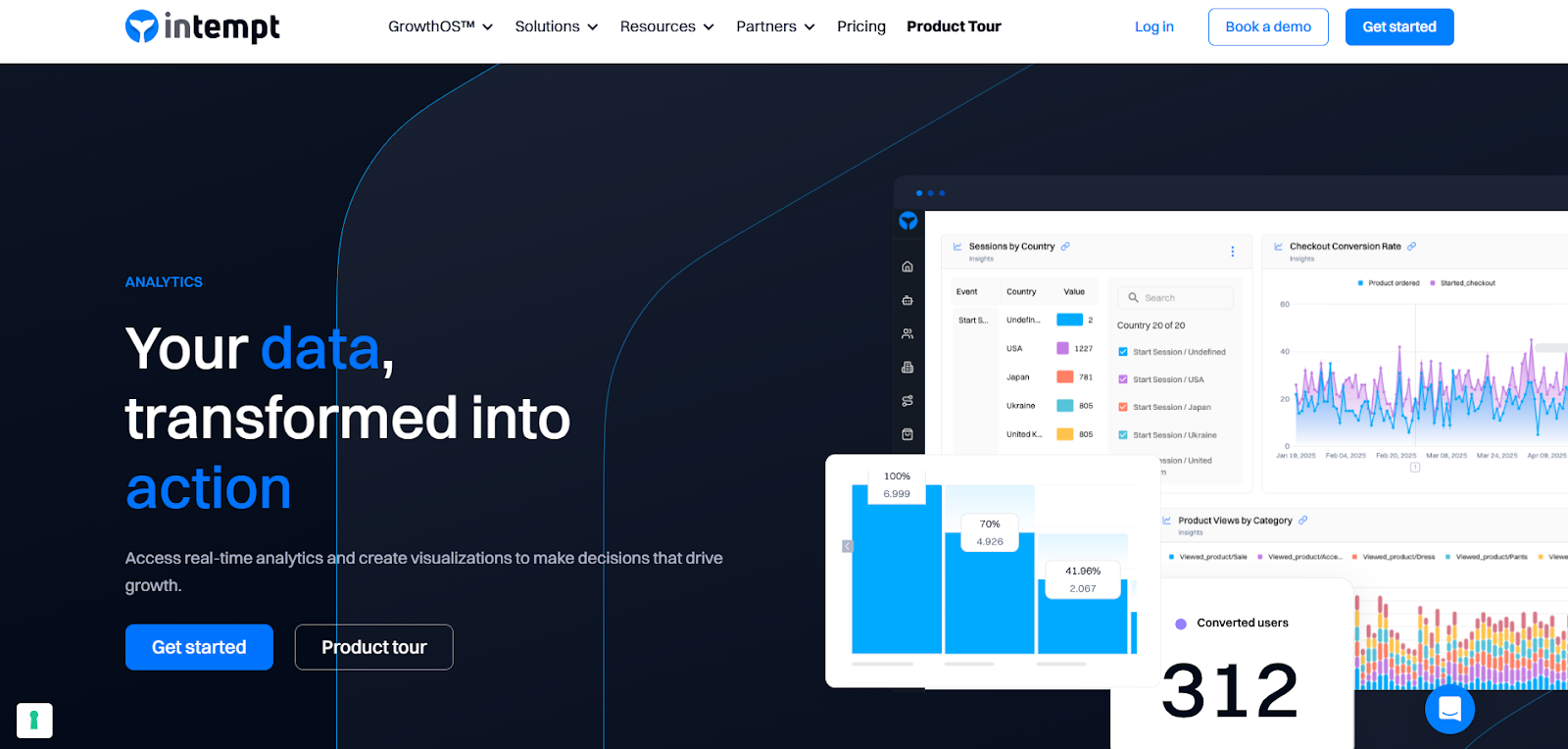
Intempt integrates analytics and revenue attribution into every layer of its GrowthOS. This means funnels, cohorts, session analysis, and predictive insights are not just charts; they directly influence journeys, audiences, and recommendation logic. If funnel drop-offs spike or a specific segment shows declining purchase intent, the AI co-marketer inside Intempt adapts the experience automatically. Every metric becomes actionable.
Clerk.io offers helpful analytics that highlight search performance, recommendation clicks, and conversion metrics inside the storefront. They are valuable for merchandising insights, but they exist independently from a broader lifecycle engine. Without a built-in revenue attribution system or unified behavioral analytics, those insights remain descriptive rather than prescriptive.
CDP
Intempt functions as a complete customer data platform from the ground up. It unifies behavioral streams, CRM attributes, product events, revenue data, and multi-channel touchpoints into one living customer profile with identity resolution. Every attribute is directly connected to experiments, journeys, segmentation, and recommendations.
Clerk.io does not operate as a CDP. It stores e-commerce and browsing data, which is excellent for onsite personalization, but it does not unify CRM, app behavior, or multi-channel data into full profiles. As a result, personalization remains in the e-commerce bubble, without the cross-channel intelligence that modern customer lifecycle strategies demand.
Experiences (Personalization + Experiments)
Experiences inside Intempt are not widgets; they are intelligence-driven flows. Personalized experiments live directly inside journeys, so marketers can test different variations of a recommendation, layout, or message and have Intempt optimize results automatically. Personalization happens across web, email, push, app, and CRM in a unified, AI-driven manner.
Clerk.io personalizes beautifully within the store. It is highly effective at showing the right products to the right visitors, but it does not run personalized experiments across lifecycle stages or adapt behavior across channels. Personalization remains surface-level compared to Intempt’s lifecycle-wide approach.
Integrations and Pricing
Integrations
Intempt integrates across the entire revenue stack with CRM, ecommerce, data warehouses, and marketing tools. Shopify, HubSpot, Stripe, Segment, and native SDKs all plug into the platform seamlessly. But more importantly, Intempt’s integrations are not just data pipes; they are activation layers. A predictive score from Intempt can update a CRM record, trigger a personalized journey, or adjust an experiment without any manual intervention. Data moves both ways in real time.
Clerk.io also integrates deeply with e-commerce platforms like Shopify, WooCommerce, Magento, Prestashop, and BigCommerce. These integrations excel at syncing product catalogs, orders, and onsite behavior, enabling fast personalization. But Clerk.io does not orchestrate broader lifecycle actions or unify data points beyond ecommerce events.
Pricing
Intempt uses a Monthly Tracked Users (MTU) pricing model, starting at $ 52.6 per 1,000 users. Because the pricing is based on the number of users you personalize for, costs stay predictable as your business expands. You do not pay for event volume or sudden traffic spikes. More importantly, Intempt replaces multiple tools by bundling CDP, analytics with revenue attribution, recommendations, journeys, and experiments into one GrowthOS.
Clerk.io’s pricing scales with ecommerce features and catalog size. As you add search, recommendations, email personalization, and more modules, the price goes up. The pricing starts from $119 per month for 100,000 recommendations. So, for brands seeking unified personalization across the lifecycle usually end up layering it with more tools, increasing their total cost of ownership, as Intempt focuses on the total number of users rather than the total number of recommendations.
When to Choose What?
Choosing between Intempt and Clerk.io doesn’t have to be complicated. The real distinction is simple: one is built to optimize storefronts, the other is built to optimize entire customer lifecycles. Here’s the marketer-friendly breakdown so you instantly know which platform fits your brand, your team, and your growth model.
Choose Clerk.io If…
- You want plug-and-play merchandising tools like trending products, search suggestions, and PDP recommendations that require minimal configuration.
- You want to improve onsite conversions fast through catalog-based models like best sellers, co-purchase, new arrivals, and alternative products.
- Your main personalization channels are your website and ecommerce emails, not app, CRM, or push channels.
- Your growth strategy revolves around optimizing the onsite browsing experience rather than orchestrating full lifecycle journeys.
- You prefer a recommendations + search tool without needing a CDP, experiments, or predictive segmentation.
- You don’t require multi-channel orchestration or AI-driven journey branching.
Clerk.io: a merchandising engine built for ecommerce brands focused on optimizing onsite discovery and conversions.
Choose Intempt If…
- You need recommendations that go beyond product tiles and adapt across journeys, email, push, web, and app in real time.
- You want unified analytics with funnels, cohorts, journeys, predictive insights, and revenue attribution powering every decision.
- You need a full CDP that unifies behavioral, product, CRM, and revenue data into one evolving customer profile.
- You want AI-driven RFM segmentation, predictive scoring, and audiences that update continuously as users move through lifecycle stages.
- You want to run personalized experiments (layout tests, journey variants, multi-surface flows) across all channels, not just A/B tests inside emails or PDPs.
- You want an AI co-marketer that qualifies users, suggests journey changes, and optimizes outcomes automatically.
- You operate on multiple surfaces, including app and CRM, and need orchestration that spans far beyond the ecommerce store.
- You want a platform that scales with your actual customer base rather than message volume, making it significantly more cost-efficient as you grow and engage users across multiple channels.
Intempt: intelligent orchestration for brands that want adaptive growth loops, not just smarter product blocks. If your growth strategy depends on full lifecycle personalization and real-time AI decisioning, Intempt is the clear winner.
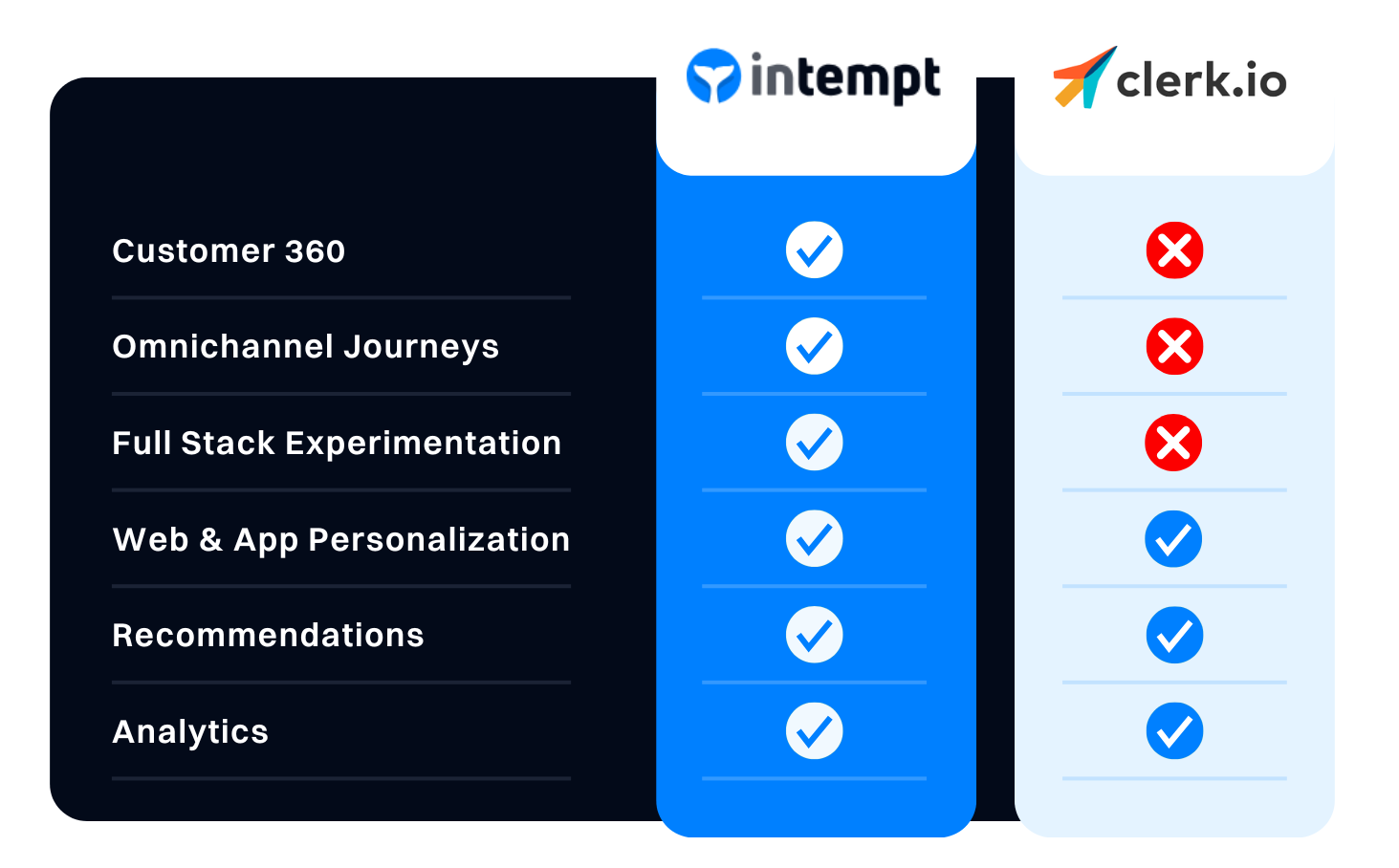
TL;DR
- Recommendations: Clerk.io offers strong onsite recommendations, while Intempt delivers cross-channel, predictive recommendations that adapt to the full customer journey. Clerk offers 9 recommendation algorithms, and Intempt offers 16 recommendation algorithms.
- Personalization: Clerk.io personalizes storefront and email experiences; Intempt extends personalization across web, app, CRM, push, and email.
- Journeys: Clerk.io supports basic onsite-triggered flows, whereas Intempt builds AI-adaptive journeys that update instantly as user intent changes.
- Analytics: Clerk.io provides clear ecommerce metrics, but Intempt connects every action to revenue attribution and lifecycle performance.
- CDP: Clerk.io stores ecommerce behavior for personalization; Intempt unifies behavioral, product, CRM, and revenue data in a built-in CDP.
- Experiments: Clerk.io has limited experimentation, but Intempt enables journey-level experiments that optimize content, offers, and recommendations.
FAQs
1) What’s the main difference between Intempt and Clerk.io?
Clerk.io focuses on e-commerce search and recommendations, helping stores personalize product discovery.
Intempt goes far beyond e-commerce widgets. It is an AI-driven GrowthOS that connects recommendations to journeys, analytics with revenue attribution, a unified CDP, predictive cohorts, and personalization across every channel.
2) Does Intempt replace Clerk.io completely?
Yes. Intempt supports all recommendation types. Clerk.io offers best sellers, new arrivals, top picks, co-purchase, visitor-specific suggestions, and more, while adding AI-powered journeys, experiments, predictive segmentation, and omnichannel personalization. It becomes the single system that automates and optimizes the entire user lifecycle.
3) How are Intempt’s recommendations different from Clerk.io’s models?
Clerk.io’s recommendation engine focuses on optimizing onsite behavior, offering 9 recommendation algorithms that adapt product blocks and search results based on browsing activity.
Intempt provides 16 recommendation algorithms out of the box and powers them with unified CDP data, intent scoring, predictive analytics, and revenue attribution. These models run not just onsite, but across journeys, campaigns, and every channel.
4) Which platform offers deeper personalization across channels?
Intempt. It delivers personalized experiences across web, app, email, and push notifications. Clerk.io focuses the majority of personalization on-site and in ecommerce-specific emails.
5) Which tool is more marketer-friendly to use?
Marketers often find Intempt’s interface cleaner and more intuitive, with a journey builder, CDP, analytics, and experiment workflows designed for fast iteration, fewer clicks, and minimal complexity. It’s built so non-technical growth teams can move quickly without relying on developers.
Clerk.io’s UI is straightforward and effective for merchandising teams, but it’s primarily centered around ecommerce tasks like product blocks, search tuning, and onsite recommendations, not full lifecycle orchestration.
FAQs
Can I trial Webflow before pa

Sure! You can test out Webflow on our free plan where you can experiment with 2 projects. Your unhosted projects will have a two-page limit, but you can purchase a site plan on a per-project basis to unlock up to 100 static pages and additional CMS pages.
What is a project?
A project is a website that you build in Webflow. You can publish projects to a webflow.io staging subdomain for free, export the code on a paid plan, or add a site plan to connect your custom domain and unlock hosting features.
What can I white label?
Pro accounts can add their own logo to Client Billing forms and the Editor. Pro accounts can also remove references to Webflow in the source code and form submission emails, and hide the Webflow badge from their staging sites.
How much traffic can the hosting handle?
Webflow hosting scales automatically to handle millions of concurrent visits. All site plans serve sites through our Amazon's Cloudfront CDN and accelerated using Fastly, loading sites in milliseconds.
What kind of support does Webflow provide?
We offer fast email support to paid accounts and prioritized help for team accounts. Community support (forum.webflow.com) is available to free accounts.
How long does it take to learn Webflow?
If you're new to building websites, our video tutorials will get up and running quickly. If you already know concepts behind CSS and the box model, you will feel at home in Webflow.
Check out Growth Play Library ➡️
Get started free on GrowthOS ➡️
Book a growth call ➡️
.svg)
Sid Chaudhary
Founder & CEO


Looking for ways to grow faster?
Discover marketing workspace where you turn audiences into revenue.
Learn about IntemptReceive Monthly Insights
Get expert insights & news on the latest promotion trends in our monthly newsletter.
Sid Chaudhary
CEO & Founder

Lifecycle automation tips
Industry tips
Case Studies
You might also like...
%20In-Depth%20Comparison.png)
Intempt vs Customer.io (2025): In-Depth Comparison
Customer journeys are most effective when they evolve with user behavior. But most automation tools still rely on static flows that remain unchanged until a marketer updates them manually. Customer.io delivers strong messaging automation and excellent segmentation. It can move users in and out of segments in real time based on events, attributes, and behavior, which makes targeting very powerful. Intempt takes a different approach. It uses AI to orchestrate journeys that adjust themselves in real time, predict user intent, and connect every step to analytics and revenue attribution, turning your lifecycle into a system that learns and improves automatically. In this comparison, we break down Intempt vs. Customer.io so you can understand which platform delivers truly adaptive lifecycle orchestration in 2025.

%20In-Depth%20Comparison.png)
Intempt v/s Klaviyo (2025): In-Depth Comparison
Marketers want seamless customer journeys, not a maze of rules and manual triggers. If the system feels like work, it’s not automation, it’s stress in a shiny UI. Klaviyo has long been the go-to for e-commerce platforms, powering email, SMS, and now even WhatsApp automation. But 2025 teams want more than AI that writes better subject lines; they want an AI comarketer that thinks ahead. In this comparison, we’ll explore Intempt v/s Klaviyo with a sharp focus on their Journeys to help you find out which one delivers true AI-powered orchestration rather than just automated messaging.
%20In-Depth%20Comparison.png)
Intempt vs VWO (2025): In-Depth Comparison
Marketers don’t just want to test ideas; they want to turn those ideas into real customer experiences. Simple A/B tests and standard conversion lifts were once the gold standard, but now they have become the ghost of the past, because in 2025, growth teams demand more. They want to personalize in real time, orchestrate intelligently, and connect experiment results to revenue outcomes.
Subscribe to The Full Stack Marketer 📈
Zero theory or mindset discussions here; just actionable marketing tactics that will grow revenue today.

Web A/B testing
Use front-end A/B and multi-page experimentation product built for any business size. Run multiple experiments on the same page.

Targeting & personalization
Deliver targeted messaging, personalized offers and recommend the most relevant content for your users.

Visual editor
Empower your team to collaborate with an easy-to-use visual editor without using developer time to get things up and running.

Analytics
Gain insight into the impact of your experiments with statistically valid results. No complex statistical analysis required.

Server & client-side testing
Go beyond client-side testing and deploy experiments on the server-side. Test and optimize content changes and even complete re-brands.

Flexible goal selection
Select the right goal for each personalization and experimentation campaign to ensure you’re optimizing towards the right objectives.
.svg)

.svg)


.svg)
.svg)