


- The two products meter opposite things, and the meter decides the winner before any feature grid does. Mixpanel charges for events with free seats. Intempt charges for seats with usage on top.
- At low event volume Mixpanel is usually the cheaper analytics product. Price both at your own volume, with current Intempt rates at intempt.com/pricing. Mixpanel ships session replay; Intempt does not.
- If low-volume analytics is the whole job, pick Mixpanel. If you also need journeys, experiments, and personalization on one profile, pick Intempt.
Every take on Intempt vs Mixpanel, including the previous version of this page, argues the wrong thing first. It argues features, then leads with the reveal that Mixpanel cannot send an email and holds no billing object to run revenue attribution against. Both true, and neither is the deciding factor for most teams, because the feature grids on this pair are broadly settled and the bill is not. Both products publish a rate card. Both meters are public. They meter opposite things, and running one against the other produces a number that decides the purchase before a single requirement gets discussed.
Mixpanel charges for data and gives away people. Unlimited seats on every tier, including free. One million events a month free, then $0.28 per 1,000 events. Intempt does the reverse: it charges for people and meters the data on top. That means a price per seat, billed from the first event, then a graduated usage rate that falls at volume. Current rates are on our pricing page.
That is not a pricing footnote. It is a statement about who each product was built for, and it produces a crossover you can compute. At low event volume, Mixpanel is the cheaper analytics product. At high volume the seat model can win. Most comparison content on this pair, written by whichever vendor is doing the comparing, never admits the first half because it is inconvenient. It is stated here first. Work out the crossover at your own volume with the current rates on our pricing page.
The short version
- Mixpanel meters events, unlimited seats. Intempt meters seats, events billed separately. That inversion is the whole comparison.
- There is an event volume below which Mixpanel is cheaper. Compute yours from Mixpanel's rate card and our pricing page.
- Every Intempt seat you add moves that crossover higher.
- Below the crossover, Mixpanel is cheaper for analytics. Any post that hides this is selling, not comparing.
- Mixpanel says volume discounts exist on Growth and does not publish them, so a negotiated crossover is higher than the published one.
- Mixpanel's free plan is more generous on events: 1M a month against Intempt's 100,000.
- Intempt's free plan is more generous on reports: pre-built dashboards against Mixpanel's five saved reports per seat.
- Mixpanel ships session replay. Intempt does not, and says so on its own product analytics page. That is the clearest capability gap in Mixpanel's favor.
- Five things Mixpanel's own plan table marks as add-ons: account-level behavioral analytics, experiment reporting, feature flags, metric trees, data pipelines. No published price on any of them.
- Mixpanel's schema holds no subscription, MRR, or billing object, and its Compare Us menu names eight rivals, all of them analytics tools. It is not competing for the revenue question.
- Intempt's schema holds web behavior, product events, and revenue on one identity, plus the channels to act on them. Depth of behavioral exploration is where it gives ground.
- Search demand: "mixpanel" gets 14,800 US searches a month. "intempt vs mixpanel" returns no measurable volume. This pair is not a shopping query yet.
What each product actually is, checked against its own pages
Both descriptions below come off the vendors' own navigation and pricing pages on July 31, 2026, not from recollection or a third-party review. The reason to do it this way is that Mixpanel in 2026 is meaningfully wider than the Mixpanel most comparison posts describe, and repeating a 2023 description of it would make the rest of the argument worthless.
Mixpanel in July 2026
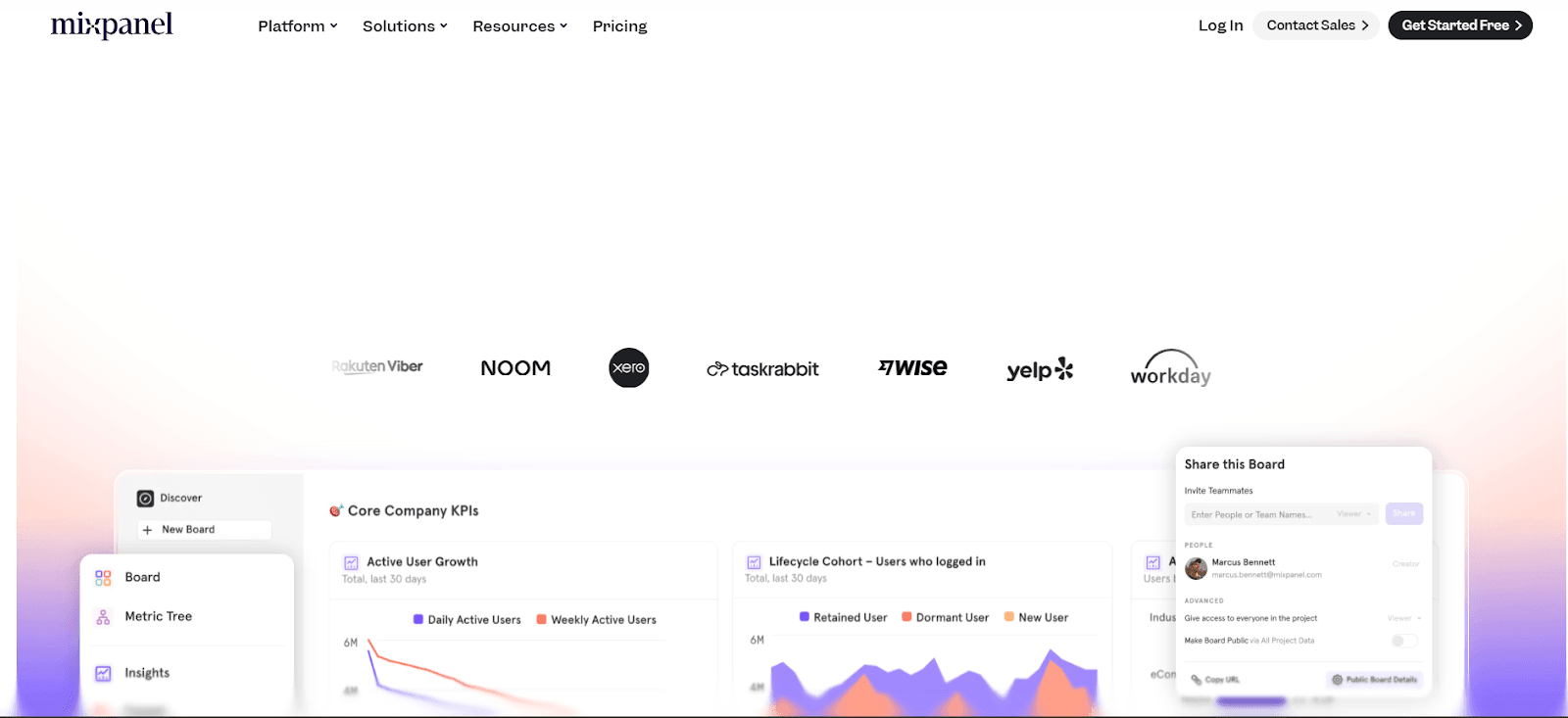
Mixpanel calls itself a product intelligence platform for the AI era, with the tagline "Build faster, with direction" and a second line about grounding every decision in customer truth. It cites more than 29,000 companies and a 4.5 out of 5 score across 1,300-plus reviews. The platform menu lists six products: Product Analytics, Web Analytics, Mobile Analytics, Experiments, Metric Trees, and Session Replay.
- Queries run on Arb, its own database, which is the basis of the speed claim rather than a generic performance line.
- Mixpanel AI covers a Root Cause Analysis Agent that diagnoses what changed and delivers a working dashboard, an Experiments Agent that designs and interprets a test, and AI Metric Trees.
- Mixpanel Agent can be tagged in Slack. Mixpanel MCP connects Claude, ChatGPT, Cursor, or any MCP client. Mixpanel Headless exposes the platform in a single line of Python.
- AI Data Governance ships a Context Engine and a Verified Mode, which is a real answer to the accuracy problem most conversational analytics features ignore.
- Session replay includes AI summaries across hundreds of replays, heatmaps, and Magic Playlists built from events or properties.
- Governance covers GDPR, CCPA, SOC 2 Type II, US or EU data residency, SAML SSO with SCIM provisioning, audit logs, sensitive data classification, compartmentalized access, HIPAA compliance tools, and a customizable retention policy.
One more thing worth reading, and it is the most informative page on the whole site. Mixpanel's own Compare Us menu lists exactly eight competitors: Amplitude, Heap, Pendo, Google Analytics, PostHog, Fullstory, Adobe Analytics, and Statsig. Every single one is an analytics or experimentation tool. There is no customer data platform, no lifecycle messaging tool, and no subscription analytics tool on that list. Mixpanel knows precisely which race it is in, and the wider field it sits in confirms the same read from the outside.
Intempt in July 2026
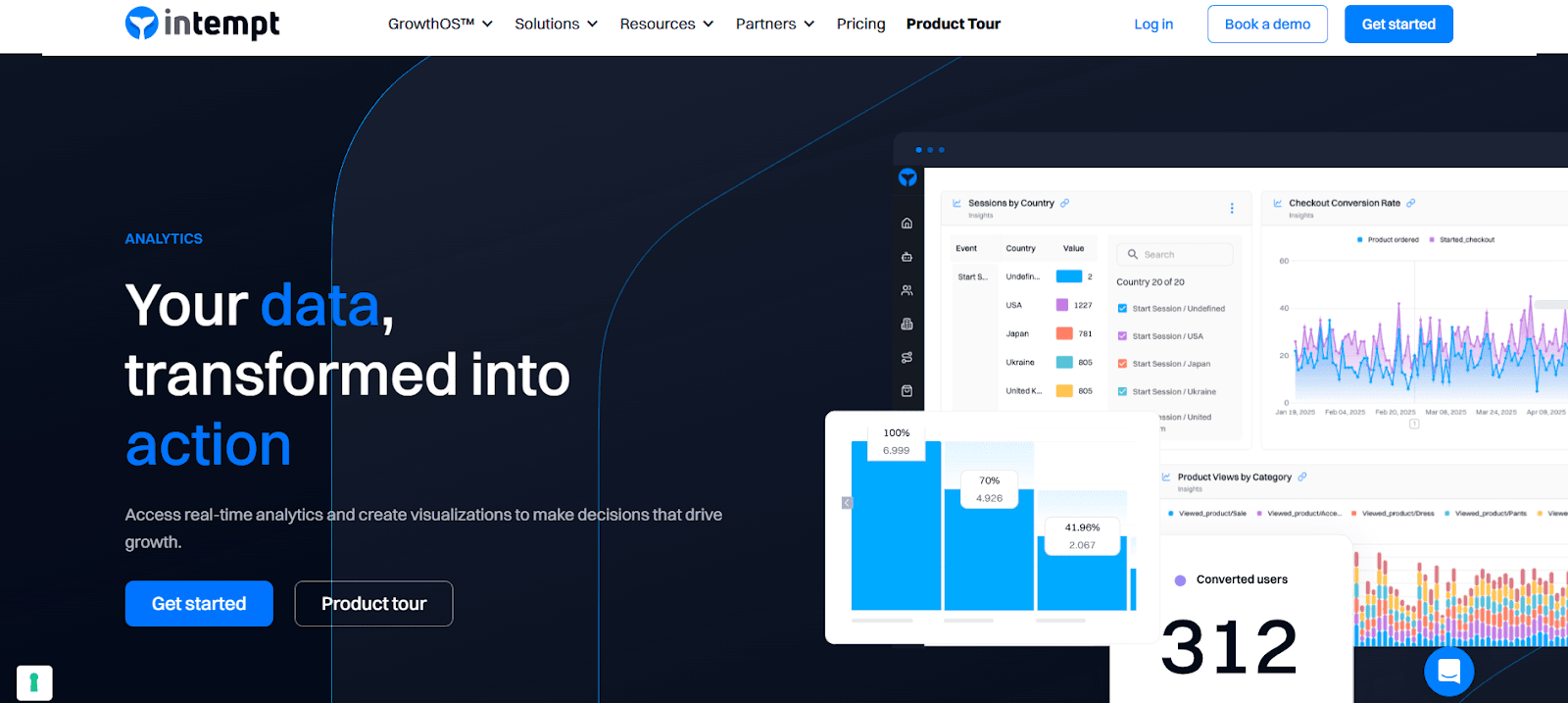
Intempt is the agentic GTM software, and against Mixpanel specifically that means one primitive doing four jobs. A profile holds traffic and revenue events, product usage, and subscription metrics on the same identity, which is what turns marketing attribution into a query rather than a reconciliation project. The Data Analyst reads that profile, names the driver behind a metric movement, and ranks fixes by dollar impact.
- Product analytics: funnels with drop-off to the underlying user list, cohort retention curves and weekly heatmaps, user paths, and pre-built dashboards for trial-to-paid, net revenue retention, and expansion.
- A customer data platform underneath it: identity resolution, unified profiles, an events pipeline, and connectors including Stripe, Shopify, HubSpot, web, and app.
- The channels Mixpanel has no product for: email, SMS, push, in-app messages, and web personalization, triggered directly from an analytics event.
- Experiments: A/B testing on web, email, and in-app, plus API-based feature flags and rollouts. Multivariate testing starts at the Organization tier.
- Nine agents across the five products, each proposing work you review before it ships. Blu is where you direct them.
- Ask Blu takes a plain-language question against a report you have open and explains what moved and why.
- Worked examples rather than claims: the MRR trend report, the signup activation funnel, and revenue by channel all run on live data.
Two omissions on Intempt's side belong in this section rather than buried later. There is no session replay, stated plainly on its own product analytics page. And the free tier's 100,000 events a month is one tenth of Mixpanel's free allowance, which matters for a team that wants to evaluate on real production traffic before paying anybody.
The meter test: whichever meter you blow through first decides
Here is the test, and it takes about a minute. Write down two numbers: the events your product fires in a month, and the humans who will log into the analytics tool. Then ask which of those two numbers is growing faster. Whichever one is, the tool that meters the other one is the cheaper purchase, and no feature comparison overturns that arithmetic.
The test works because both vendors made an explicit and opposite bet. Mixpanel decided the data is the thing worth charging for and that access should be free, which is why every plan including the free one carries unlimited seats. Intempt decided the accountable human is the thing worth charging for and that data volume is a pass-through cost, which is why a seat is the unit and events are metered underneath it.
Neither is a trick. They are answers to different questions about what a customer values. And they produce cleanly opposite outcomes for two teams that look similar on a feature checklist. A 30-person product organization firing 2M events a month pays Mixpanel $280 and pays Intempt for 30 seats. A three-person team firing 30M events pays Mixpanel $8,120 and pays Intempt for three seats plus usage. Same two products, opposite verdicts, and the deciding input was never on the feature grid.
The crossover, and how to compute it
Both rate cards are public, so this is arithmetic rather than an estimate. Mixpanel Growth, off its own pricing page: first 1M events free, then $0.28 per 1,000 events, unlimited seats. Intempt, off its pricing page: paid plans bill from the first event at graduated usage rates, plus a price per seat, and the current numbers are on that page. The 100,000-event allowance is a Free-plan cap, not a discount on a paid bill. Brackets are graduated and not retroactive, so each slice bills at its own rate.
| Events per month | Mixpanel Growth |
|---|---|
| 500,000 | $0 |
| 1,000,000 | $0 |
| 2,000,000 | $280 |
| 5,000,000 | $1,120 |
| 7,800,000 | $1,904 |
| 10,000,000 | $2,520 |
| 20,000,000 | $5,320 |
| 50,000,000 | $13,720 |
Put your own volume next to that column and the current Intempt rates on our pricing page, and the honest verdict is hard to avoid. For the event volume a seed to Series B company actually generates, Mixpanel tends to be the cheaper analytics product at the low end. Every Intempt seat you add moves the crossover higher.
Three caveats, all of which cut against the table rather than for it. First, Mixpanel's Growth page says volume discounts are available and publishes none of them, so a negotiated Mixpanel contract crosses over later than $0.28 implies. Second, Mixpanel Growth caps at 20M events and above that you are in an Enterprise conversation with no published rate at all, which makes the last row of that table a comparison against a list price nobody pays. Third, and most importantly, the table compares analytics against analytics, and that is not what either bill actually buys.
That third point is where the comparison stops being about price and starts being about scope. Intempt's meter is also paying for journeys, experiments, personalization, and the customer data platform under all three. Mixpanel's meter is paying for analytics, with account-level analysis, experiment reporting, feature flags, metric trees, and data pipelines all sitting outside it as add-ons. So the fair version of the question is not which analytics is cheaper. It is what your whole stack costs, which the per-meter breakdown of GTM tool pricing works through across the wider field.

Where the two schemas actually differ
This is the honest capability table, verified against both vendors' own product pages and plan tables in July 2026. Where Mixpanel wins, it says so. Column four is the one that matters most, because a capability sold as an add-on with no published price is not the same purchase as one included in the rate you can read.
| Capability | Mixpanel | Intempt | Honest read |
|---|---|---|---|
| Event tracking and autocapture | SDKs across web, mobile, and server, with autocapture and a flexible event schema | JavaScript, server-side, and mobile SDKs with auto-capture and 50-plus integrations | Effectively a tie. The old claim that Mixpanel needs manual instrumentation while Intempt auto-captures is wrong, and it was wrong on this page before today |
| Funnels | Industry-standard funnel reports with deep filtering, segmentation, and custom queries | Funnels with conversion, drop-off, and time-to-convert per step, clickable through to the user list | Mixpanel goes deeper on ad hoc exploration. Intempt gets you from a drop-off bar to a message faster |
| Retention and cohorts | Behavioral cohorts on event sequences and user properties. Limited on the free plan | Cohort retention curves, weekly heatmaps, and a visual segment builder with computed traits | Mixpanel for depth of cohort definition. Intempt for retention that connects to a journey on the same screen |
| Session replay | 10,000 replays a month free, 20,000 on Growth, customizable to 500,000, with AI summaries, heatmaps, and Magic Playlists | None. Intempt's own page states it does event-based analytics rather than replay | Mixpanel wins outright. This is the clearest single gap in the comparison and it is not close |
| Metric trees | A first-class product, marked as an add-on on the plan table, with AI-generated trees | Pre-built dashboards and custom metrics, no equivalent tree modeling surface | Mixpanel wins on the capability, then charges separately for it |
| Experiments | A named platform product with an Experiments Agent. Experiment reporting is an add-on line | A/B on web, email, and in-app included. Multivariate starts at Organization | Mixpanel is deeper on statistical rigor. Intempt includes it in the seat price |
| Feature flags | Present, marked as an add-on on Mixpanel's own plan table | API-based flags and rollouts | Neither replaces a dedicated flag platform for multi-environment feature management |
| Account-level analysis | Account-level behavioral analytics, marked as an add-on on every tier | Accounts, subscriptions, and revenue on the same profile as the product events | Both cover it. Only one of them includes it in the published price |
| Marketing attribution | Campaign reporting and multi-touch attribution are both listed on the plan table, computed over events | Attribution modeling starting at the Organization tier, computed over events plus connected billing data | Both ship it, and neither is wrong. The difference is what the model can attribute to: a conversion event on one side, an invoice on the other |
| Subscription and revenue metrics | No subscription, MRR, or billing product anywhere in the platform navigation | MRR, net revenue retention, expansion, and churn off connected billing data | Intempt wins outright. This is the gap ChartMogul and Baremetrics exist to fill for Mixpanel users |
| Customer data platform | None. Data warehouse connectors and integrations, but no identity resolution layer of its own | Built-in: unified profiles, identity resolution, and an events pipeline | Intempt wins. Mixpanel users typically run Segment in front of it |
| Messaging channels | None. Mixpanel cannot send an email, SMS, or push notification | Email, SMS, push, in-app, and web personalization from the same platform | Intempt wins, and this is the difference the old version of this page led with. It matters less than the meter |
| Journeys and orchestration | None. No journey builder, no multi-week nurture, no wait or branch logic | Journeys with waits, branches, and re-entry, triggered off analytics events | Intempt wins. A Mixpanel team needs a lifecycle tool alongside it |
| Plain-language questions | Mixpanel Agent in Slack, Root Cause Analysis Agent, MCP server, Headless Python, Context Engine and Verified Mode | Ask Blu explains the drivers behind a report you have open. The Data Analyst ranks fixes by dollar impact | Mixpanel is further along on open-ended exploration and on governing the answer. Intempt is further along on the fix that follows |
| Warehouse integration | Data warehouse connectors as a named product. Data pipelines as an add-on | Connectors plus a data export and Analytics API, both starting at Organization | Mixpanel wins for a warehouse-first data team. Intempt gates the API behind a tier |
| Seats | Unlimited on every plan, including free | The billing unit. Priced per seat per month, see intempt.com/pricing | Mixpanel wins outright for large teams. Per-seat pricing has no answer to unlimited seats |
| Free tier events | 1M events a month, no credit card, five saved reports per seat, 10,000 replays | 100,000 events a month, no credit card, pre-built dashboards, weekly AI credits plus 75 on signup | Mixpanel is 10 times more generous on events. Intempt is more generous on reports |
| Startup program | First year free for companies under five years old with up to $8M in total funding | Free plan with no time limit and no funding test | Mixpanel's is worth more in year one. Intempt's does not expire |
| Enterprise governance | SAML SSO, SCIM, audit logs, HIPAA tools, sensitive data classification, custom retention, US or EU residency | SSO, SCIM, SOC 2, ISO 27001, white-label, dedicated CSM on Enterprise | Both credible. Mixpanel publishes the longer governance list |
| Track record | More than 29,000 companies, 4.5 out of 5 across 1,300-plus reviews | Materially smaller and newer, with no comparable public review volume | Mixpanel wins outright. Buying the newer product is a real risk and pretending otherwise would be dishonest |
Count the outright wins and the picture is a split rather than a sweep. Mixpanel takes session replay, unlimited seats, free-tier event volume, and track record. Intempt takes revenue and subscription metrics, the customer data platform, messaging, and journeys. Everything else is a genuine trade where the answer depends on whether you value depth of exploration or speed from finding to fixing. If account-level analysis is the specific job, account-based analytics and the net revenue retention by cohort report are the concrete versions of what Intempt holds natively and Mixpanel sells as an add-on.
What Mixpanel does better, stated plainly
A comparison page written by one of the two vendors is worth reading only if this section is specific. Five things, in rough order of how often they should change somebody's mind away from Intempt.
- Unlimited seats on every tier, including free. If 40 people need to look at product data, Mixpanel's model is simply better and per-seat pricing has no counter-argument. This is the single most underrated line on its pricing page.
- Session replay, included and mature. 10,000 replays free, 20,000 on Growth, up to 500,000 customizable, plus AI summaries across hundreds of replays and heatmap comparison. Intempt has no answer to this at all, and the replay-first field is where you go if that is the binding requirement.
- Depth of behavioral exploration. Mixpanel has been refining event exploration for over a decade on its own database, and a team running many concurrent ad hoc cohort analyses will hit the ceiling in a generalist platform long before it hits one in Mixpanel. The same is true of Amplitude, its closest peer.
- The AI surface is broader and better governed. Mixpanel MCP, Mixpanel Agent in Slack, Headless in Python, a Root Cause Analysis Agent, and an AI Data Governance layer with a Context Engine and Verified Mode. That last part is the piece most vendors skip: an answer you cannot trust is not an answer.
- Track record. 29,000-plus companies and 1,300-plus reviews against a materially smaller and newer product. Vendor risk is a real input into a multi-year data decision, and it points at Mixpanel.
There is a sixth item that is not a Mixpanel strength so much as a caution about switching at all. Migrating an event store is genuinely painful, your history does not come with you, and the team that has to relearn a query interface loses weeks. If Mixpanel is answering your questions today, the cost of moving is higher than any line on the pricing table. The broader alternatives field is worth reading before you conclude that switching is the answer at all.
What Intempt does better, and the condition attached to each
Four things, each with the condition under which it stops being an advantage. An advantage stated without its condition is a sales claim rather than a comparison.
- Revenue lives in the schema. MRR, net revenue retention, expansion, and churn read off the same profile as the product events. The condition: this only matters if your questions actually cross behavior and money. A pure product team measuring feature adoption gets nothing from it.
- The action layer is in the same tool. A drop-off you find in a funnel becomes an email, a push, or a personalized page without an export, a second contract, or a sync that breaks quietly. The condition: if you already run Klaviyo or Braze and like it, this is duplication rather than consolidation.
- One identity graph instead of a join. Anonymous-to-known stitching, one retention policy, and one grain, which is the failure that quietly kills long-cycle attribution as documented in why revenue attribution breaks on three clocks. The condition: it fixes the question going forward and rebuilds nothing about the past.
- The seat bill is small and legible for a small team. Three Professional seats cover analytics plus messaging plus experiments plus the data platform. The condition: at 30 seats that same logic is working against you, and Mixpanel's unlimited-seat model wins.
Notice what is not on that list. Nothing about Intempt being deeper on analytics, because it is not. Its own comparison data says Mixpanel has deeper custom query capability and more flexible event exploration, and that is the correct thing to say. The claim is narrower: for a founder or head of growth with no analyst on staff, breadth on one identity beats depth across four tools, and the analyst work that job actually involves is mostly reconstruction rather than exploration.
The add-on question, which is where Mixpanel's clean rate card stops
Mixpanel publishes the cleanest per-unit rate in product analytics, and that deserves credit. It also marks seven lines on its own plan table as add-ons with no published price, and five of them are things a serious team will want. This is not a scandal and it is not hidden. It does mean the $0.28 per 1,000 events figure is the analytics-only number rather than the bill.
| Marked as an add-on on Mixpanel's plan table | Who needs it | Published price |
|---|---|---|
| Account-level behavioral analytics | Any B2B team analyzing by company rather than by user | None |
| Experiment reporting | Any team running A/B tests and reading results in Mixpanel | None |
| Feature flags | Any team gating a rollout | None |
| Metric trees | Any team modeling how product metrics ladder into company KPIs | None |
| Data pipelines | Any team exporting raw events to a warehouse on a schedule | None |
| Slack shared channel support | Teams that want a support channel rather than a ticket queue | None |
| Faster response SLAs | Teams with a production dependency on the data | None |
The practical consequence is specific, and it is sharpest for a subscription business. A B2B SaaS team on Mixpanel Growth that wants account-level analysis and experiment reporting cannot price its own stack from the pricing page. It has to talk to sales, which is exactly the thing the published $0.28 rate makes it feel like you have avoided. Meanwhile the free plan marks formulas and saved metrics, behavioral cohorts, and lookup tables as Limited, so a free-tier evaluation is not testing the product you would buy.
Intempt gates by tier rather than by add-on, which is a different shape of the same problem and worth naming with equal precision. Its tier table is public, and reading it honestly means admitting where the walls are. The custom report builder starts at Professional. Attribution modeling, shared team dashboards, cross-project analytics, and the data export and Analytics API all start at Organization. So the Free plan is a real product and not a full one, and a team that needs attribution is on Organization rather than Professional. Neither vendor lets you read your final bill off a single line.
Search demand says this is not a shopping query yet
Worth stating because it changes how you should read every comparison page on this pair, including this one. Pulled from DataForSEO for the United States on July 31, 2026: the head term is enormous, every comparison term is tiny, and the exact pairing has no measurable demand at all.
| Term | Monthly US searches | CPC | What it tells you |
|---|---|---|---|
| mixpanel | 14,800 | $18.12 | The category is shopped by brand name, not by category name |
| mixpanel pricing | 480 | $15.30 | The biggest question people bring to the brand is the bill |
| mixpanel cost | 480 | $15.30 | Same query, same volume, different words |
| mixpanel vs amplitude | 260 | $28.27 | The only comparison pairing with real demand behind it |
| posthog vs mixpanel | 140 | $22.20 | PostHog's page ranks on this and it is genuinely thorough |
| mixpanel alternatives | 110 | $50.87 | A $50 click on 110 searches means late-stage switching intent |
| mixpanel competitors | 110 | $29.01 | Same intent, cheaper click, high competition |
| mixpanel vs posthog | 90 | $31.14 | The reversed pairing, at two thirds the volume |
| mixpanel vs google analytics | 70 | None recorded | The seam Mixpanel already closed with Web Analytics |
| mixpanel free plan | 50 | $19.59 | Small, and the 1M-event allowance is why it converts |
| mixpanel vs heap | 40 | $22.96 | A pairing that used to matter more than it does now |
| mixpanel review | 30 | None recorded | Almost nobody searches for a verdict. They search for a price |
| mixpanel vs ga4 | 10 | None recorded | Effectively zero |
| intempt vs mixpanel | No measurable volume | None | This exact pairing has no search demand behind it |
Two conclusions fall out, and both are consistent with what the wider analytics category looks like on search. First, "mixpanel pricing" at 480 searches beats every comparison term combined, which means the meter argument that opens this post is the thing people are actually trying to work out. Second, "mixpanel alternatives" at a $50.87 cost per click on only 110 searches is the classic signature of late-stage switching intent: small volume, expensive clicks, buyers with budget already allocated. Nobody discovers this category. They arrive holding a bill.
Agents on both sides, and the difference that actually matters
Both vendors now name agents in their own navigation, so "has AI" separates nothing here. What separates them is where the agent's work stops, and that follows from the schema rather than from model quality.
Mixpanel's Root Cause Analysis Agent diagnoses what changed and why, and delivers a dashboard the team keeps working from. Its Experiments Agent sets up a statistically valid test and interprets the result. Mixpanel Agent answers questions from Slack, MCP puts the same power inside Claude or Cursor, and Headless exposes it in a line of Python. The AI Data Governance layer with Context Engine and Verified Mode is the part most competitors have no equivalent for, and it addresses the real objection to conversational analytics, which is that a confident wrong answer is worse than no answer.
Intempt's Data Analyst does the explanation job and then keeps going into work Mixpanel has no surface for. It names the driver behind a movement, ranks fixes by dollar impact, and hands the highest-impact one to the Lifecycle Marketer, who builds the journey, or the Experimentation Lead, who builds the test. The reason it can do that is not a better model. It is that the journey and the experiment write to the same profile the analysis read from.
Being precise about the limit on Intempt's side: open-ended exploratory analysis that composes a new analysis from nothing is a direction rather than a shipped feature, and there is no dated roadmap page committing to it. Mixpanel is ahead on that specific job today. Anybody buying on the promise of conversational exploration should test both against their own data before signing, and the state of that capability across the category is worth reading first.
Migration: what transfers and what does not
The honest version is short. Your tracking plan transfers. Your history does not. Anybody describing a clean historical backfill between two event stores is describing something more fragile than the sentence makes it sound, and this page previously made a version of that claim that did not hold up.
- Export your Mixpanel event taxonomy and user properties. Map each event to the Intempt schema. Most map one to one, and the exercise usually finds dead events nobody has read in a year.
- Install the Intempt SDK alongside Mixpanel and dual-fire. Do not remove anything yet.
- Validate that event counts and user counts agree within about five percent. If they do not, the mapping is wrong and no amount of dashboard work will fix it downstream.
- Rebuild your five most-used reports in Intempt during the overlap window, not your fifty. If the five that get opened weekly do not reproduce, stop.
- Remove the Mixpanel SDK only after the team confirms parity. Intempt's history starts at the dual-fire date, so size the overlap around the longest reporting period you cannot lose.
- Keep a replay tool if your team uses replay. Intempt does not cover it, and discovering that after the cutover is the avoidable version of this mistake.
Step three is where migrations actually fail, and step six is where they generate the most regret. A five percent variance on event counts sounds tolerable until it turns out to be concentrated in the one funnel your board reviews. Run the comparison at the report level rather than the total level.
Decision cheatsheet
Match your situation to the row. Choosing on the feature grid instead is the most reliable way to end up with a tool that works exactly as advertised and still costs three times what the other one would have.
| Your situation | Choose | Because |
|---|---|---|
| Low event volume and analytics is the whole job | Mixpanel | It is cheaper at that volume, deeper on exploration, and includes session replay |
| A large team, modest event volume, many people reading dashboards | Mixpanel | Unlimited seats on every tier. Per-seat pricing cannot win this one |
| Session replay is part of how the team debugs | Mixpanel | Intempt has no replay product, and no roadmap page claiming one |
| A dedicated data team that wants warehouse-first and code-level access | Mixpanel | Warehouse connectors, Headless in Python, and an MCP server are all shipped products |
| Above about 11M events a month with a team under 15 people | Intempt | The graduated meter falls to $0.18 and $0.11 while Mixpanel stays at $0.28 list |
| Every question you care about crosses web, product, and revenue | Intempt | Mixpanel's schema holds no subscription or billing object. This is a structural gap, not a feature gap |
| You would otherwise buy a lifecycle messaging tool alongside analytics | Intempt | Email, SMS, push, in-app, and personalization are on the same bill and the same profile |
| Founder or head of growth, no analyst on staff, needs the fix not the chart | Intempt | The Data Analyst ranks fixes by dollar impact and hands them to an agent that executes |
| You are happy with Mixpanel today and are only comparing on price | Stay put | Migration cost plus lost history usually exceeds the delta below the crossover |
| You need product analytics but the real problem is data not arriving | Neither yet | That is a pipeline problem. See our Segment alternatives guide |
What this comparison does not claim
- Not that Mixpanel is a weak product. It is one of the two deepest product analytics tools on the market, it publishes the cleanest per-unit rate in the category, and it wins four of the categories in the table above outright.
- Not that Intempt is cheaper. At low event volume it is usually more expensive for analytics, and this post says so rather than leaving it out.
- Not that Intempt matches Mixpanel on analytics depth. It does not, and its own comparison data says so. The claim is about breadth on one identity, not depth on one primitive.
- Not that the meter test is an industry framework. It is this post's own model. The rate cards underneath it are published and checkable. The framing is an argument.
- Not that Mixpanel's add-on pricing is dishonest. It is on the page. It does mean a Growth plan quoted at $0.28 per 1,000 events is not what a B2B team with experiments and account analysis will actually pay.
- Not that either vendor's agents close the gap on their own. Mixpanel is ahead on open-ended exploration and on governing the answer. Intempt is ahead on the work that follows the answer. Both are worth a demo question rather than a feature checkbox.
- Not that these numbers hold. Mixpanel's Growth tier caps at 20M events with volume discounts it does not publish, Intempt's brackets are graduated and could change, and every figure here is dated July 31, 2026 on purpose.
- Not that switching is usually right. Most teams reading a comparison page should stay where they are. The ones who should move are the ones whose questions have started crossing a boundary their schema does not hold.
The 15-minute version of this evaluation
- Read this month's event count out of your current tool. Write it down. Not an estimate, the actual number.
- Count the humans who logged in this month. Write that down too. Most teams have never put these two numbers side by side.
- Price both at your event number: Mixpanel from the table above, Intempt from the current rates on our pricing page. If Mixpanel comes out cheaper on analytics, you now know by how much.
- List the questions your board or your investors ask that nobody can currently answer in one query. Name every data source each one touches.
- Count how many of those questions need billing data. If the answer is zero, buy the deeper analytics tool. If it is more than one, you are buying architecture and depth is not your constraint.
- Add the tools you would need alongside each option. A Mixpanel stack usually means a customer data platform and a lifecycle tool. An Intempt stack usually means keeping a replay tool.
- Check whether replay is load-bearing for your team. If engineers watch sessions to debug, that decides it before anything else on this list does.
- Price the switch, not just the subscription. Lost history, a re-instrumentation sprint, and a team relearning a query interface are real costs that never appear on either pricing page.
Step five is the one that changes decisions, and step three is the one that stops most of them. Teams argue about dashboards for weeks and then discover the meter settled it in an afternoon. So skip the feature grid, price both meters at your own volume, and count how many of your real questions need money and behavior in the same query. If that count is zero, Mixpanel is very likely your answer and any honest comparison should say so out loud. If it is more than one, and the bill for four tools has started to look like the cost of the join rather than the cost of the software, then Intempt vs Mixpanel is not a feature argument at all, and one profile that holds behavior and money together is the different purchase.