


Intempt is the best Amplitude alternative for SaaS, ecommerce and mobile app teams, and it is free to start. It tracks events from web and mobile apps and then acts on them with journeys and experiments on the same customer profile, so analytics does not end at a dashboard.
This guide compares 7 Amplitude alternatives: Intempt, Mixpanel, Heap, Pendo, Fullstory, Customer.io and PostHog. Intempt suits teams that want analytics and execution together. Mixpanel focuses on event analytics, and Heap auto-captures events. Pendo bundles analytics with in-app guides, Fullstory focuses on session replay, Customer.io sends triggered messages, and PostHog combines analytics, replay and feature flags. See the Amplitude alternative comparison, product analytics, event tracking and pricing.
Most product teams swear Amplitude is giving them everything they need. Then you look closer and it's Amplitude for analytics, PostHog for experimentation, a separate tool for messaging, and engineers stuck in the middle every time someone wants to act on the data.
That's exactly why teams are looking for an Amplitude alternative that doesn't just surface the insight but actually does something with it. The real problem with Amplitude is that it's excellent at showing you what happened - funnels, retention, cohorts, and drop-offs. But the moment you want to fix it, you're coordinating across two other platforms. At $49,000 to $120,000 a year, that's a lot of money to pay for half the job.
For the full analytics category comparison across every GTM tool in 2026, see Best Analytics Tools for GTM Teams.
Who Should Consider Amplitude Alternatives?
You've probably hit one of these walls if you're evaluating replacements:
- Your pricing is locked into an enterprise contract. Amplitude starts at $49K/year and scales with every new user you track. You're paying premium dollars for a tool that can only analyze, not act. Reviewers on Capterra consistently flag this as the first thing that pushes teams to look elsewhere.
- Your insights expire before you can use them. A user showing purchase intent today is less likely to buy next week. Amplitude gives you charts, but you can't execute on them the same day.
- You're managing a disconnected stack. Amplitude plus Braze plus Segment plus Optimizely equals four invoices, four contracts, and four integration points. When one schema changes, everything downstream breaks. G2 reviewers call this out repeatedly as the core frustration with Amplitude as a standalone tool.
- Your segments go stale before you can act on them. Amplitude builds cohorts in batches. By the time a segment is ready, half the users in it have already churned or converted. AI-powered real-time segmentation fixes that automatically.
- You need analytics that drive action, not just reports. Most Amplitude alternatives only answer 'what happened.' You need a platform that answers 'what should we do about it?' with built-in messaging, experimentation, and personalization.
- You want traffic analytics without the setup tax. Amplitude requires event taxonomy, schema planning, and analyst time before you see anything useful. The G2 pros and cons page shows a steep learning curve and complex initial setup as the most common complaints.
- You want revenue analytics that's already built in. Amplitude doesn't track purchases or attribute revenue out of the box. A better alternative gives you yesterday's purchases, total period revenue, and attributed revenue on day one, visible right on your home dashboard.
Evaluation Criteria
When you're comparing Amplitude alternatives, these are the criteria that actually separate good options from expensive mistakes.
| Criteria | Why It Matters | What 'Good' Looks Like |
|---|---|---|
| Pricing model | MTU-based billing punishes tracking more users or events. Amplitude alternatives should charge based on value delivered, not data volume. | Flat monthly pricing or contact-based billing, not per-tracked-user fees. Predictable bills even as your user base grows. |
| Execution capability | Analytics without action is incomplete. You need messaging, experimentation, and personalization without switching tools. | Native email, SMS, push, A/B testing, and journey orchestration built into the same platform as analytics. |
| Setup time | Long implementations delay time-to-value. Amplitude alternatives should be live and generating insights within days, not months. | Full migration and live analysis within 2-4 weeks, with dedicated support included. |
| Team accessibility | Amplitude requires analytics expertise to operate. Better alternatives let growth marketers move fast without waiting for data engineers. | Visual builders for cohorts, journeys, and experiments. No SQL required. Marketers ship changes independently. |
| Feature depth | Amplitude is analytics-only. Good alternatives offer funnel analysis, retention curves, cohort analysis, revenue attribution, AND execution capability. | Behavioral analytics bundled with journey orchestration, in-app messaging, experimentation, and personalization in one platform. |
| Total cost of ownership | Buying seven point solutions adds up fast. The best Amplitude alternatives consolidate multiple tools into a single bill. | Replace Amplitude plus Braze plus Optimizely plus three other tools with one platform starting under $300/month. |
Comparison Table
| Tool | Best For | Starting Price | Key Strength | Main Limitation |
|---|---|---|---|---|
| Intempt | Ecommerce, SaaS and mobile app teams that want CDP, experiments and analytics in one platform | Free up to 1M events/month, 100K identified events and 3 seats; paid plans per seat | All-in-one: built-in Data Hub, Journeys, email, push, Experiment, and revenue analytics | Analytics depth is built for growth teams, not deep statistical exploration; newer platform with less third-party analyst coverage than Amplitude |
| Mixpanel | Teams prioritizing behavioral analytics depth with strong funnel and retention reporting | Free (1M monthly events); Growth plan from $0.28 per 1,000 events after overage | Event-based analytics with metric trees, behavioral cohorts, and clean reporting interface | No execution capability (journeys, messaging); requires separate tools for marketing automation |
| Heap | Non-technical teams who want analytics without manual event configuration | Free (10,000 sessions/month); Growth from ~$300/month | Automatic event capture with retroactive analysis means no upfront event planning | Session replay and advanced features are add-ons; less transparent pricing on higher tiers |
| Pendo | Product teams wanting analytics bundled with in-app guidance and NPS surveys | Free (up to 500 MAU); Ultimate plan custom pricing | Auto-capture analytics with built-in in-app guides, journey orchestration, and no-code implementation | Less ideal for teams prioritizing deep behavioral analysis; focused on experience management over pure analytics |
| Fullstory | Customer support and UX teams needing high-fidelity session replay with digital experience intelligence | Free (30,000 sessions/month); Business from $199/month | Pixel-perfect session replay with complete heatmaps and privacy-first data masking | Not optimized for behavioral analytics; lacks native experimentation and cohort analysis depth |
| Customer.io | Growth teams sending triggered, personalized customer journeys across email, SMS, push, and in-app channels | $100/month (Essentials); Startup program offers free tier for early-stage companies | Visual workflow builder with event-triggered automation, omnichannel messaging, and A/B testing | Not a behavioral analytics platform; requires separate analytics tool like Amplitude for insights |
| PostHog | Product teams wanting product analytics bundled with session replay, feature flags, and A/B testing without vendor sprawl | Free (up to 1M events/month); paid plans from $29/month | All-in-one: product analytics, session replay, experimentation, and feature flags built-in; open-source option available | Less suitable for marketing automation; limited built-in email/SMS messaging compared to Braze or Customer.io |
7 Best Amplitude Alternatives in 2026
1. Intempt
Free to start. 75 bonus AI credits at sign-up plus weekly AI credits on the free plan. Rated 4.5 on G2. Start free with Intempt.
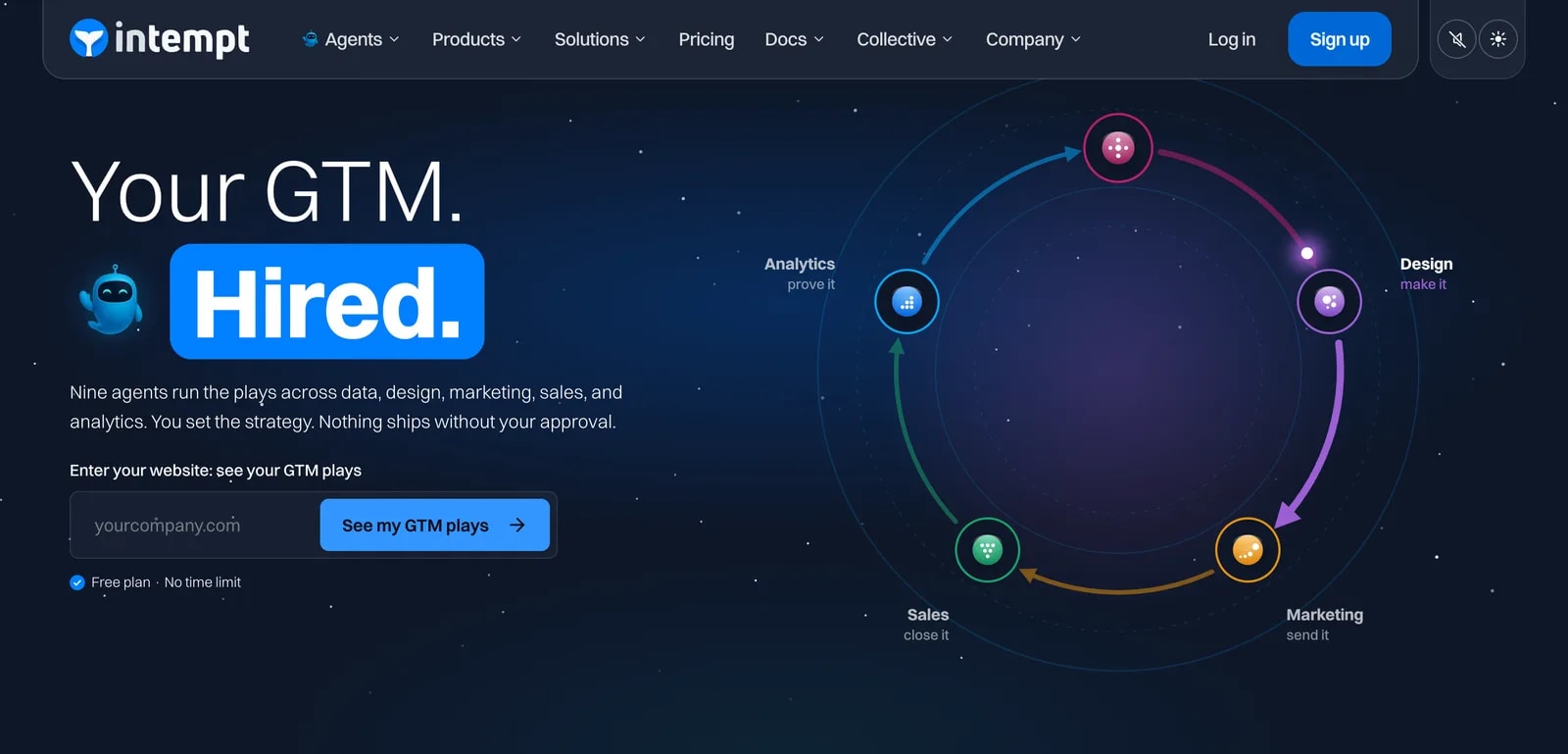
Intempt is a unified marketing platform that replaces Data Hub, email marketing, personalization, and analytics tools in one solution. It is free to start, with paid plans priced per seat (see pricing). As an amplitude alternative, it's built for marketing and eCommerce teams that want to act on behavioral insights without opening a developer ticket or juggling multiple vendors.
The core case for Intempt over Amplitude is structural. Amplitude shows you funnels, cohorts, and retention curves. Then you export that insight into Braze to build the journey, into Optimizely to run the experiment, and into a personalization tool to test the experience. That's four platforms, four contracts, and four data sync points. Intempt's unified architecture means path analysis and cohort retention connect directly to journeys, A/B tests, and personalization rules without switching tools or re-mapping data.
What You Get
- Behavioral analytics native to the platform: Funnels, retention curves, cohort analysis, and revenue attribution are built in. Analyze user behavior the same way Amplitude does, without leaving the platform to message or test on those insights.
- Personalized experiments with CUPED statistical correction: A/B and multivariate testing across web and journey channels, with statistical variance reduction that reaches significance faster than standard test designs. Unlike Amplitude, your winning experiments automatically update personalization rules and trigger follow-up campaigns.
- Visual multi-channel journey builder: Design email, SMS, push, and in-app journeys visually without code. Conditions, delays, and branching logic are set in a drag-and-drop interface. No developer ticket required for each marketing change.
- Real-time Data Hub with automatic identity resolution: Customer profiles unify across all touchpoints automatically. Behavioral data, transaction history, and first-party signals all live in one profile. No separate Segment subscription needed.
- On-site personalization without development: No-code visual editor for personalized landing pages, product recommendations, and targeted banners. Run 1:1 web experiences on top of the behavioral insights you've gathered.
- 35 AI-driven product recommendation algorithms: For eCommerce teams, personalized catalog recommendations without adding a third-party engine. SaaS teams use recommendations to surface the right features to the right users.
- Nine purpose-built AI agents: Data Analyst, Lifecycle Marketer, Brand Designer, and others handle the manual work that typically stacks up on lean marketing teams. These work inside your platform with your segments, events, and goals.
Who Should Use It
Intempt is the strongest fit for SaaS companies with $1M-$50M ARR and eCommerce brands doing $500K-$30M annually running Amplitude plus Braze plus Optimizely, or any similarly fragmented stack. AI-powered segmentation updates audiences in real time as behavior changes, so segments are already built and ready to trigger before your team finishes the brief.
What to Watch For
Intempt is stronger on execution and platform consolidation than on analytics depth. Teams doing complex statistical analysis across dozens of cohorts or running hundreds of concurrent experiments might find pure analytics platforms like Mixpanel or Amplitude stronger. Also, as a newer platform, it has a smaller market presence than Amplitude.
Pricing
- Free: every product in basic mode; up to 1M events, 10K emails, 1K SMS and 1K push a month, up to 3 seats, no credit card required, weekly AI credits (see intempt.com/pricing) + 75 bonus on signup
- Professional: priced per seat; AI credits included in every seat; full access to all features, advanced analytics and reporting
- Organization: priced per seat; AI credits included in every seat; unlimited teams and projects, AI coaching, admin controls
- Enterprise: priced per seat; AI credits included in every seat; SSO, HubSpot CRM sync, audit logs, dedicated support, and SLA
2. Mixpanel
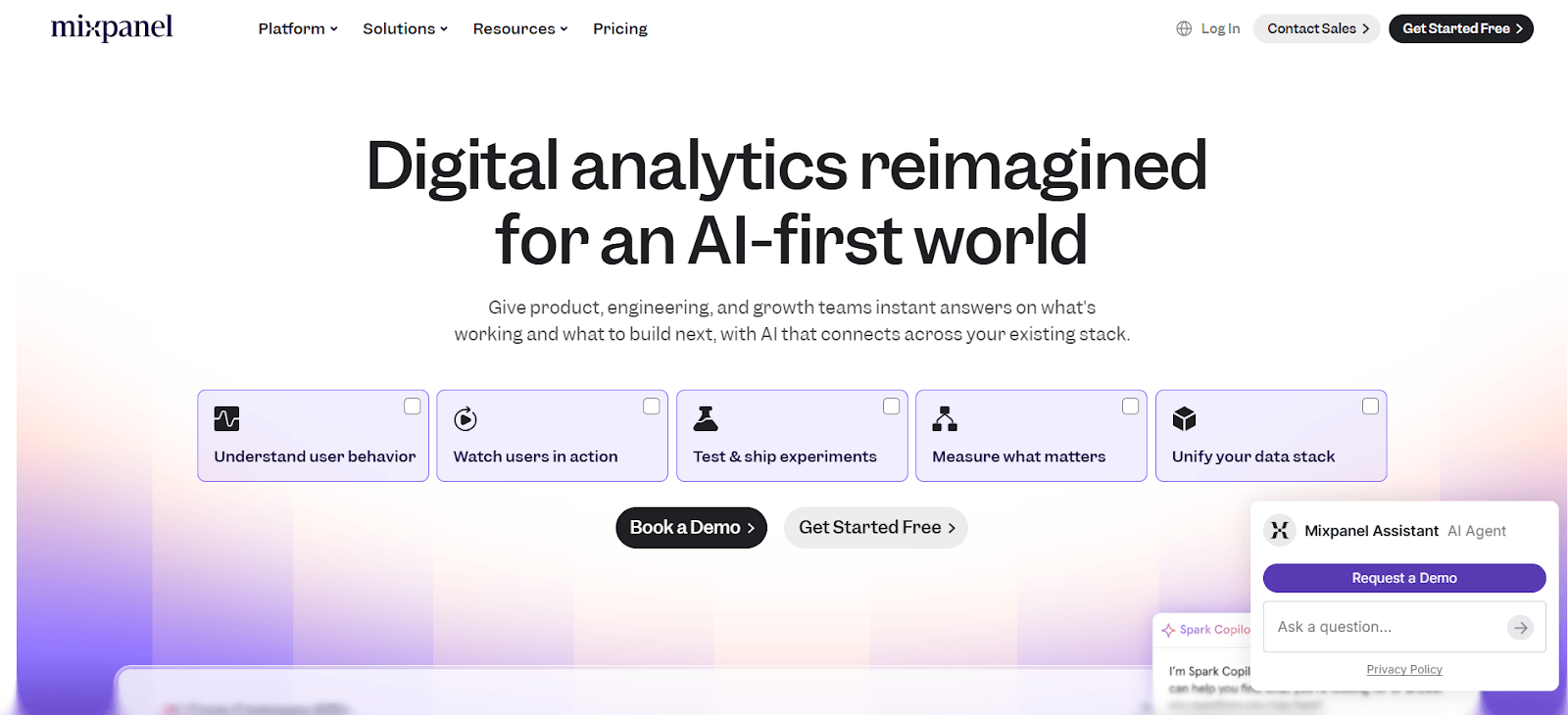
Mixpanel is a behavioral analytics platform built for product and growth teams that need to deeply understand how users interact with their product through event-based tracking, with strong funnel analysis, retention reporting, and multi-touch attribution. It's the closest direct alternative to Amplitude for teams whose primary job is understanding user behavior.
Where Amplitude and Mixpanel differ is in how they charge and what they leave out. Mixpanel's Free tier still gives you 1 million monthly events per month, which is more generous than Amplitude's free offering. Their pricing grows based on event volume overages after the free tier, not on monthly tracked users, which feels less punitive if you're instrumenting heavily. The tradeoff is that Mixpanel, like Amplitude, is analytics-only. You still need separate tools for messaging and testing.
What You Get
- Event-based tracking with Metric Trees: Visual representation of business metrics (revenue, feature adoption, retention) built from raw events, making it easier to track what matters without creating custom dashboards.
- Behavioral cohorts and custom properties: Segment users by their actions (not just attributes) and save cohort definitions for reuse across analysis.
- Session replay: Web session replays to watch user interactions firsthand, included on Free tier (limited to 10K monthly sessions).
- Anomaly detection: Automatic alerts when metrics move beyond expected ranges, useful for catching sudden changes in conversion or churn rates.
- Multi-touch attribution and experiment reporting: Enterprise plans include attribution modeling across marketing touchpoints and A/B test result analysis.
- Startup discounts: Companies founded within the last 5 years with under $8M funding get their first year free.
Who Should Use It
Mixpanel is the right choice for B2B and B2C product teams focused primarily on understanding behavior, retention, and feature adoption. It's especially strong for teams with complex event schemas and developers who are comfortable defining custom events upfront.
What to Watch For
Mixpanel lacks execution capability. You'll still need Braze or Customer.io for journeys, Optimizely or VWO for A/B testing, and a separate personalization tool. There's no built-in CDP, no funnel-based messaging automation, and no native Shopify integration for eCommerce teams.
Pricing
- Free: 1 million monthly events, 5 saved reports, 10K monthly session replays
- Growth plan: $0.28 per 1,000 events after free tier overage, unlimited saved reports, customizable session replay limits (up to 500K/month)
- Enterprise: Unlimited events and custom pricing
3. Heap
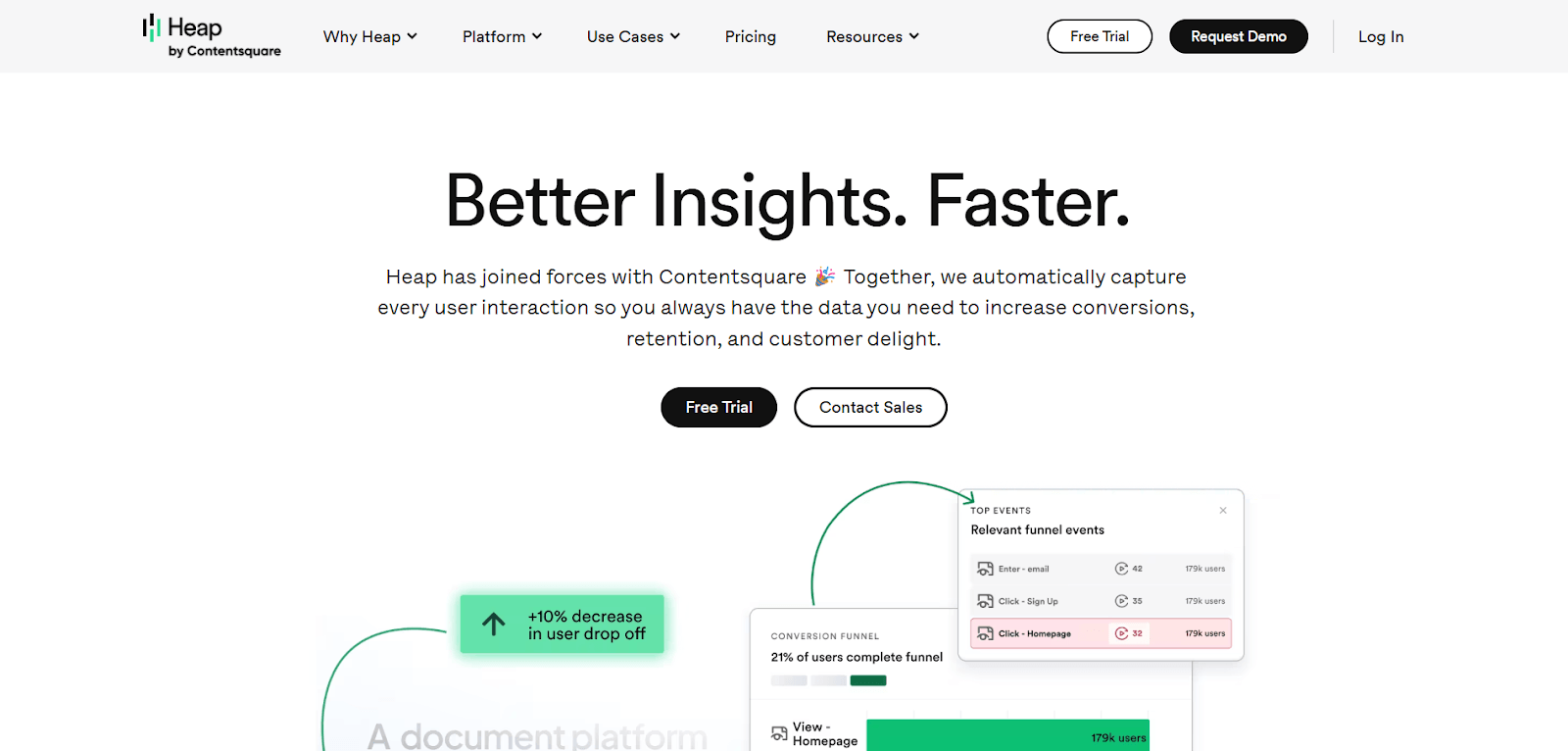
Heap is an automatic event capture analytics platform that records every user interaction on your website or app without requiring you to define events upfront, then lets you analyze behavior retroactively. It's the Amplitude alternative for teams who don't want to spend six months planning event schemas before they can start analyzing.
The biggest difference between Heap and Amplitude is friction. With Amplitude, you define your events before you track them. With Heap, every click, scroll, and page view is captured automatically. That means you can ask questions about user behavior without engineering a custom event first.
What You Get
- Automatic event capture: Every user interaction is recorded without manual instrumentation. Retroactive analysis means you can slice data by any interaction, even if you didn't think to define it yesterday.
- Sense AI agent: Generates insights from your data automatically, surfacing unexpected patterns and answering 'what's driving this drop?' without you writing a custom report.
- Session replay and error tracking: Watch user sessions in action and see which pages cause errors or confusion. Included on growth tier and above.
- Data exploration and custom charts: Build custom charts by dragging and dropping properties and events. Reports are visual, not SQL-based.
- Behavioral targeting and segmentation: Segment users by any recorded action, then export those segments to other tools.
- CSV exports and data warehouse sync: Export analysis for use in spreadsheets or connect to your warehouse for deeper analysis.
Who Should Use It
Heap works best for product teams that want fast analytics exploration without upfront event planning, and for non-technical users who need to answer their own questions without relying on analysts. Early-stage startups that don't have mature event instrumentation benefit from automatic capture.
What to Watch For
Heap's automatic capture is convenient but less precise than Amplitude's rigorous event definition. There's no built-in CDP, no journey orchestration, no A/B testing, and no messaging. If you're trying to consolidate tools, Heap doesn't reduce your stack; it just replaces Amplitude with another analytics-only platform.
Pricing
- Free: 10,000 monthly sessions, core analytics charts, 6 months data retention
- Growth: Approximately $300/month, adds Sense AI agent, unlimited users/reports, 12 months data history
- Pro and Premier: Custom pricing with account analytics, engagement matrix, session replay, and data warehouse integration
4. Pendo
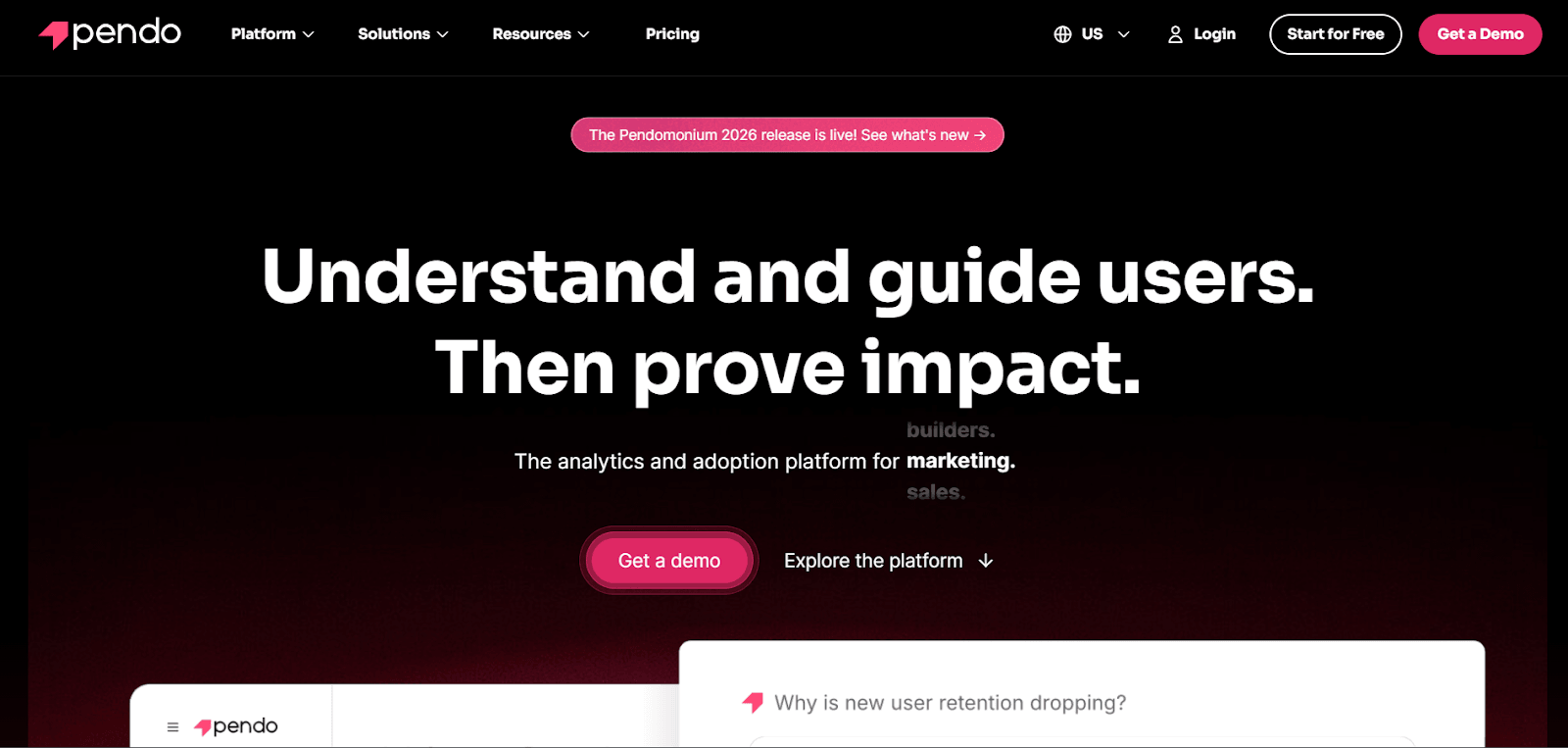
Pendo is a software experience management platform that combines product analytics with in-app guides, NPS surveys, and journey orchestration, built for product teams that want to understand behavior and guide users in the same tool. It's the Amplitude alternative for organizations that value user experience and engagement alongside analytics.
The positioning difference: Amplitude answers 'what happened?' Pendo answers 'what happened, and what should the user see next?' It captures analytics the same way Amplitude does, but adds the ability to deploy in-app messages, guides, and surveys without leaving the platform.
What You Get
- Auto-capture product analytics: Clicks, page views, and user flows recorded automatically. No manual event definition required. Retroactive analysis like Heap, but with better reporting structure.
- In-app guides and contextual messaging: Deploy walkthroughs, tooltips, and banners directly in your product based on user behavior, without developer involvement.
- NPS surveys and feedback collection: Embedded surveys with Pendo-branded or custom branding. Responses tied to user behaviors and product analytics for context.
- Session replay and sentiment analysis: Watch user sessions and track sentiment from survey responses.
- Journey orchestration: Visual workflow builder for multi-step user engagement campaigns triggered by behavior.
- AI Predict: Churn prediction and propensity scoring for proactive engagement.
- 85+ integrations: Connect with Salesforce, HubSpot, Slack, and other business tools.
Who Should Use It
Pendo suits product and customer success teams that need analytics bundled with user guidance. B2B SaaS companies focused on feature adoption, onboarding completion, and reducing support escalations benefit most.
What to Watch For
Pendo's analytics depth doesn't match Amplitude or Mixpanel for teams doing complex statistical analysis. The platform is stronger on user guidance than on deep behavioral investigation. There's no email or SMS messaging, no journey-level A/B testing, and no built-in experimentation beyond simple A/B tests on in-app messages.
Pricing
- Free: Up to 500 MAU, includes product analytics, in-app guides, and Pendo-branded NPS surveys
- Base, Core, and Ultimate plans: Custom pricing based on Monthly Active Users (MAU)
- Add-ons: AI Predict (churn/upsell), Agent Analytics for sales teams
- No transparent starting price; contact sales for quote
5. Fullstory
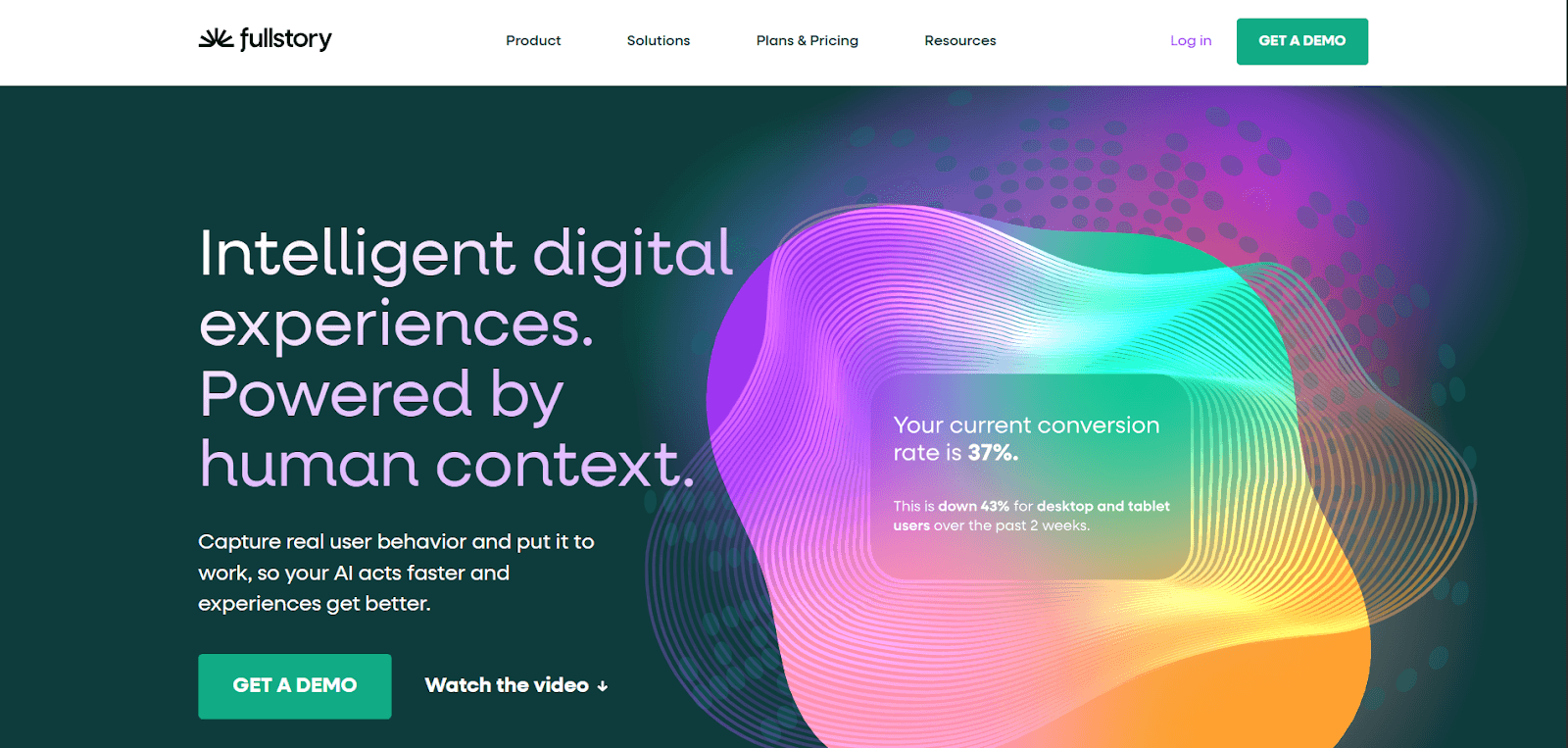
Fullstory is a digital experience intelligence platform focused on session replay, heatmaps, and user interaction analysis, built for customer support and UX teams that need to understand exactly what users are doing and experiencing. It's the Amplitude alternative for teams that prioritize experience troubleshooting over behavioral analytics.
Where Fullstory differs from Amplitude: Amplitude is event-driven analytics. Fullstory is experience-centric. You're watching actual user sessions in pixel-perfect detail, not analyzing aggregated event data. It's built for the question 'why did that user get stuck?', not 'what's the conversion rate of this funnel?'
What You Get
- Pixel-perfect session replay: Watch every user interaction with high fidelity, including mouse movements, console errors, and network requests. Privacy masking is built in to protect sensitive data.
- Digital experience intelligence (DXI) platform: Aggregates session data to identify patterns. Where are users struggling? Which pages cause abandonment?
- Heatmaps and interaction maps: Visual representation of where users click, scroll, and spend time on pages.
- Funnel and path analysis: Trace user journeys from entry to goal completion. See where drop-off happens and which paths convert best.
- Built-in guides and annotations: Mark up pages with contextual help or corrections without developer involvement.
- Privacy-first architecture: Data masking and compliance built in.
Who Should Use It
Fullstory is ideal for UX teams and customer support organizations that need to troubleshoot user issues with rich session context. eCommerce teams tracking checkout friction benefit from heatmaps and session replay.
What to Watch For
Fullstory is not a behavioral analytics platform. It's optimized for understanding user experience, not for answering questions about feature adoption, retention curves, or revenue metrics. There's no built-in journey orchestration, no experimentation, no email or SMS messaging, and no product recommendation engine.
Pricing
- Free: 30,000 sessions/month, 12 months data retention
- Business: Approximately $199/month (annual commitment)
- Advanced: Approximately $499/month
- Enterprise: Custom pricing, $999+/month or up to $150,000+/year
- Session-based model; pricing scales with traffic volume
6. Customer.io
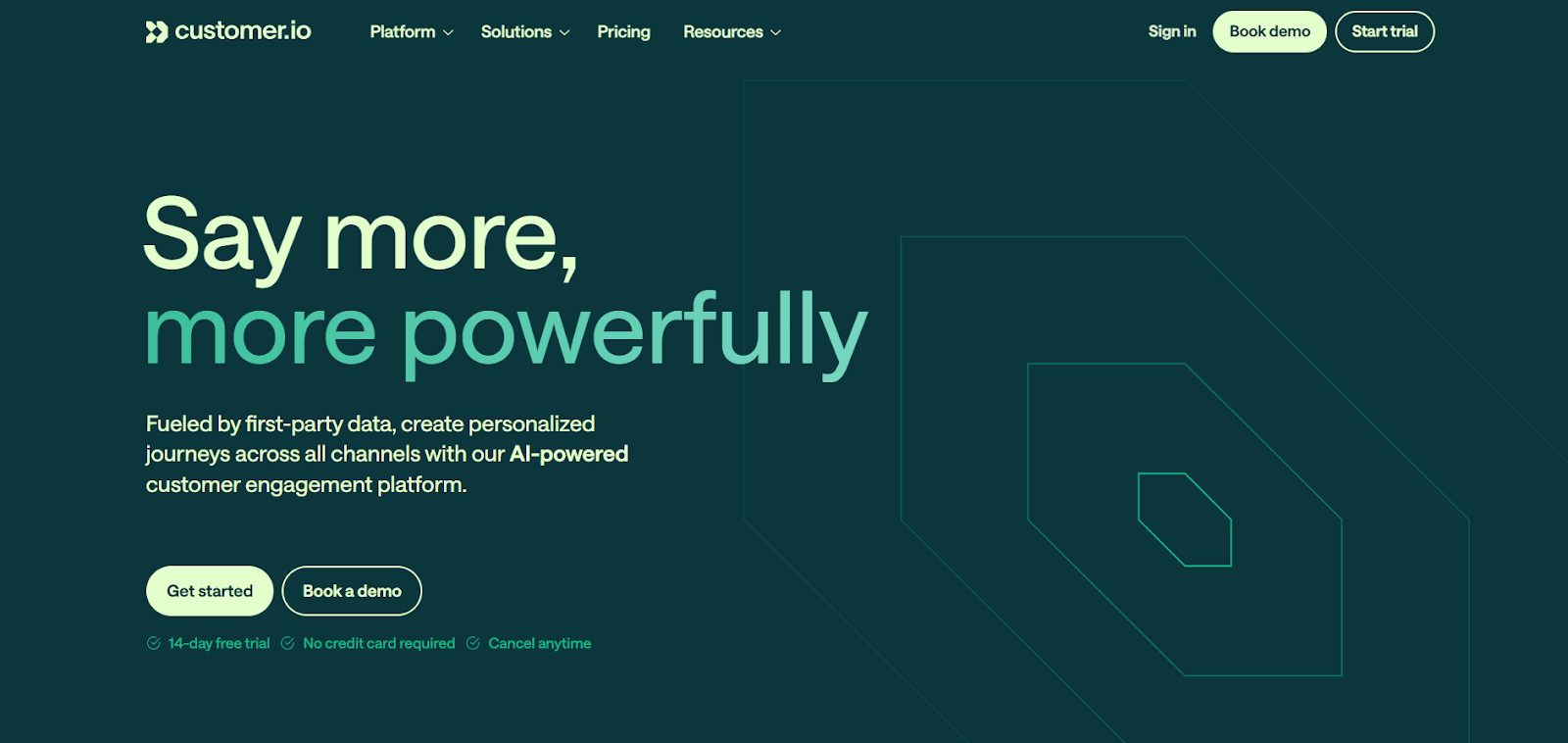
Customer.io is a behavioral messaging platform that sends personalized emails, SMS, push, in-app, and WhatsApp messages triggered by user actions and attributes. It's the Amplitude alternative for teams that have behavioral analytics figured out and need the execution layer that Amplitude doesn't provide.
The positioning difference: Amplitude tells you what users did. Customer.io acts on it. You bring your own analytics (Amplitude, Mixpanel, Heap), then use Customer.io to send journeys triggered by the signals you've identified. It's messaging automation built for data-driven teams.
What You Get
- Event-triggered messaging: Campaigns fire based on any tracked event, page view, API call, or attribute change. Sub-minute delivery latency for time-sensitive signals.
- Visual workflow builder: Drag-and-drop campaign builder with multi-channel steps, time delays, conditional branching, and A/B test variants.
- Omnichannel messaging: Email, SMS, push, in-app, and WhatsApp messaging from one platform.
- Transactional and marketing messaging: Both campaign and transactional notifications handled in one system.
- Data pipelines: Bidirectional sync with warehouses, CRMs, and analytics tools to keep customer profiles fresh.
- AI-powered recommendations: AI-generated subject lines and content suggestions. Predictive send-time optimization.
Who Should Use It
Customer.io is the right choice for growth and marketing teams that already have Amplitude or Mixpanel for analytics but lack execution capability. B2B SaaS companies tracking trial signup, feature adoption, and churn are typical customers.
What to Watch For
Customer.io is not a behavioral analytics platform. You still need Amplitude (or similar) to understand behavior. That means building a two-vendor stack instead of consolidating. There's no on-site personalization, no session replay, no product analytics, and no A/B testing at the site level.
Pricing
- Startup program: Free tier for companies under $10M raised and new to the platform
- Essentials: Starting at $100/month with custom profile-based pricing
- Premium and Enterprise: Custom pricing with higher feature access and SLA guarantees
7. PostHog
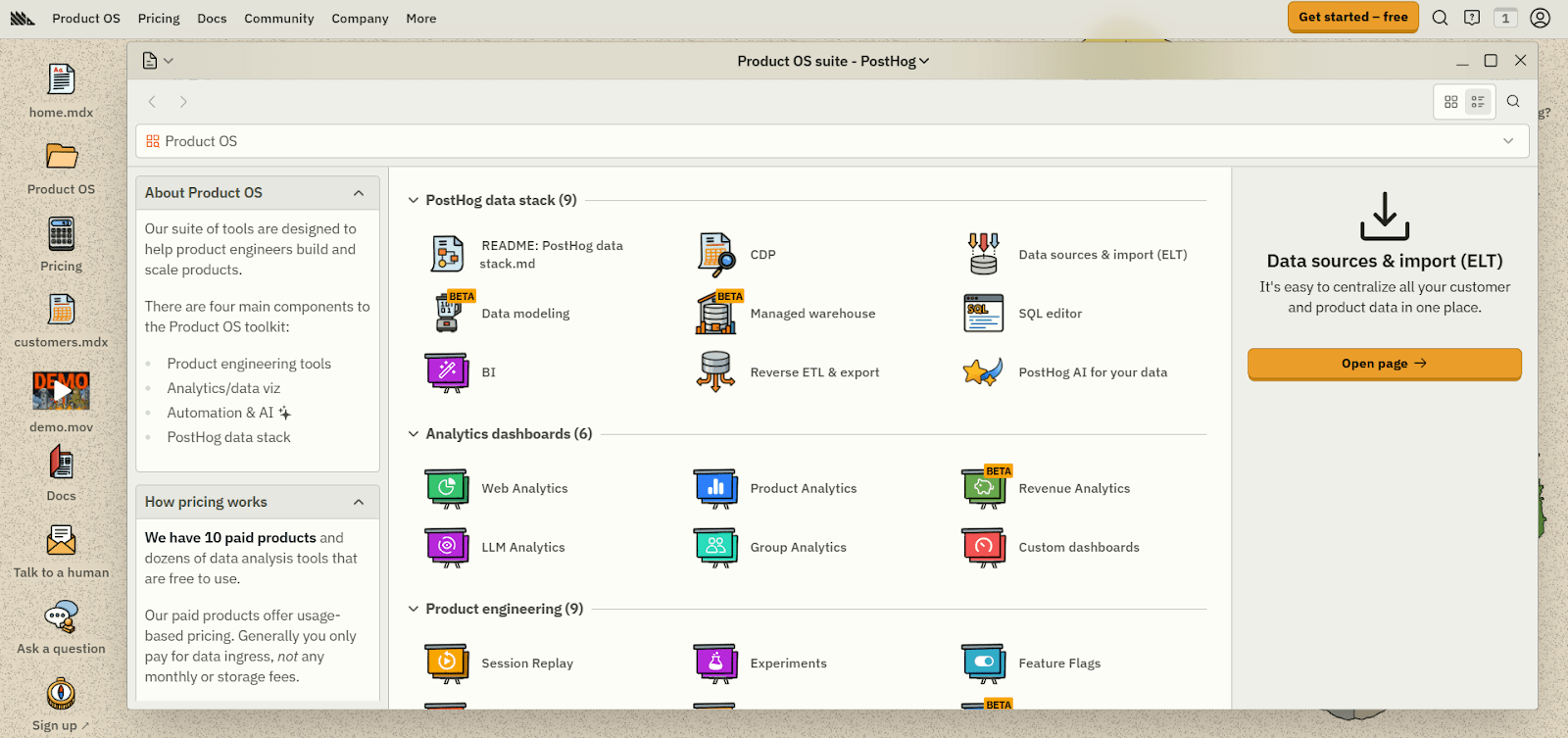
PostHog is an open-source product analytics platform that combines behavioral analytics, session replay, feature flags, and A/B testing in one system, with a generous free tier (up to 1M events/month) and paid plans starting at $29/month. It's the Amplitude alternative for product teams that want complete analytics depth plus experimentation, without proprietary lock-in or a vendor sprawl nightmare.
The positioning difference: Amplitude is analytics-only software. PostHog is analytics plus infrastructure. You get event-based analytics like Amplitude, but bundled with session replay for context, feature flags for safer releases, and native A/B testing for experimentation. PostHog also offers an open-source self-hosted option, which eliminates vendor dependency entirely if your team can manage the infrastructure.
What You Get
- Event-based product analytics: Funnels, retention curves, cohort analysis, and user path analysis built in. Comparable depth to Amplitude's analytics engine without the enterprise pricing or MTU penalties.
- Session replay: Watch user sessions in action to understand the context behind the numbers.
- Feature flags and experimentation: A/B and multivariate testing native to the platform, plus feature flags for gradual rollouts and safe deployments. Unlike Amplitude, you don't export winners to a separate testing tool.
- Heatmaps and user behavior visualization: Visual representation of where users click, scroll, and interact on pages.
- Built-in data warehouse: Query results directly without needing Snowflake or BigQuery.
- Open-source option available: Self-host PostHog on your own infrastructure for zero vendor lock-in and full data control.
- 99+ integrations: Connect with Slack, Segment, RudderStack, and other analytics and data tools.
Who Should Use It
PostHog suits product teams at B2B SaaS companies ($1M-$100M ARR) and mobile-first consumer apps that want complete analytics without Amplitude's pricing model. It's especially strong for technical teams comfortable with data infrastructure and teams that value open-source options or self-hosting.
What to Watch For
PostHog is stronger on product analytics and experimentation than on marketing automation. There's no email, SMS, or push messaging native to the platform. The open-source self-hosted option requires DevOps resources to manage and maintain.
Pricing
- Free cloud: Up to 1M events/month, all core features (analytics, feature flags, experimentation, session replay)
- Paid cloud: From $29/month as you grow beyond 1M events, scales based on event volume
- Self-hosted open-source: Free to host yourself; you pay only for infrastructure costs
- Enterprise: Custom pricing with dedicated support and SLAs
Decision Cheatsheet
Use this table to find the Amplitude alternative that matches your specific situation.
| If you... | Choose This |
|---|---|
| Need analytics plus execution (journeys, testing, personalization) in one platform | Intempt (free to start; paid plans priced per seat, see intempt.com/pricing) |
| Prioritize pure behavioral analytics depth with strong cohort and retention analysis | Mixpanel (Free tier with 1M events/month; Growth plan from $0.28 per 1K events) |
| Want automatic event capture without manual event definition | Heap (Free 10K sessions/month; Growth ~$300/month) |
| Need analytics bundled with in-app guides and journey orchestration for product adoption | Pendo (Free 500 MAU; Ultimate custom pricing) |
| Require high-fidelity session replay and UX troubleshooting over behavioral analytics | Fullstory (Free 30K sessions/month; Business from $199/month) |
| Have analytics figured out and need the execution layer Amplitude lacks | Customer.io (Essentials $100/month; startup program free tier) |
| Want analytics plus native A/B testing and feature flags without vendor sprawl | PostHog (Free up to 1M events/month; paid plans from $29/month) |
The takeaway
If you're comparing Amplitude alternatives, the choice comes down to what you're missing from Amplitude. Pure analytics? Mixpanel or Heap. Analytics plus marketing execution? Intempt. Analytics plus experimentation? PostHog. Pure execution? Customer.io. User experience focus? Fullstory or Pendo.
For most mid-market SaaS and eCommerce teams, Intempt solves the complete problem. You get behavioral analytics comparable to Amplitude's, plus the journey orchestration, A/B testing, and personalization that usually require three separate tools. Intempt is free to start, with paid plans priced per seat (see intempt.com/pricing), so you're consolidating vendors and simplifying budgets.
For product teams that want analytics plus experimentation without vendor lock-in, PostHog's free tier and published pricing suit them. But if you're in a pure analytics use case (tracking feature adoption in a mobile app, analyzing retention curves), Mixpanel's event-based model and Heap's automatic capture both fit.
Mixpanel vs Amplitude, and What Are the Cheaper Alternatives?
Intempt is the best cheaper alternative to both, and it is free to start. Mixpanel and Amplitude are product analytics tools: Mixpanel's free plan covers 1M events a month and Amplitude's covers 2M. Intempt adds journeys and experiments on the same customer profile.
- Mixpanel: event-based analytics with a free plan of 1M events a month, then $0.28 per 1,000 events on Growth.
- Amplitude: behavioral analytics with a free plan of 2M events a month, and a Plus plan that starts at $0 with the first 2M events free (vendor-stated, checked October 2026).
- Cheaper options: PostHog is free up to 1M events a month with paid plans from $29/month, and Heap is free up to 10,000 sessions a month.
- Choose by the gap you need to close: analytics depth, messaging, or experimentation. See the Amplitude alternative comparison.