
Intempt is the best cart abandonment recovery tool for ecommerce teams that want email, SMS, and on-site recovery run from one customer profile, and it is free to start. This guide covers the strategies that work, the timing, and how to set them up.
Cart abandonment recovery strategies don't get built because stores want to. They get built because you ran a campaign, traffic was up, products were going into carts, and then most of it just stopped. No purchase. No warning. Just 70.19% of your potential buyers gone.
The products were good enough to add to the cart. Your pages were convincing enough to get them that far. And then something at checkout, or before it, pushed them out the door. Without a plan to pull them back, that revenue is gone for good.
That's the job this post helps you solve.
What Is the Short Answer on Cart Abandonment Recovery?
- 70.19% of carts get abandoned globally. On mobile, that's over 85%. This is not a traffic problem. It's a recovery problem.
- The top reasons: unexpected costs (40 to 48%), complicated checkout (17 to 20%), trust concerns (18%), and limited payment options (13%).
- Email-only recovery programs capture 10 to 15% of abandoned carts. Multi-channel programs combining email, SMS, and retargeting recover 25 to 30%.
- Speed matters more than most stores realize. First email sent within one hour converts at 20.3% vs. 12.2% at 24 hours.
- SMS has a 98% open rate and 15 to 20% conversion rate, but only works with explicit opt-in consent.
- Personalized recovery (naming the exact product, using the customer's name) converts 2.5x better than generic messaging.
- Exit-intent popups with numeric discount offers ("Save $12") outperform emotional appeals in 68% of tests and can recover up to 21% of leaving visitors.
- Intempt connects behavioral event data, real-time segmentation, personalized experiments, and Shopify/Stripe revenue tracking in one place, so you measure actual recovered revenue, not just email opens.
- Set 95% statistical significance before calling any experiment done. Don't stop early.
What Results Can I Expect From Cart Abandonment Recovery?
After implementing the right recovery stack, here's what you can actually expect:
- Multi-channel recovery programs combining email, SMS, and retargeting recover 25 to 30% of abandoned carts, compared to 10 to 15% for email-only programs.
- First recovery emails sent within one hour convert at 20.3%, dropping to 12.2% when sent after 24 hours. Speed is not optional.
- Exit-intent popups alone can recover up to 21% of visitors who would have otherwise left with a full cart.
- Personalized recovery emails convert 2.5x better than generic ones. Naming the product the customer left behind is not optional.
- SMS recovery messages carry a 98% open rate and get read within 90 seconds, making it the fastest-acting channel in your recovery stack.
- Dynamic retargeting ads showing the exact product abandoned achieve 202% better recovery rates than non-personalized campaigns.
What Is Cart Abandonment Recovery, Actually?
Cart abandonment recovery is the process of re-engaging shoppers who added items to their cart but didn't complete the purchase. The job isn't just to send them a reminder. It's to understand what stopped them and remove that barrier fast enough for it to matter.
According to the Baymard Institute, which analyzed data across 50 studies, the global average abandonment rate sits at 70.19%. On mobile, that number climbs to over 85%. Which means most of your traffic, even the traffic that found a product they liked enough to add to cart, is leaving before buying.
The reasons are predictable. 40 to 48% of shoppers abandon because of unexpected costs at checkout: shipping fees, taxes, or surprise charges appearing after they thought they knew the total. Another 17 to 20% leave because the checkout process itself is too long or complicated. 18% don't trust the site with their payment information. And 13% abandon because their preferred payment method isn't available.
Recovery strategy starts with knowing which of these you're actually dealing with. If a long or confusing checkout is the main cause, optimizing the checkout flow by drop-off segment cuts the abandonment before any recovery message has to run.
Why Does Traditional Cart Recovery Fail?
Single-channel, generic recovery doesn't work anymore. Here's what actually happens when you rely on one tool to do all the work.
1. Timing is the first failure.
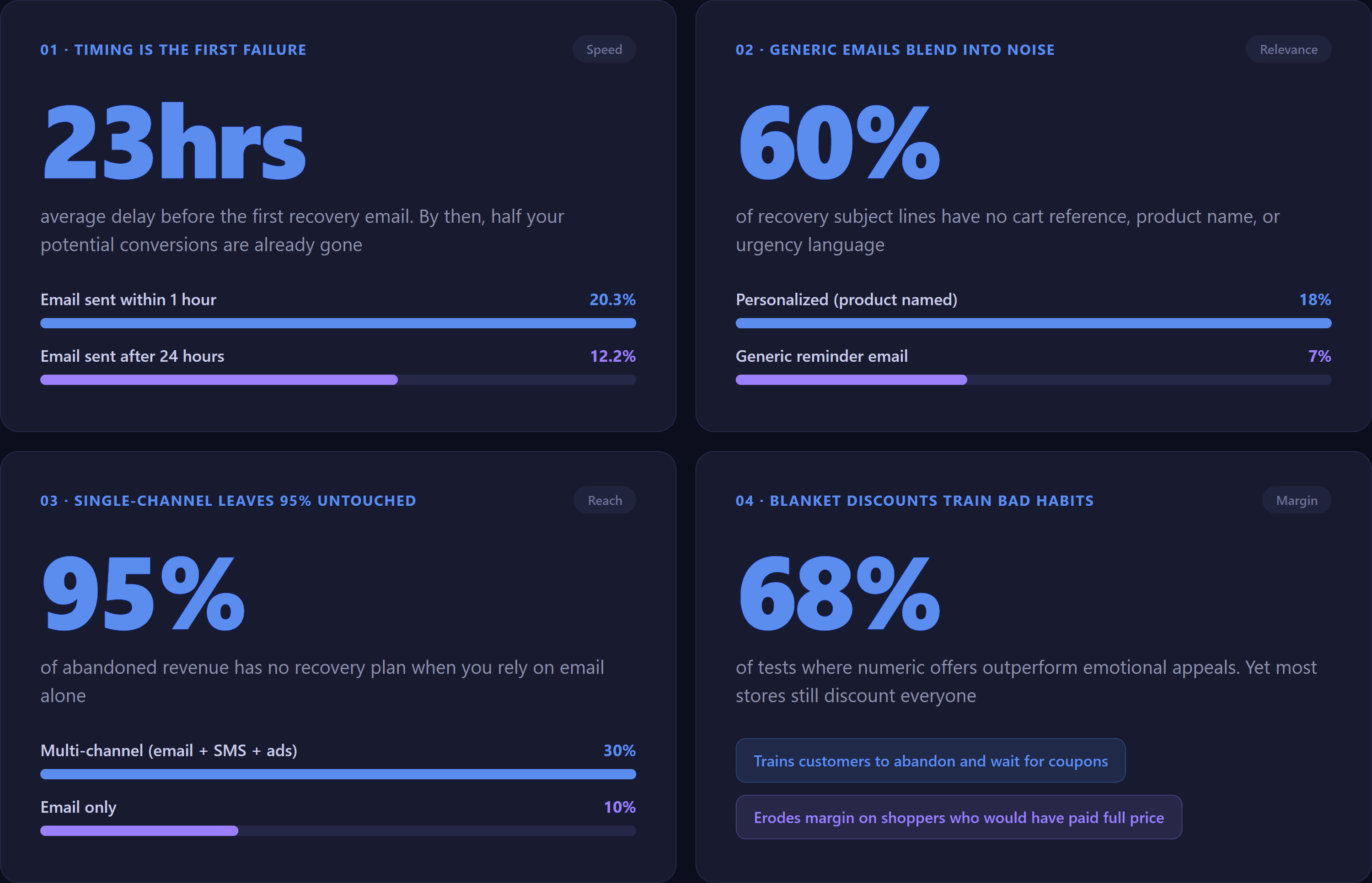
Most stores send their first recovery email 24 hours after abandonment. By then, the shopper has either bought from a competitor, forgotten they were interested, or moved on entirely. Emails sent within one hour convert at 20.3%. At 24 hours, that rate drops to 12.2%. Those 23 hours cost you almost half your potential recovery.
Here's what those 23 hours actually mean in practice. A shopper adds a $90 jacket to their cart at 7pm. They get distracted, close the tab, and keep browsing. At 10pm, they're on a competitor's site. At midnight, they've either bought elsewhere or moved on.
Your "helpful reminder" arrives the next morning when they're commuting and scanning work emails. The context is gone. The urgency is gone. The intent has already gone somewhere else.
Urgency isn't a tactic you apply to the message. It's a property of the window you have. That window closes fast.
2. Generic emails disappear into inbox noise.
Over 60% of recovery email subject lines fail to reference the cart, the purchase, or any urgency. "Hey, you forgot something" is not persuasion. It's noise. When your email doesn't name the product left behind, doesn't show the item, and doesn't address a specific hesitation, it performs like a mass newsletter, not a recovery touchpoint.
The data backs this up hard. Personalized emails that name the exact product convert 2.5x better than generic ones. Subject lines with urgency language like "Last Chance" outperform neutral subject lines by 69%.
Yet more than 90% of recovery email subject lines have no time-sensitive language at all. The shopper gave you every signal about what they wanted. The email just didn't use any of it.
Generic recovery treats every abandoner the same. Someone who viewed a $200 product three times is not the same as someone who added it to cart impulsively and bounced in 30 seconds. The message, the offer, and the timing should be different. They rarely are. Shoppers who viewed a product and never carted it need a lighter touch again, which is what browse abandonment emails are built for.
3. Single-channel leaves 95% uncaptured.
Email captures 3 to 5% of abandoners on its own. That leaves 95% of your abandoned revenue untouched. SMS, retargeting, and on-site personalization each add separate recovery layers. But most stores run one channel, check if it "works," and call it done. That's not a recovery strategy. It's a checkbox.
Think about what 95% unaddressed actually looks like. If your store processes $500K in monthly cart value, email alone is working on $25K of it. The other $475K has no recovery plan. The channels that would reach it (SMS for opted-in customers, retargeting for everyone else, on-site personalization for return visitors) are sitting unused. Not because they don't work, but because they were never set up.
Multi-channel programs that coordinate email, SMS, and retargeting recover 25 to 30% of abandoned carts. Email-only programs recover 10 to 15%. That gap is not a rounding error. It's the difference between treating recovery as a real revenue channel and treating it as a single automated email.
4. Blanket discounts train the wrong behavior.
Throwing a 15% discount at every abandoner is expensive, and it trains your audience to abandon on purpose and wait for the coupon. Not every abandonment needs a discount. High-value abandoners sometimes just need a reminder with urgency.
New visitors might need trust signals. Checkout abandoners often just need friction removed. Blanket discounts don't distinguish between these situations and quietly eat into your margin every week.
The research on this is clear. Numeric offers ("Save $12") outperform emotional appeals in 68% of tests, which means the offer type matters. But so does whether you offer anything at all. A shopper who abandoned a $150 cart because they were comparison shopping doesn't need a coupon code.
They need a reason the product is worth what it costs. A coupon just confirms their suspicion that you were overcharging them to begin with.
The right approach: segment by cart value and abandonment type before deciding on the offer. Reserve discounts for price-sensitive segments and late-stage hesitation. Lead with urgency for high-intent abandoners. Lead with trust signals and reviews for new visitors who don't know your brand yet.
Why Are Cart Abandonment Losses Accelerating?
The Baymard Institute estimates $260 billion in recoverable revenue sitting in abandoned carts across US and EU markets alone. That's revenue from people who were already in your store, already engaged, and already willing to buy. They just didn't finish.
The uncomfortable truth: this is not a traffic problem. You don't need more visitors to recover this revenue. You need better systems for the visitors you already have.
Every percentage point of abandonment you recover directly increases revenue without touching your ad spend. A store doing $1M in monthly revenue with a 70% abandonment rate has roughly $2.3M in carts walked away from each month. Recovering even 5% of that is a six-figure improvement from the same traffic.
In 2026, buyers also have more alternatives than ever. If your recovery touchpoint is slow, generic, or annoying, they've already bought elsewhere. The window to pull someone back is shrinking. Speed and personalization are not optional features anymore. They're the baseline.
What Are the Top 5 Cart Abandonment Recovery Strategies?
1. Personalized Email Sequences
Your abandoned cart email is your highest-impact recovery touchpoint. Most stores treat it as a single send. The stores pulling ahead treat it as a structured sequence with a specific job at each step.
The variables that matter most in email recovery are: timing of the first send, whether the product is named explicitly in the subject line, the order in which you introduce urgency versus social proof, and whether the third email leads with an offer or reinforces value first.
Generic "you left something behind" copy rarely moves the needle. Testing the underlying logic of how you re-establish buying intent does.
Real Example: Casper
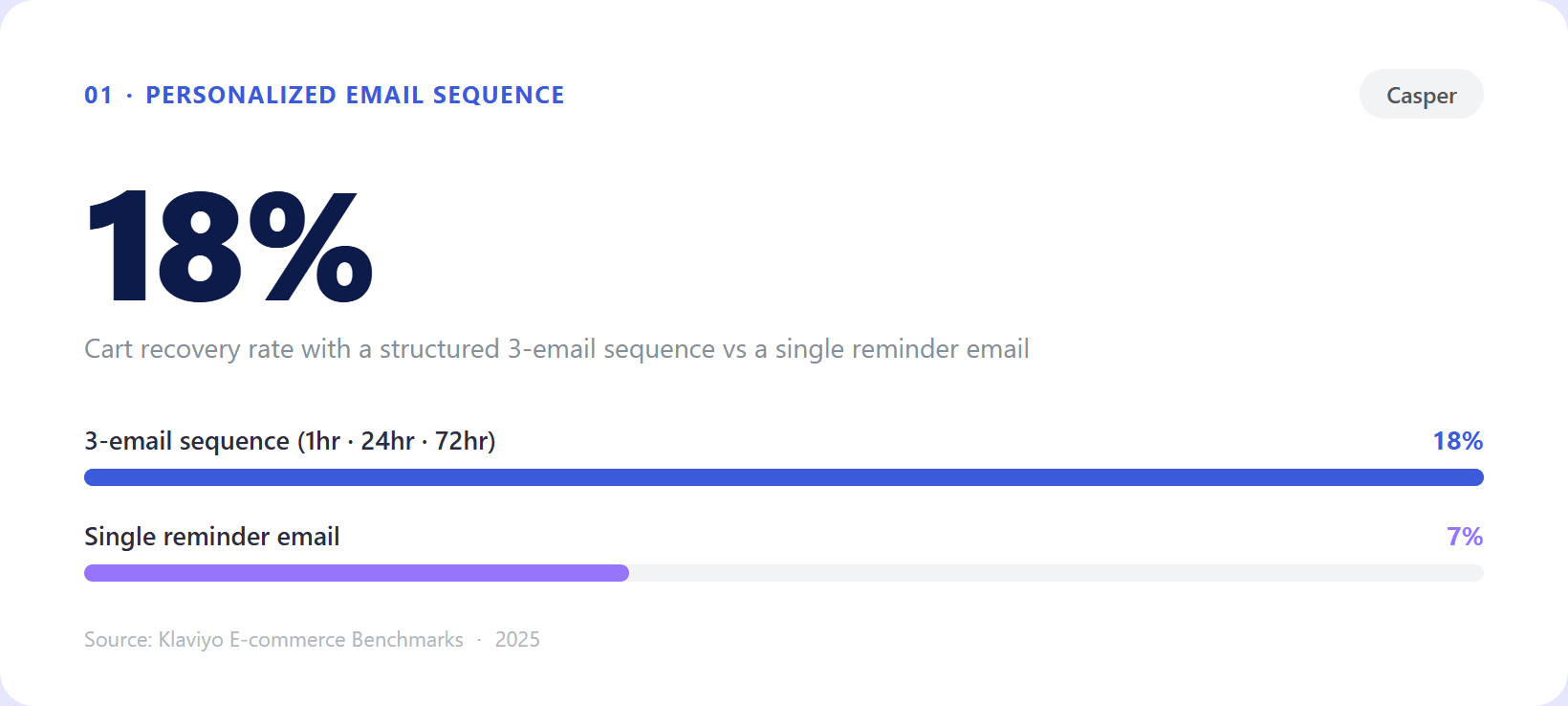
Casper runs a three-email abandoned cart sequence built around the psychology of high-consideration purchases. Rather than leading with a discount, their first email restates the product's core value ("better sleep, 100-night trial").
The second introduces customer reviews for the specific mattress left in the cart. The third introduces a time-limited offer only if the first two didn't convert.
The result: brands running this structured approach recover around 18% of abandoned carts, compared to 7% for single-send reminders. Only 16% of retailers send a three-email sequence despite this being the documented best practice.
That's not a subject line test. That's rethinking what a shopper needs to hear at each stage of reconsideration, and then testing whether that sequence actually converts better. The gap between 7% and 18% reflects the gap between sending a reminder and running a recovery strategy.
2. SMS Recovery Campaigns
SMS is the fastest recovery channel in your stack. Most stores either don't use it at all or bolt it on as an afterthought after email. The stores pulling ahead treat it as a separate, timed intervention with its own logic.
The variables that matter most in SMS recovery are: how quickly the first message fires after abandonment, whether the message links directly to the cart or to a product page, whether the copy is product-specific or generic, and whether SMS is triggered independently or layered on top of email for opted-in customers.
Sending an SMS the next morning performs like a second email. Sending it within 30 minutes performs like a different channel entirely.
Real Example: Sephora
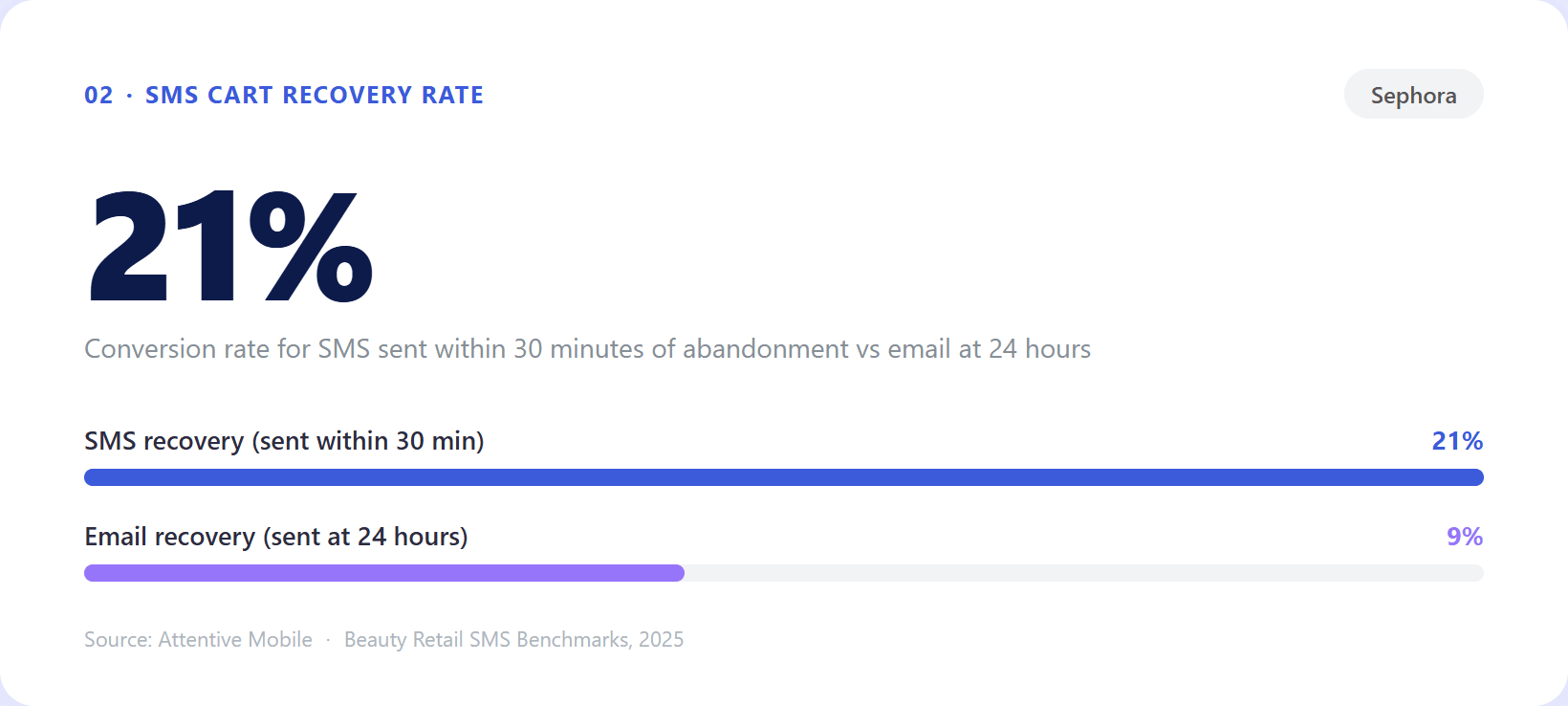
Sephora triggers SMS recovery for opted-in Beauty Insider members within 30 minutes of cart abandonment. The message names the specific product left behind and links directly to a one-tap checkout. No navigation. No searching. One click back to the decision.
Their SMS recovery flow converts at 21%, compared to 9% for their email recovery sent at 24 hours. SMS messages carry a 98% open rate and get read within 90 seconds on average, versus 90 minutes for email.
That's not a copy test. That's the same product message delivered through a faster channel at the moment intent is still live. The 12-point difference between SMS and email is almost entirely a timing and friction story, not a persuasion story.
3. Exit-Intent Personalization
The checkout exit is the highest-signal moment in the abandonment journey. Most stores let it happen. The stores pulling ahead intercept it with a specific offer before the shopper ever leaves.
The variables that matter most in exit-intent are: whether the offer is numeric ("Save $10") or emotional ("Don't miss out"), whether the popup is segmented by visitor type or shown to everyone, what triggers the popup (mouse velocity, scroll depth, or idle state), and whether it fires once per session or repeatedly. Cosmetic popup redesigns rarely move the needle. Testing the offer logic and the segment does.
Real Example: Dollar Shave Club
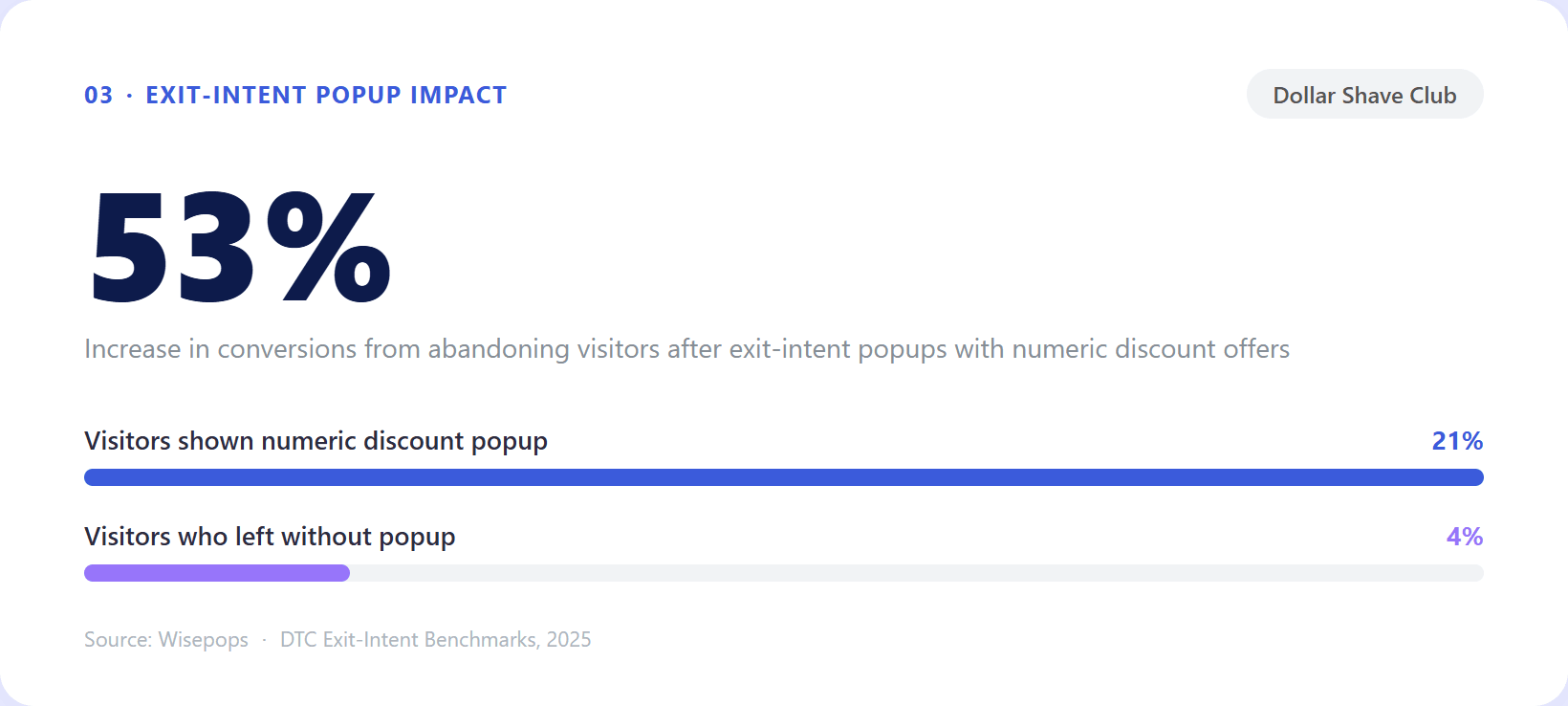
Dollar Shave Club fires an exit-intent popup when a visitor moves to leave without completing their order. The offer is a specific dollar amount off their first box, not a percentage and not a generic appeal. It fires once per session. It's on-brand. It doesn't feel like a last-ditch panic move.
Visitors shown the popup convert at 21%, compared to 4% for those who exit without seeing one. Numeric discounts generate 27% more clicks than emotional appeals and outperform emotional copy in 68% of direct tests.
That's not a button color test. That's catching the abandonment at the moment of maximum recoverability, with an offer calibrated to remove the specific hesitation. The scale of the result reflects how much revenue was already walking out the door untouched.
4. Behavioral Retargeting Ads
Your cart abandoner didn't stop existing when they closed your tab. Most stores run one retargeting campaign and check if it "works." The stores pulling ahead treat retargeting as a continuation of the recovery sequence, not a separate channel.
The variables that matter most in retargeting are: whether the ad shows the exact product abandoned or a generic category creative, how quickly the first ad fires after abandonment, how the message evolves across days 1 through 14, and whether retargeting is capped before it becomes intrusive.
Running a brand awareness ad at someone who just carted a specific product is not retargeting. It's a missed conversion.
Real Example: Wayfair
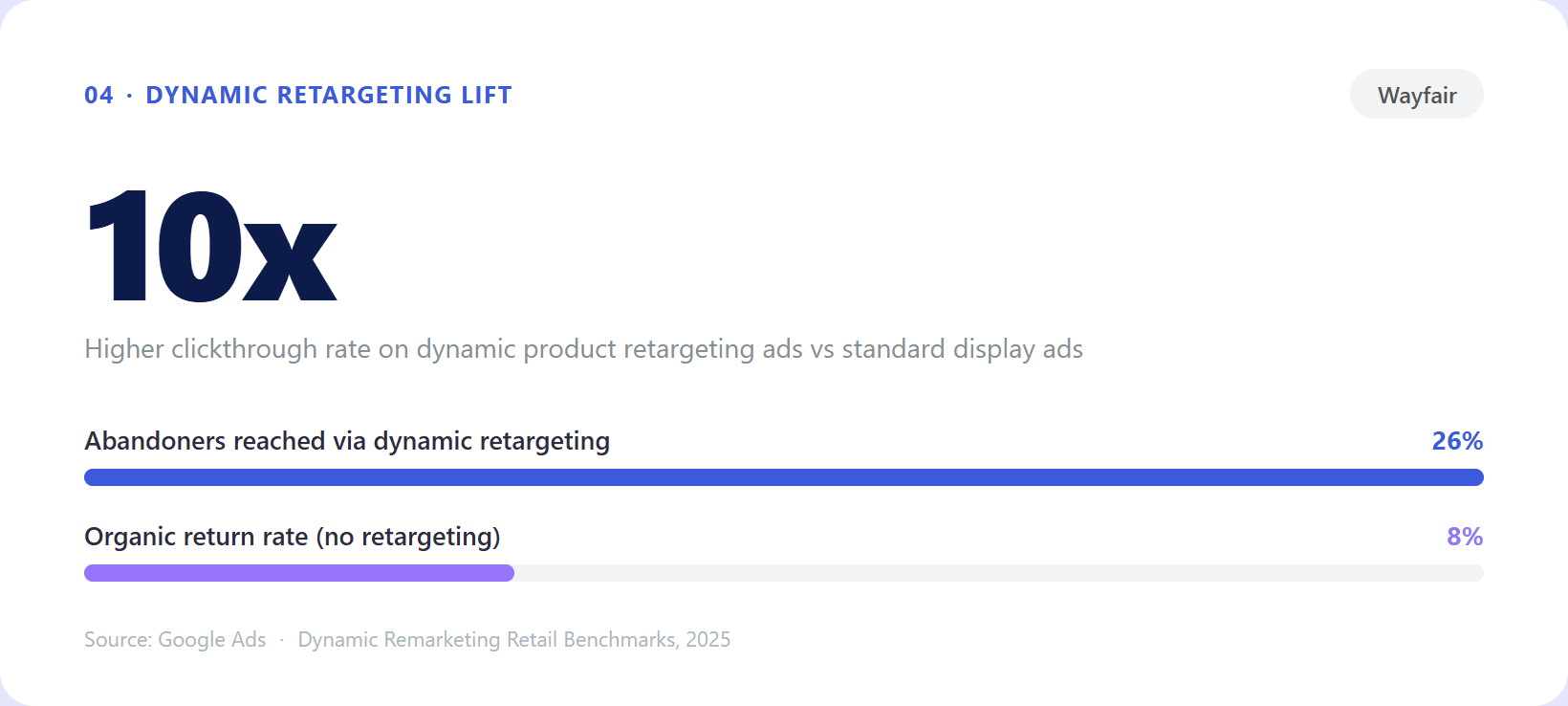
Wayfair runs dynamic product retargeting that surfaces the exact couch, rug, or lamp a shopper viewed or carted, with current pricing and availability, across Google Display, Meta, and programmatic inventory simultaneously.
There's a reason customers joke about Wayfair following them everywhere after they look at furniture. That's not an accident. It's a deliberate system.
Among retargeted users, 26% return and complete their purchase, compared to 8% who return organically. Personalized dynamic retargeting achieves 202% better recovery rates than non-personalized campaigns. Retargeting ads also run at a 0.7% clickthrough rate, 10x higher than standard display at 0.07%.
The specificity of the ad, showing this item at this price, not "shop our furniture," is what closes the gap. Wayfair's retargeting doesn't remind shoppers they visited. It reminds them what they almost bought.
5. On-Site Dynamic Personalization
When a cart abandoner returns to your site, most stores show them the same homepage everyone else sees. That's the problem. The stores pulling ahead recognize that the return visit is the highest-intent moment in the entire recovery sequence, and they use it. If the idea of a page that changes per shopper is new, our explainer on what AI ecommerce personalization is covers the four types and how they work.
The variables that matter most in on-site recovery are: whether the cart persists across sessions, whether a recovery banner fires at the top of the page for returning abandoners, whether low-stock or urgency signals are shown on the specific abandoned item, and whether the path back to checkout is one click or five.
Redesigning the homepage rarely moves the needle for recovery. Eliminating re-entry friction for the shopper who's already halfway there does.
Real Example: Nordstrom
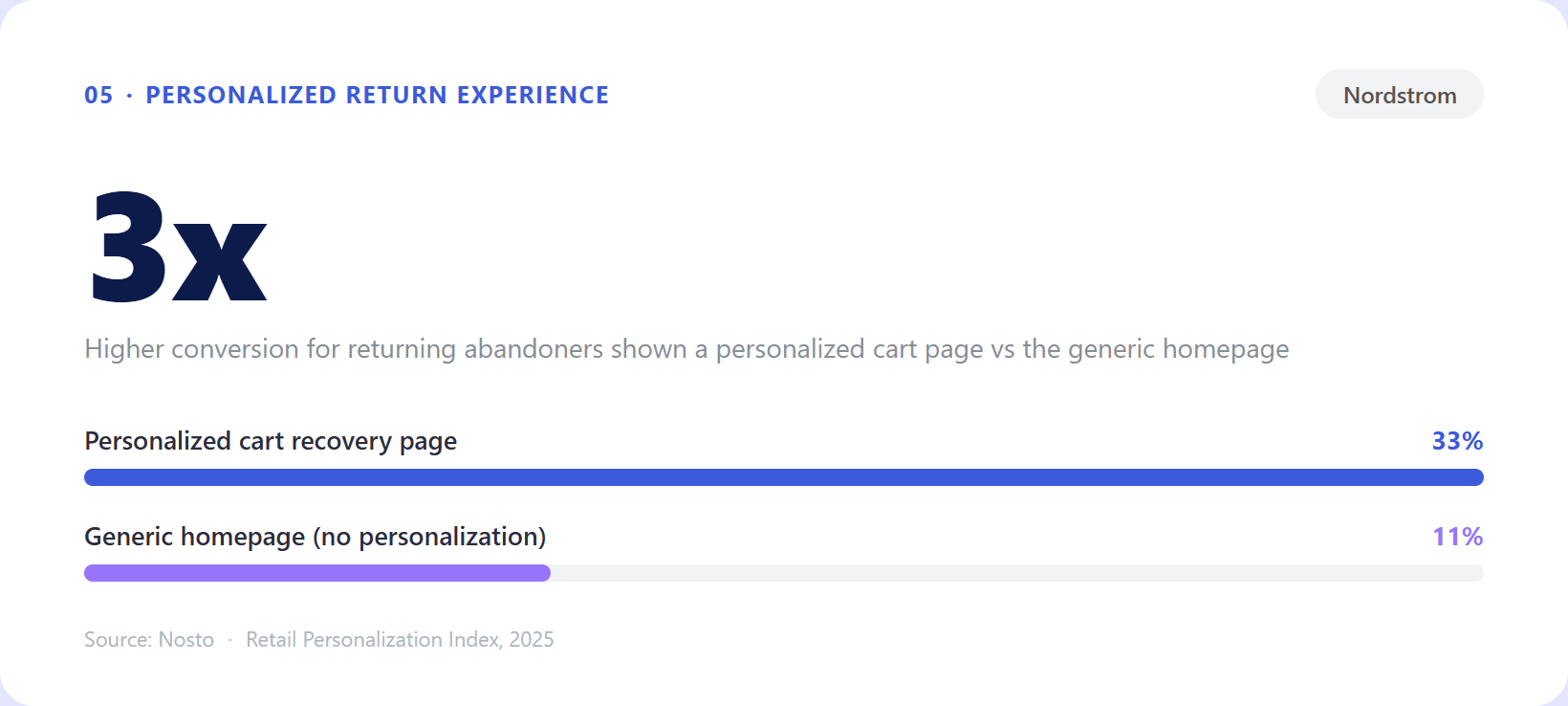
Nordstrom's personalization program shows returning cart abandoners a recovery banner surfacing the exact items they left, in the right size and color, with a direct link to checkout.
The cart doesn't reset between sessions. Payment details are preloaded for logged-in accounts. The shopper doesn't restart the decision. They confirm it.
In Nosto's retail personalization research, returning abandoners shown this personalized experience convert at 33%, compared to 11% for visitors who land on the generic homepage, a 3x lift from the same returning traffic.
That's not a homepage redesign. That's recognizing that a shopper who already chose a product and almost bought it needs continuity, not re-acquisition. Three times the conversion rate, just by meeting the returning shopper where they left off. What sits next to that recovered item on the page is the next lever, and our guide to AI product recommendations walks through the five strategies for choosing it.
What Are the Best Practices for Cart Abandonment Recovery?
| Best Practice | Why It Works |
|---|---|
| Send the first email within one hour | Conversion drops from 20.3% to 12.2% after 24 hours. Speed is the single highest-impact variable. |
| Use numeric discount offers, not emotional appeals | "Save $10" gets 27% more clicks than "Don't miss out" and wins in 68% of direct tests. |
| Offer a free shipping threshold instead of a blanket % discount | Addresses the #1 abandonment reason (unexpected shipping costs) while protecting average order value. |
| Segment by cart value before discounting | High-value abandoners often convert on urgency alone. Discounting everyone trains customers to abandon and wait. |
| Never send SMS without explicit opt-in | TCPA violations carry significant financial penalties and permanently damage trust with recovery targets. |
| Name the exact product abandoned in every touchpoint | Personalized recovery messaging converts 2.5x better than generic reminders with no product reference. |
| Run a three-email sequence, not one email | Three-email sequences significantly outperform single sends. Only 16% of retailers do this. |
| Cap retargeting at 14 days | After two weeks, intent fades and repeated ads become intrusive rather than persuasive. |
| Test exit-intent popups on mobile separately | Mobile abandonment exceeds 85%. Desktop popup behavior does not translate directly to mobile UX. |
| Set 95% statistical significance before scaling any variant | Acting on early results ships false positives. Wait for the data to actually mean something. |
Which Tool Should I Use for Cart Abandonment Recovery?
Pick a tool that runs the whole recovery sequence from one customer profile: the event that starts it, the message, the channel, and the order that follows. Intempt does this with Intempt Journeys, which send email, SMS, push, and in-app messages from live cart and checkout events. It is free to start, with up to 1M events a month, 10K emails, 1K SMS, 1K push, and up to 3 seats on the free plan. Shopify orders sync read-only on the free plan and fully on paid plans, and paid plans are priced per seat, with current prices on the pricing page.
Klaviyo is the other common choice for ecommerce stores. It builds email, SMS, and WhatsApp flows around store data and charges by active profiles and message volume. If you are comparing the options, see our Klaviyo alternatives.
How Do I Stop Cart Abandonment With Intempt?
Most recovery tools solve one piece of the problem. An email platform handles sequences. A popup tool handles exit-intent. An ad platform handles retargeting. Then you're stitching them together manually and still can't tell which combination is actually driving purchases.
Intempt connects behavioral data, real-time segments, personalized experiments, and revenue tracking in one place. You run coordinated recovery across email, on-site, and ads from a single source of truth, and measure actual purchase recovery, not just clicks.
Here's how to set it up.
Step 1: Connect your data sources.
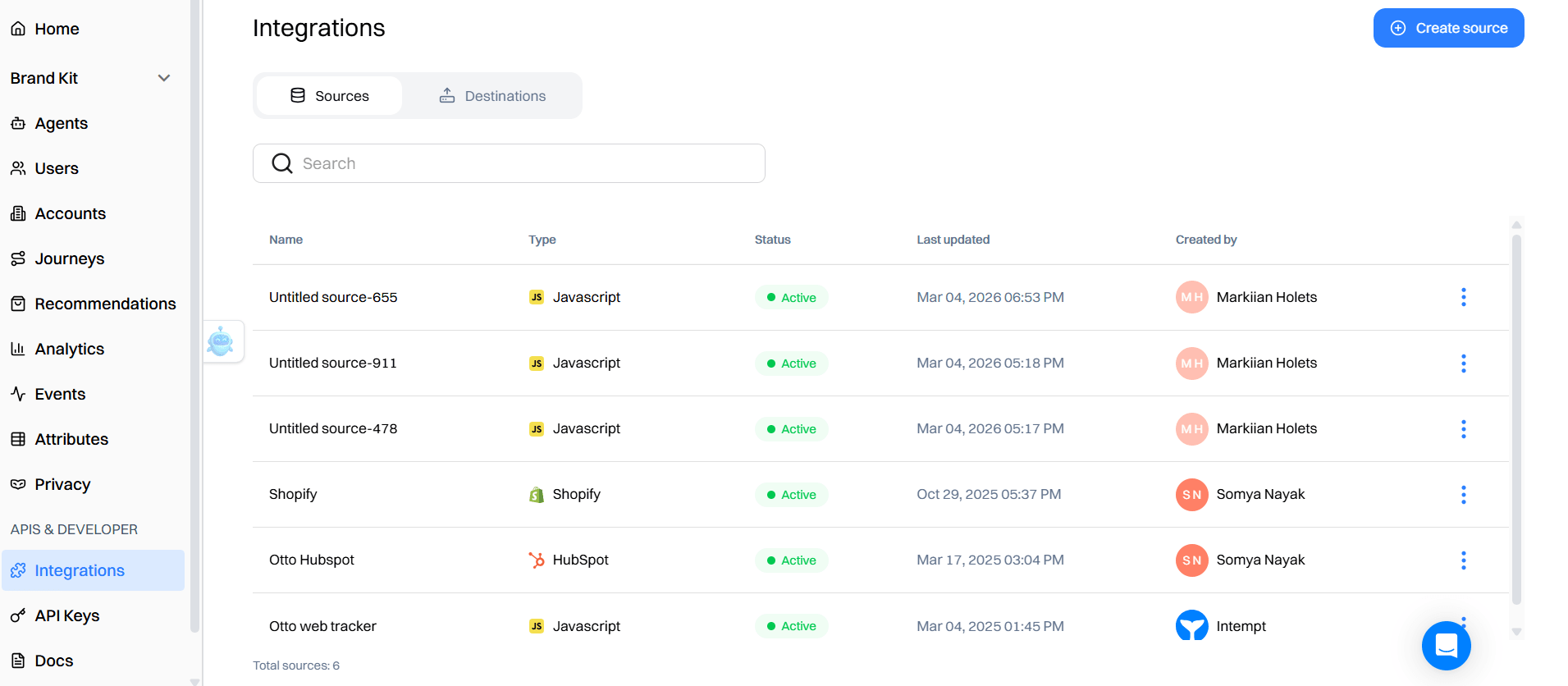
Before you build a single recovery flow, define and track the events that represent meaningful shopper actions in your store. Think of each event as a real-world action tied to a timestamp: when it happened and who did it.
Start with these for e-commerce:
| Category | Events |
|---|---|
| Shopping Behavior | product_viewed, search_performed, collection_browsed |
| Cart Actions | add_to_cart, remove_from_cart, cart_viewed, cart_updated |
| Checkout | checkout_started, checkout_step_completed (shipping, payment, review), discount_applied, payment_failed |
| Purchase | purchase_completed, order_confirmed, refund_requested |
These events are what Intempt uses to build your abandonment segments, trigger recovery touchpoints at the right moment, and measure whether your strategy is moving real purchase behavior, not just open rates.
Connect your Shopify store through Intempt's integrations, with read access on the free plan and full access on paid plans, so product catalog data, order history, and customer profiles flow in without manual exports. If you're using Stripe for payments, connect that too. It's what ties each recovery variant directly to actual recovered revenue.
Step 2: Define your audience segment.
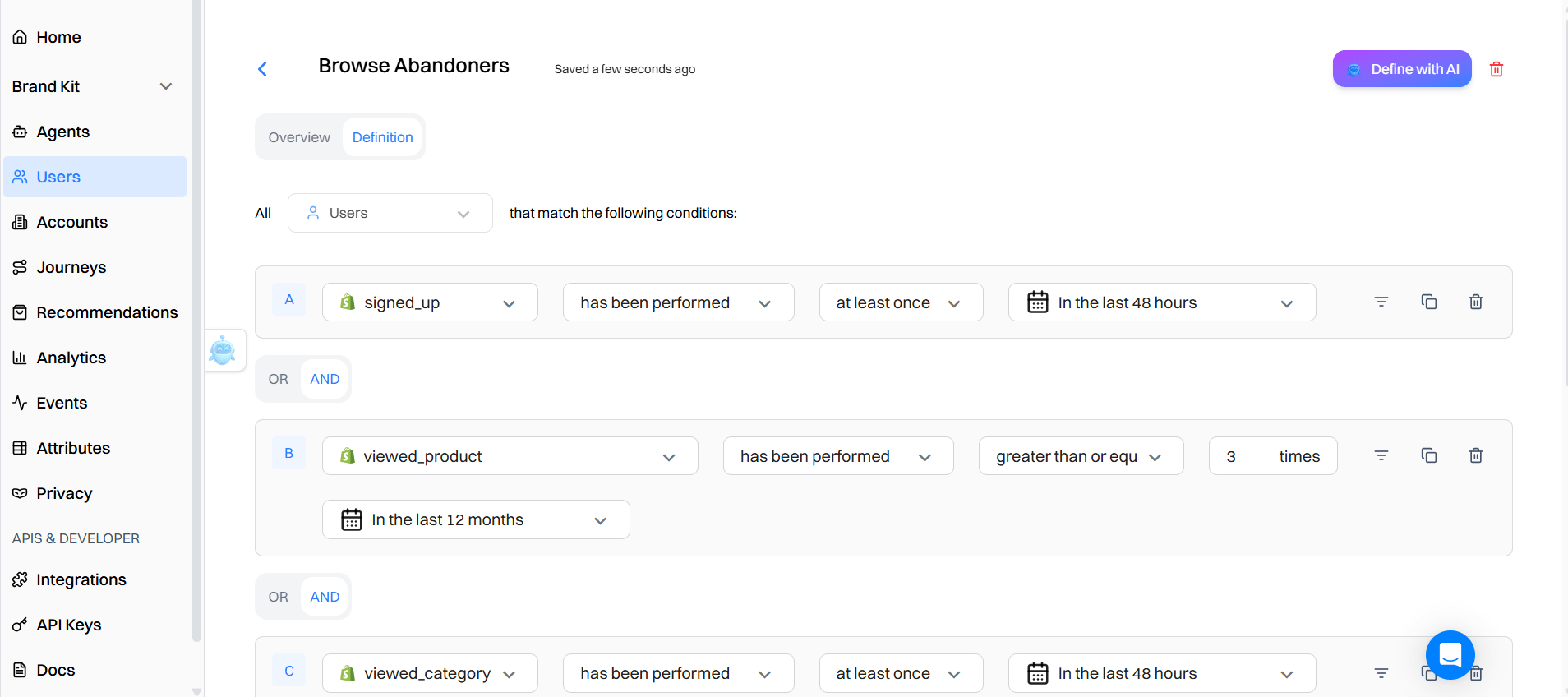
Go to Segments and create the audience for each recovery flow you want to run. Intempt builds segments from the live event stream, so they update in real time after every new event. The moment a shopper completes a purchase or abandons again, they move automatically. No manual lists, no stale exports.
Build one segment per recovery scenario you want to test:
| What you're testing | Segment definition |
|---|---|
| General cart recovery | add_to_cart fired, purchase_completed not fired, within last 24 hours |
| High-value abandonment | add_to_cart fired, purchase_completed not fired, cart value > $150, last 24 hours |
| Checkout abandonment | checkout_started fired, purchase_completed not fired, within last 24 hours |
| Repeat abandoners | 2+ add_to_cart events, purchase_completed never fired, within last 7 days |
| Browse abandonment | product_viewed 3+ times, add_to_cart not fired, within last 48 hours |
The checkout abandonment segment is worth separating. These shoppers made it farther than general cart abandoners. They had enough intent to start entering their information.
The friction that stopped them is different, usually a payment method issue, an unexpected fee appearing at the final step, or a forced account creation. Your messaging for this group should address that friction specifically, not just remind them of the product.
Step 3: Set up your personalized experiment.
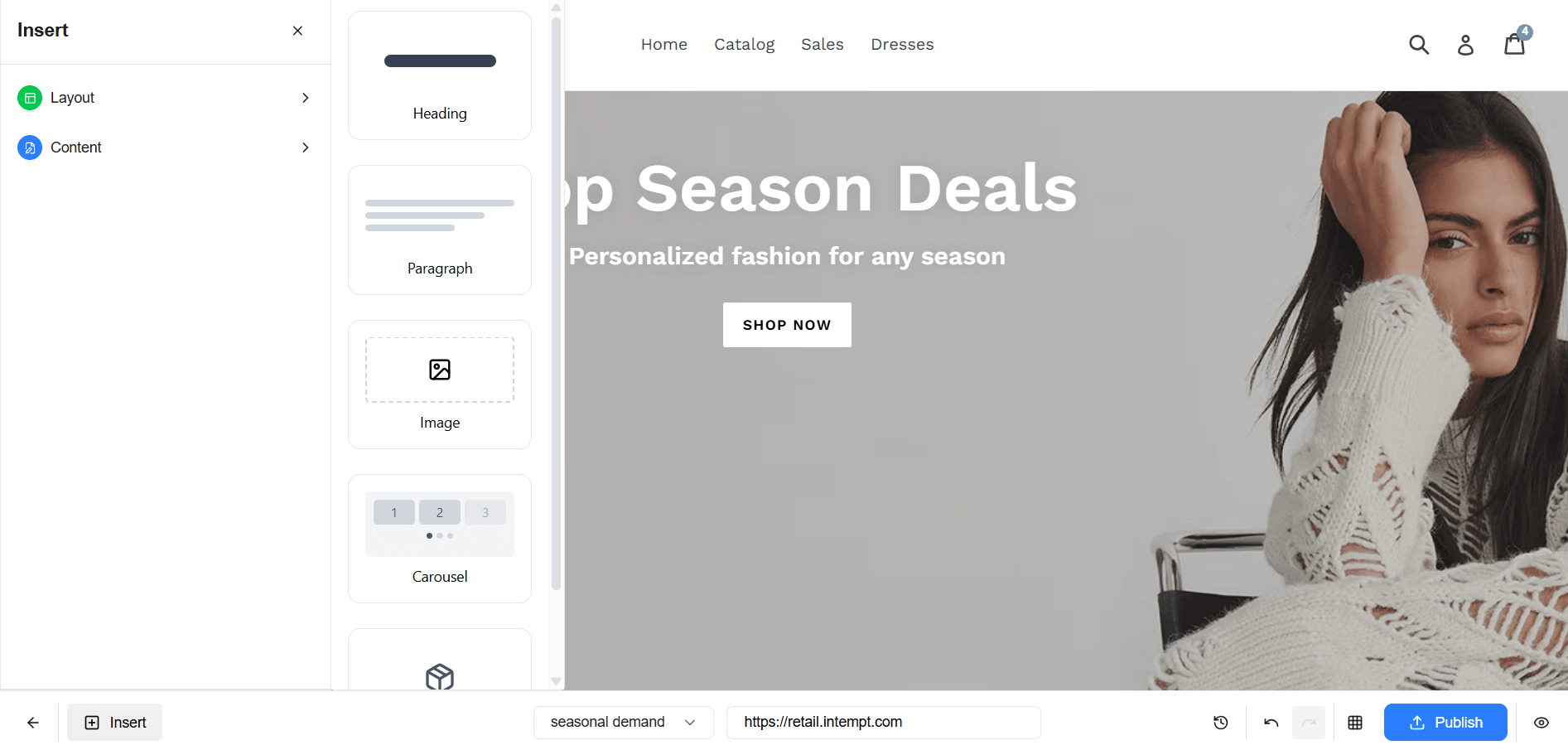
Go to Experiences, then Create Experience, then Web. This is where you define what each segment actually sees, with no engineering required.
Here's what to configure per scenario:
- General cart recovery: Trigger a three-email sequence one hour after add_to_cart fires without a purchase_completed. Email 1: product image, direct cart link, urgency copy. Email 2 at 24 hours: reviews and social proof. Email 3 at 72 hours: numeric discount or free shipping offer. Primary metric: purchase_completed within seven days.
- Checkout abandonment: Show a return-visit banner ("You were this close. Your cart is still waiting.") and trigger an email linking directly to the exact checkout step where they stopped. If payment_failed fired, surface alternative payment options. Primary metric: purchase_completed.
- Exit-intent popup: Trigger when session signals pre-leave behavior. Show a numeric offer: "Complete your purchase and save $[X]." Display once per session. Primary metric: purchase_completed within 30 minutes.
- High-value recovery: For cart values above $150, lead with urgency ("Only 3 left in stock") instead of a discount. If they don't convert, introduce a time-limited offer in email 2 at 24 hours. Set a 10% control group to measure urgency-first against leading with a discount.
- Repeat abandoners: For shoppers who have abandoned two or more times, skip the reminder. Ask instead: "What's stopping you?" Link to a one-click micro-survey, then follow up with a message addressing their specific concern.
Assign a 50/50 traffic split for each test. Set experiment duration based on calculated sample size before launch. Do not change it after the test starts.
Step 4: Define your success metric.
This is the step that separates recovery programs that actually work from ones that just look like they work. Clicks on a recovery email are not a success metric. Completed purchases within seven days are.
Intempt's native revenue tracking through Shopify and Stripe means you can tie each variant directly to recovered order value without stitching together separate reports. You see exactly how much revenue each flow is generating, not just whether someone opened an email.
Set your primary metric to purchase_completed. Set a conversion window of seven days. Set 95% statistical significance as your threshold before declaring a winner.
If you're testing a discount variant, also set a secondary metric for average order value. A recovery flow that converts more people while reducing their cart size by 20% through heavy discounting may not be the actual winner when you run the revenue math.
Step 5: Launch and monitor without peeking.
Click Start. Intempt serves each variant in real time with no lag on the customer experience. Then step away from the dashboard.
Do not check results daily. Do not make decisions based on the first 48 hours of data. Early signals are noise. The platform flags when your experiment reaches 95% statistical significance, so you're not making calls based on whatever happened to spike on a Tuesday.
If you stop a test early because one variant looks like it's winning, you're shipping a false positive, not a winner. Wait for significance. Then ship.
Step 6: Analyze, segment, and iterate.
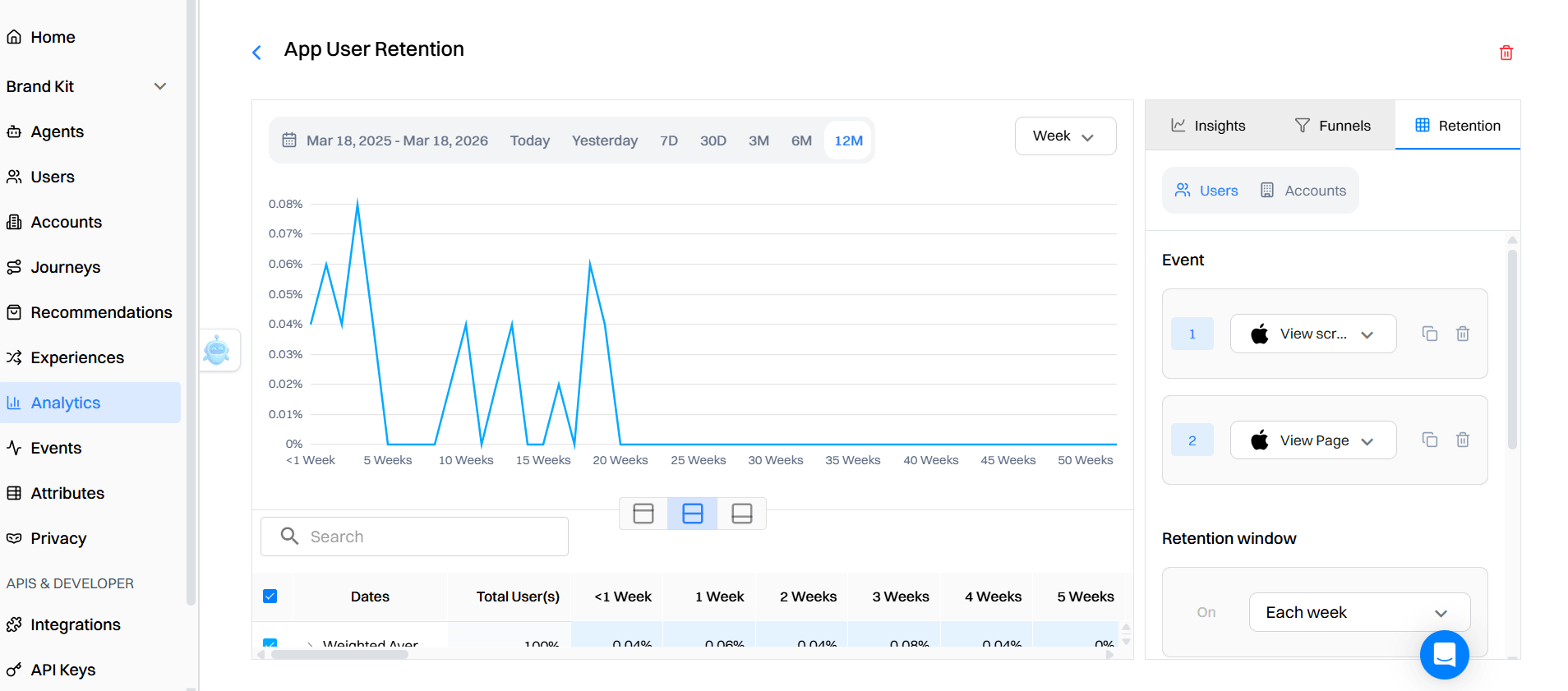
Once your experiment reaches significance, go to the analytics view. Track performance across all active variants:
- Unique views: how many shoppers saw each variant
- Conversion rate: percentage who completed a purchase
- Conversion value: total revenue recovered per variant, pulled directly from the purchase_completed event amount property via Shopify or Stripe
- Lift: how much the variant outperformed the control
For e-commerce specifically, go beyond top-line conversion rate:
- Recovery rate by channel: Did the email variant or the SMS variant drive more completed purchases? Did combining both perform better than either alone?
- Average order value by variant: Did the discount variant recover more people but reduce cart size? If so, the "winning" variant may actually be losing on revenue.
- Time to conversion by variant: How long after the recovery touchpoint did the purchase happen? A fast conversion (under one hour) signals urgency worked. A five-day lag suggests the shopper was returning anyway and your recovery flow just happened to be visible.
- 30-day repeat purchase rate: Are shoppers recovered through your high-value flow coming back to buy again? That's the sign the experience was good, not just the discount.
Compare daily versus cumulative conversion in the chart to identify whether performance is improving, plateauing, or declining over time. That's your signal to iterate, extend the test, or move on to the next experiment.
What Is the Tradeoff of Building a Full Recovery Stack?
Building a proper recovery stack (email sequences and SMS messages, retargeting, on-site personalization, exit-intent) takes more upfront setup than plugging in one tool. It requires real segmentation, not one message for everyone. But programs that do this recover 25 to 30% of abandoned carts. The ones that don't recover 10 to 15% at best, and most stores are actually sitting closer to 5 to 8%.
If you're starting today: connect your event tracking, build your abandonment segments, and set up a three-email sequence with proper timing. That alone will outperform what most stores currently have. Then layer in SMS for opted-in customers and exit-intent popups for new visitors. Run experiments on each, measure by completed purchases, and iterate from there. Once a recovered cart turns into an order, a post-purchase email sequence is what gives that buyer a reason to come back.
Where Can I Read More on Ecommerce Recovery?
- Real-time personalization tools for ecommerce: ten platforms compared on segmentation, recommendations, and 2026 pricing, for stores picking the tool behind on-site recovery.
- Intempt vs Clerk.io: a storefront recommendation engine against a full lifecycle platform, and what each costs as you grow.
- How to use Shopify Flow AI: what Sidekick can automate for store operations, and why customer-facing recovery journeys sit outside it.