
- The real cost of staying on Mailchimp isn't the monthly bill. It's the campaigns you can't personalize and the churn you don't see coming.
- Seven alternatives, each with a free tier. [Intempt for behavior-triggered journeys](/blog/intempt-vs-klaviyo) on a unified CDP. Klaviyo for Shopify. Brevo for per-email pricing. Braze for enterprise. ActiveCampaign for deep automation. Omnisend for ecommerce multi-channel. MailerLite for creators.
- Pick by object your motion runs on: list, product event, or unified profile.
Intempt is the best Mailchimp alternative for SaaS, ecommerce and mobile app teams, and it is free to start. It replaces broadcast email with behavior-triggered journeys, real-time segments and revenue analytics on one customer profile.
This guide compares 7 Mailchimp alternatives: Intempt, Klaviyo, Brevo, Braze, ActiveCampaign, Omnisend and MailerLite. Intempt suits teams that want email, journeys and analytics together. Klaviyo and Omnisend focus on ecommerce messaging. For a side-by-side view, see the Mailchimp alternative comparison, the marketing solution and pricing.
For a long time, "just use Mailchimp" was the smartest advice anyone could give a new business. Simple, affordable, and good enough to get real results without a learning curve.
"Good enough" is exactly where it gets complicated.
People look for the Best Mailchimp Alternatives 2026 for all kinds of reasons. Maybe your list has grown, and the per-contact pricing is starting to sting. Maybe the automation builder feels like it's holding back what your email campaigns could actually do.
Or maybe you need something more specialized. It could be a tool built for e-commerce. Or it may offer deeper behavioral triggers and lifecycle marketing. We build these features in; we don't bolt them on.
The good news is that the alternatives market has never been stronger. Intempt, Klaviyo, Brevo, and the other tools in this guide cover every use case Mailchimp doesn't. Here are the 7 Best Mailchimp Alternatives in 2026, broken down by what you're actually looking for.
For the full marketing automation category comparison across every GTM tool in 2026, see Best Marketing Automation Tools for GTM Teams.
Who This Is For?
This guide is written for B2B SaaS, E-commerce founders, and early-stage marketing teams who need email that responds to what users actually do, not just when a schedule fires. If you need Stripe-triggered sends, revenue analytics, or product-event segmentation, you're in the right place. If you just need newsletters and simple drips, Mailchimp may still work for you. The reason is capability, not pricing. If any of these sound familiar, you're in the right place:
- You need emails to send when a customer pays on Stripe.
- Send emails when they hit a usage milestone.
- Send emails when they go quiet for 14 days.
- Do not send them on a fixed schedule.
- You want to see which customer segments are generating the most revenue, not just who opened what.
- You're running a PLG motion and need your marketing stack to talk to your product data in real time.
Who Should Consider Alternatives? (Why Switch)
Mailchimp works well until it doesn't, and the break usually happens around list growth, automation limits, or pricing. The free plan was cut to 250 contacts in 2025, multi-step automation requires $100/month, and every inactive contact still counts toward your bill. If any of those have hit you, you've already hit the ceiling.
Mailchimp is a serious email marketing platform. It has a polished campaign builder, audience segmentation, behavioral targeting, multivariate testing, and send-time optimization. Millions of businesses use it every day and never need anything else. The reason teams move isn't because Mailchimp is weak. Their specific needs now fall outside what a general-purpose email tool can do well.
Here's what specifically pushes teams over the edge:
- You're paying for contacts you can't email. Mailchimp charges you for unsubscribed, bounced, and inactive contacts. Every one of them counts toward your billing limit. At 10,000 contacts on Standard, you're paying $135/month, whether those people open your emails or not.
- The free plan is no longer a real option. Mailchimp cut its free tier from 2,500 contacts to 250 in 2025. It also removed all automation workflows from free accounts on June 1, 2025. This included existing workflows that were already running. If you're a new business or early-stage startup, 250 contacts isn't a free plan. A trial barely lasts a week.
- The automation builder hasn't kept up. The Standard plan locks multi-step automation workflows and starts at $100/month for 5,000 contacts. For context, MailerLite includes automation on its free plan. ActiveCampaign offers the most powerful automation sequences in its class for $19/month.
- They have already confirmed another price hike. Mailchimp has raised prices in 2022, 2023, and now in April 2026, with an 11-13% increase for legacy plan holders. This isn't a one-time adjustment.
- Customer support disappears unless you pay. Free users get zero live support. Even on paid plans, response times are a recurring complaint on Trustpilot and Reddit. If a campaign breaks during a peak period, you're on your own.
Why SaaS Teams Specifically Leave Mailchimp
Mailchimp's limitations for SaaS aren't cosmetic; they're structural. It was built for broadcast email to static lists, not for product-led growth motions where every message should respond to what a user just did. The 4 gaps below are the ones Intempt's customers cite most when they switch:
- Mailchimp can't trigger emails based on Stripe payment events. When a user pays, upgrades, or churns, nothing fires automatically. You're either doing it manually, or it's not happening at all.
- No way exists to connect website activity to product activity. You can't see that a user visited your pricing page three times and then went quiet, and you definitely can't act on it automatically.
- Revenue analytics don't exist. You can see opens and clicks. But you cannot see which campaigns drive real revenue. You also cannot see which customer segments bring the most value.
- The automation builder treats every user the same. Your product has no behavioral branching based on what someone actually does inside it. Everyone gets the same sequence, regardless of where they are or what they've done.
Evaluation Criteria
Not every Mailchimp alternative is built the same way; some excel at ecommerce automation, others at B2B lifecycle marketing, or raw pricing efficiency. These five criteria help you cut through the feature checklists and find the platform that actually fits your motion. Run every tool on this list through them before you commit.
Here's what actually matters when comparing Mailchimp competitors. Use this before you make a call.
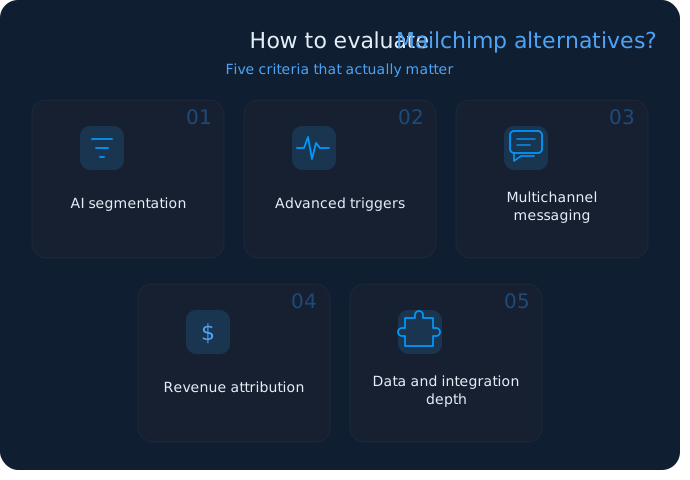
- AI Segmentation: Static lists and manual segments don't reflect how customers behave in real time. The standard is automatic segmentation that updates as behavior changes. It should also include AI predictions for churn risk, conversion likelihood, and next best action. Tools that still require CSV exports or SQL to build a segment are a step backwards.
- Advanced Triggers: Sending a campaign on a schedule is the floor, not the ceiling. The real question is whether the tool can send a message as soon as a specific action happens. A user may hit a usage milestone, abandon a cart, go quiet for 14 days, or finish an onboarding step. If a tool limits triggers to "opened email" or "clicked link," you don't have an advanced tool.
- Multichannel Messaging: Your customers are not only in their inboxes. Evaluate if the platform can manage email, SMS, push alerts, and in-app messages in one workflow. Avoid separate tools that are stitched together. Disconnected channels mean disconnected data, inconsistent timing, and more tools to manage.
- Revenue Attribution: Clicks and opens tell you nothing about whether a campaign made money. Look for platforms that tie every flow, automation, and campaign directly to revenue generated, down to the dollar. For e-commerce, this is non-negotiable. For SaaS, the equivalent is tying lifecycle campaigns to activation, expansion, and retention outcomes.
- Data and Integration Depth: An email tool is only as smart as the data it can see. Evaluate how deeply a platform connects to your existing stack: Shopify, Stripe, HubSpot, and your product database. Tools that work only with their own native data quickly hit a ceiling for teams with any real complexity in their customer base.
Comparison Table
| Tool | Best For | Key Strength | Starting Price |
|---|---|---|---|
| Intempt | B2B SaaS founders who need behavioral triggers on Stripe and product events, revenue analytics, and a full GTM motion in one platform, without the complexity of enterprise tools | Behavior-triggered journeys across email, SMS, push, and in-app, built on a unified CDP with real-time audience segmentation | Free to start |
| Klaviyo | E-commerce brands needing purchase-behavior-driven automation | E-commerce segmentation and revenue attribution | $45/month |
| Brevo | High-volume senders with large contact lists who want email-volume pricing | Charges per email sent, not per contact; stores unlimited contacts | $8.08/month |
| Braze | Mid-market and enterprise consumer apps needing real-time cross-channel engagement at scale | Real-time behavioral triggers across email, push, SMS, in-app, and content cards with deep personalization via Connected Content | Custom (Enterprise) |
| ActiveCampaign | B2B and service businesses needing deep CRM-linked automation | Most powerful visual automation builder in the category | $19/month (1,000 contacts) |
| Omnisend | E-commerce brands wanting email, SMS, and push notifications in one tool without enterprise complexity | All three channels included on every plan, including free; pre-built ecommerce flows activate in under an hour | $11.20/month (500 contacts) |
| MailerLite | Creators, bloggers, and small businesses prioritizing simplicity and value | Easiest-to-use interface in the category; automation included on the free plan | $9/month (unlimited contacts) |
The table above covers the full picture at a glance. For SaaS teams, Intempt is the clearest fit. For e-commerce, Klaviyo and Omnisend lead. For large-list pricing efficiency, Brevo wins. Scroll down for the full breakdown on each.
1. Intempt
Free to start. 75 bonus AI credits at sign-up plus weekly AI credits on the free plan. Rated 4.5 on G2. Start free with Intempt.
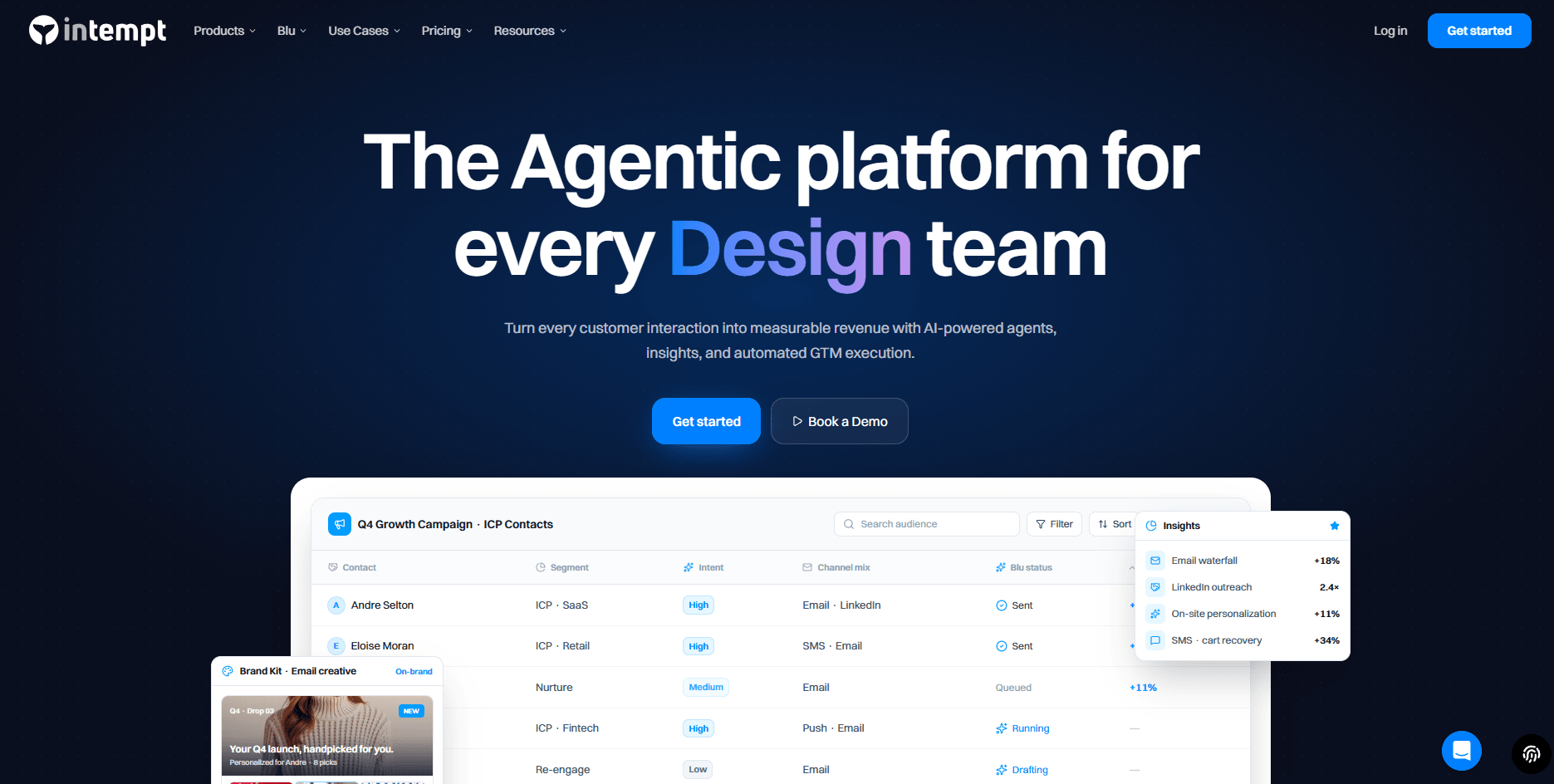
Intempt is the only platform on this list that combines a CDP, journey orchestration, A/B experimentation, and revenue analytics in one place, free to start, with paid plans priced per seat. It connects Stripe data, product events, and website behavior into a single live profile per user, and triggers the right message across email, SMS, push, and in-app from one workflow.
It builds a living profile of each customer from every touchpoint: what they browse, buy, click, ignore, and abandon. Growth-stage SaaS and ecommerce teams can use it on a per-seat plan, and it scales with their growth. It helps marketing respond to what customers do.
What You Get
- Real-Time Behavior-Triggered Journeys: Intempt sends messages as soon as a customer acts. They may abandon a cart, hit a usage milestone, go quiet for 14 days, or finish an onboarding step. Journeys run across email, SMS, and push notifications, and Slack from one workflow.
- Dynamic Audience Segmentation: Segments update in real time as user behavior changes. When a customer's lifecycle stage shifts, they move to the right audience automatically, with no manual work.
- Personalized Experiments: Run full A/B experiments on your website and app in real time. Test different banners, CTAs, product recommendations, and page layouts. Tailor each version to specific audience segments. Manage it all in the same campaign workflow. Uses CUPED methodology for faster, statistically reliable results.
- Unified Customer Data Platform: Intempt ingests data from your website, iOS and Android apps, Stripe, Shopify, and HubSpot. It merges the data into one profile using identity resolution. One person connects every email, purchase, page view, and support ticket.
- Lifecycle Agent: Scores each user by recent activity, visit frequency, and spending. This helps you find who needs a win-back campaign, who is ready to upgrade, and who you may lose soon.
- Blu (the agent layer): Builds models that predict churn risk, conversion chance, and the next best action. It runs on live customer data. No SQL, no data team required.
- Revenue Attribution: Links each journey, campaign, and experiment to revenue. This shows which sequences drive sales for your SaaS or e-commerce store. It focuses on sales results, not just engagement.
Who Should Use It
Intempt fits SaaS companies and ecommerce brands with 1,000 or more monthly active users. It helps you move beyond batch-and-blast emails. Use behavioral triggers and data-driven lifecycle marketing.
It works well for teams paying for a separate CDP, email tool, and A/B testing platform, and who want to consolidate. Teams spending more than $300/month across disconnected point solutions will often find Intempt cheaper and significantly more coherent.
Both SaaS teams track activation and churn signals. E-commerce stores track purchase and browsing behavior. Both groups find strong use cases here.
What to Watch For
The Journeys feature is an add-on to the base plan, so factor that into your total cost when comparing. If you're consolidating a CDP, email tool, and A/B testing platform into one, the total spend still works out favorably for most teams.
Intempt is not the right pick if you just need to send weekly newsletters or simple drip sequences to a static contact list.
Pricing
Free plan includes every product in basic mode, rule-based segments, simple A/B tests, HubSpot and Shopify read access, weekly AI credits (see intempt.com/pricing), and 75 bonus credits on signup. Limits: up to 1M events a month, 10K emails a month, up to 3 seats and 1 project. No credit card required.
Professional plan, priced per seat. Includes advanced AI with scored segments and RFM, custom builders, own sending domain, no Intempt branding, HubSpot write access, Shopify App, server-side SDK, and AI workflow steps. Credits pool per seat.
Organization plan, priced per seat. Adds full multivariate experimentation with CUPED and holdout groups, predictive attributes, full funnel attribution, multi-store Shopify, approvals, shared libraries, and pooled credits across the team.
Enterprise plan, priced per seat. Current prices for all three are on our pricing page. Adds SSO, SCIM, multi-org support, white-label, fine-tuned Blu, private RAG, dedicated CSM, and dedicated IP pool. Custom credit allocations and custom contracts available.
2. Klaviyo
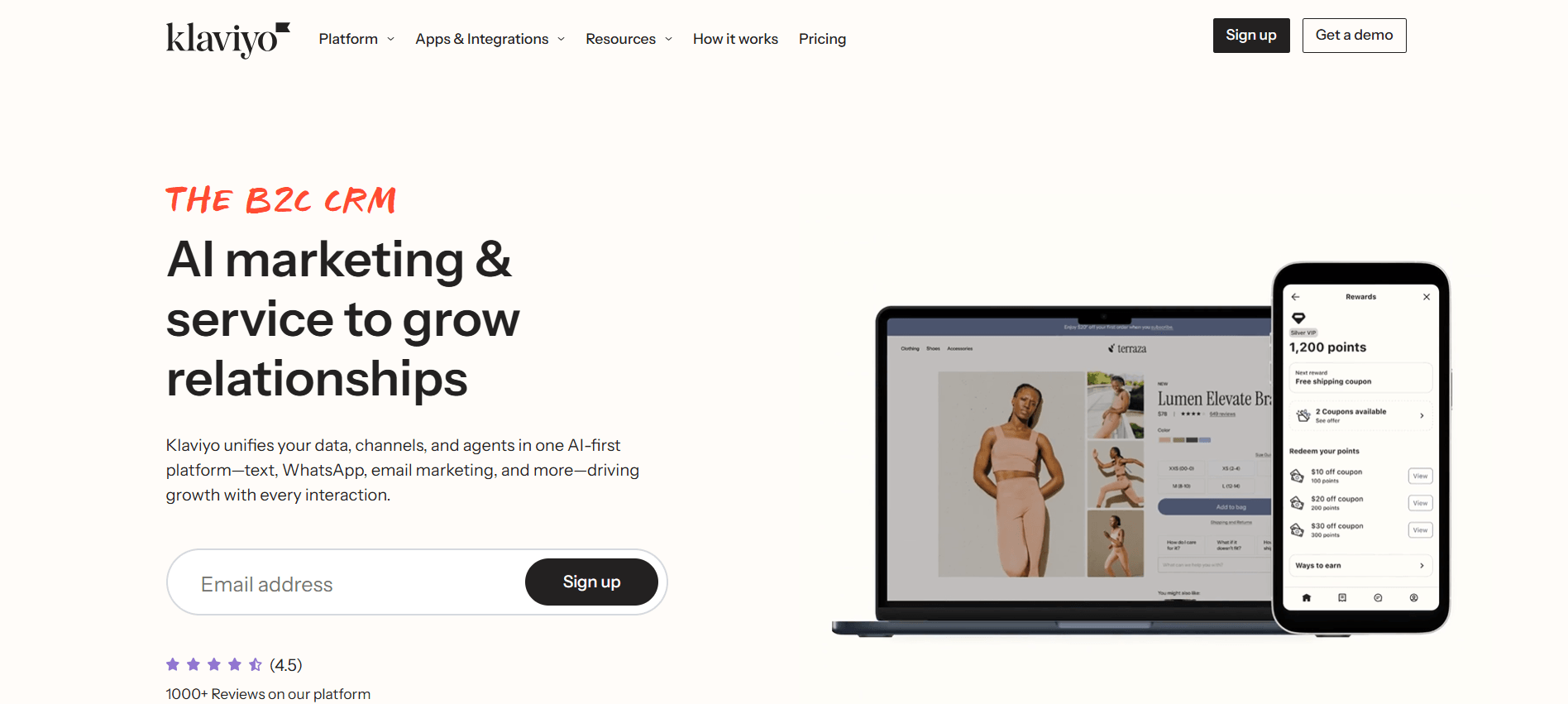
Klaviyo is the strongest Mailchimp alternative for Shopify and WooCommerce stores that need purchase-behavior automation tied directly to revenue. It centers on purchase behavior and deeply integrates with Shopify. The February 2025 billing change to active-profile pricing caught many teams off guard. If list hygiene isn't tight, costs climb fast. B2B and SaaS teams will find it a poor fit for their motion.
Over 150,000 brands use it, and it consistently tops the list of Mailchimp replacements among Shopify merchants.
Every flow, segment, and campaign links to the money it generated. It does not just track email opens.
For e-commerce brands that want clear proof of what drives revenue, Klaviyo's revenue attribution reports show real numbers, not guesses. Its purchase behavior segmentation is truly best in class.
The tight Shopify sync alone is worth the switch for DTC brands running abandoned cart and post-purchase flows.
What You Get
- Purchase-Behavior Segmentation: Segment by order history, product categories, predicted CLV, churn risk, and next purchase date. Segments update in real time as purchase data syncs from Shopify, WooCommerce, or BigCommerce.
- Pre-Built Ecommerce Flows: Abandoned cart, post-purchase upsell, browse abandonment, welcome series, and win-back flows are ready to activate from day one. Each is revenue-attributed at launch.
- Predictive Analytics: Calculates predicted CLV, churn probability, and next purchase date for every contact. You can segment directly by these predictions without any data team involvement.
- SMS and MMS Marketing: Send SMS alongside email campaigns from the same platform. The Email + SMS plan adds $15/month to the email-only rate at each tier, with 1,250 SMS/MMS credits included at base.
- A/B Testing on Flows: Test subject lines, content, send times, and entire flow branches, not just single campaigns.
Who Should Use It
Klaviyo is the go-to choice for ecommerce brands generating $250,000 or more in annual revenue that are deeply invested in Shopify or WooCommerce and need purchase-behavior-driven automation.
Particularly strong for DTC brands where small improvements in abandoned cart recovery or repeat purchase rates directly move revenue. B2B SaaS teams or service businesses rarely find the ecommerce-first feature set a good match for their use case.
What to Watch For
Klaviyo changed its billing model in February 2025. It moved from email-volume-based billing to active-profile-based billing. Every subscribed contact counts toward your tier. This applies even if they did not open your last 20 emails.
If you have a large list with lapsed subscribers, this change likely hit your bill hard. List hygiene has become more critical than it ever was.
Pricing
Free plan includes 250 active profiles, 500 emails/month, and 150 SMS/MMS credits. Email-only plan from $45/month, scaling to $1,380/month at 100,000 profiles. Email + SMS plan from $35/month at the same tier, adding $15/month across all tiers with 1,250 SMS/MMS credits included. Plans auto-upgrade when the active profile count exceeds your tier limit.
3. Brevo
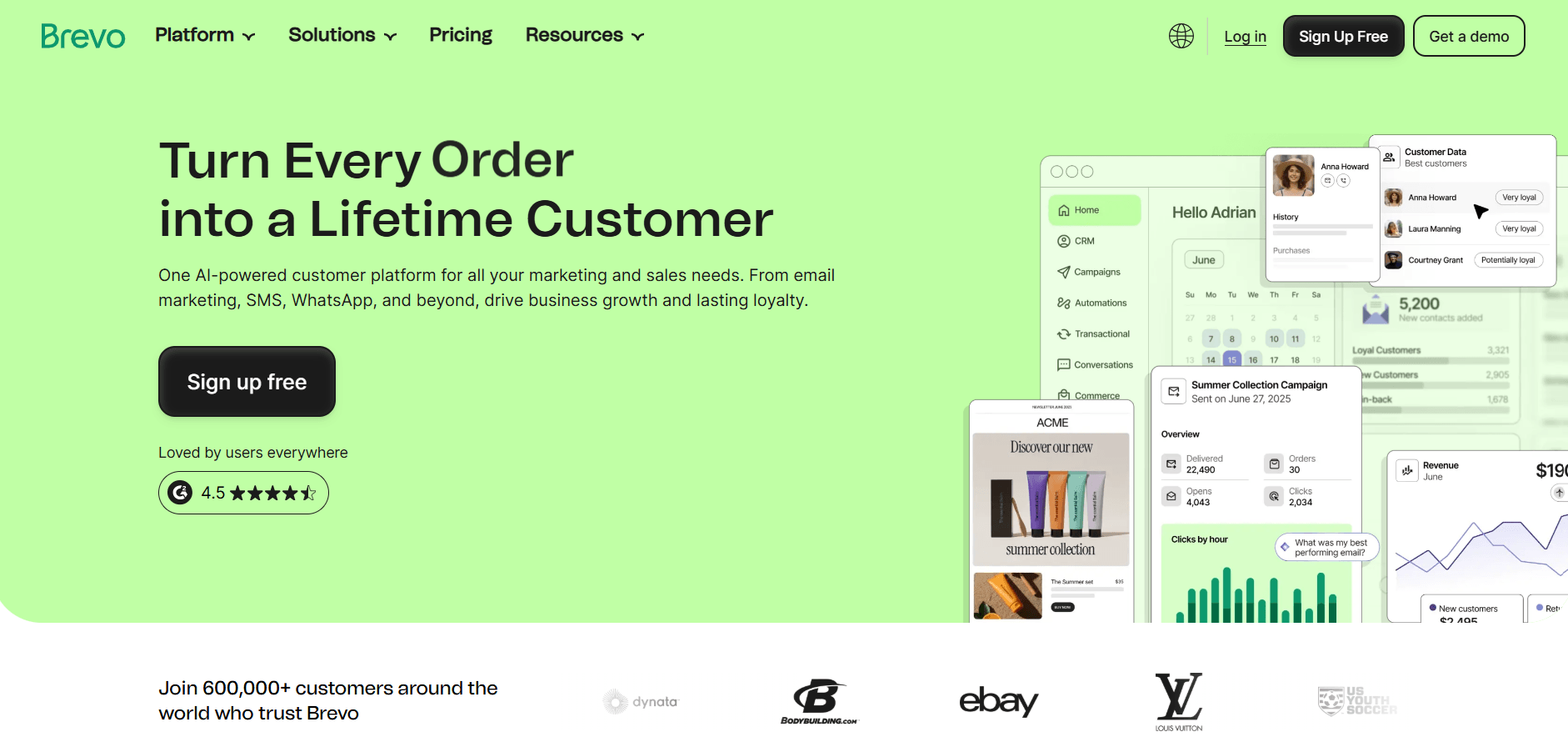
Brevo (formerly Sendinblue) is an email marketing and CRM platform. It charges based on how many emails you send each month, not how many contacts you store. That one pricing choice makes it a logical option for businesses with large, moderately active lists. Store 100,000 contacts on the free plan and pay only based on what you actually send.
Brevo is the only major platform on this list that charges by emails sent, not contacts stored, making it the most cost-effective option if you have a large list you don't email every week. Also one of the few tools that combines transactional and marketing emails in one platform, removing the need for a separate service like Postmark.
What You Get
- Email-Volume-Based Pricing: Store unlimited contacts on paid plans and pay for email sends, not contact storage. A list of 50,000 contacts with a weekly campaign to 5,000 people costs dramatically less than on contact-based platforms.
- Marketing Automation: Multi-step, behavior-triggered sequences available from the Standard plan ($16.17/month). Includes website event tracking, contact scoring, and dynamic flow branching.
- Transactional Email: Send order confirmations, password resets, and receipts from the same platform as your marketing email. No separate transactional service needed.
- A/B Testing and AI Send-Time Optimization: Test subject lines and content. AI picks the optimal send time for each individual contact. Both are available on Standard and above.
- Multi-Channel Campaigns: Email, SMS, WhatsApp (Professional plan), and web push notifications from one dashboard.
- Built-In CRM: A basic CRM is included at no extra cost. It works for small teams tracking deal stages and contact history without a separate tool.
Who Should Use It
Strong fit for small and mid-size businesses with large contact lists that don't email the full list every week. Equally useful for businesses that need transactional and marketing email under one roof. B2B companies with long sales cycles and big prospect lists often find Brevo's pricing much better than contact-based plans.
E-commerce teams doing high-frequency campaigns to their full list should compare total send costs carefully before committing.
What to Watch For
The free plan caps at 300 emails per day, not per month. A daily limit that makes it impossible to send a single campaign to even a small list all at once. The Starter plan removes the daily cap but keeps Brevo branding on emails unless you pay $10.80/month extra.
Automation is locked to Standard ($16.17/month minimum). Extra user seats cost $10.80/month each on Standard, and a dedicated IP runs $20.90/month.
Pricing
Free plan includes 300 emails/day (~9,000/month) and storage for 100,000 contacts, with Brevo branding required and no automation. Starter from $8.08/month (5,000 emails/month); branding removal costs $10.80/month extra.
Standard from $16.17/month, adding automation, A/B testing, and AI send-time optimization. Professional from $449.08/month, covering 150,000 emails/month, WhatsApp, push notifications, and 10 user seats. Annual billing available.
4. Braze
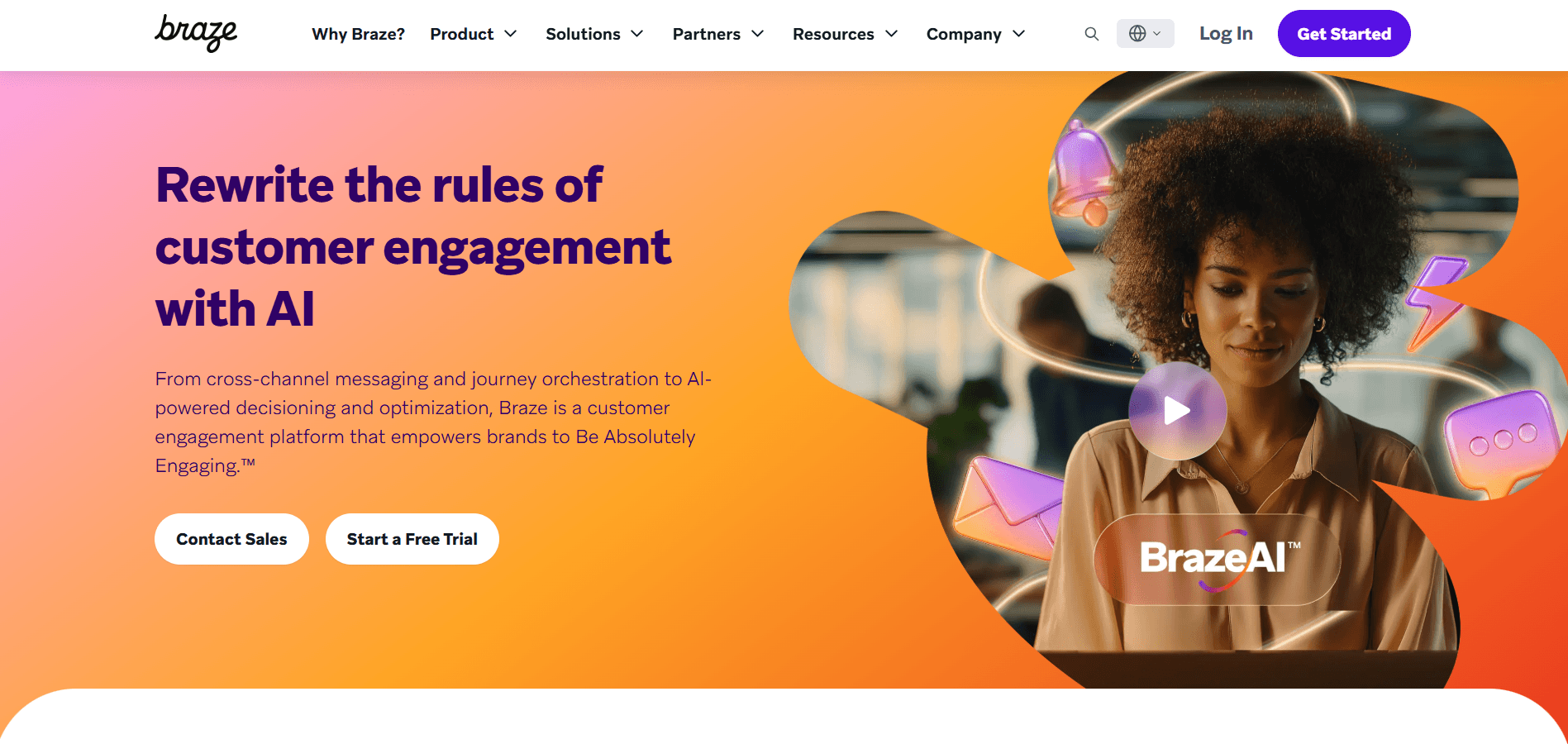
Braze is a customer engagement platform built for mid-market and enterprise teams that need real-time, cross-channel messaging at scale. Companies like HBO, Domino's, Headspace, and Grubhub use it, sending millions of messages each day across mobile, web, and email simultaneously. Braze is enterprise-only, with contracts typically starting at $30,000-$60,000/year and no self-serve option. It's the right call for mid-market and enterprise consumer apps running millions of cross-channel messages daily with dedicated engineering resources.
Where most email tools build automation on top of a contact list, Braze builds everything on top of a real-time event stream. Every user action, anywhere in your product, can trigger a message within seconds.
What You Get
- Canvas Flow: A visual, multi-channel journey builder. It runs email, push, SMS, in-app messages, content cards, and WhatsApp in one workflow. Branches, delays, audience splits, and A/B experiment steps are all native to the builder.
- Real-Time Behavioral Triggers: Send messages right when a user acts in your app or website. This includes completing a purchase, reaching a usage milestone, or abandoning a session mid-flow. No batch processing or delay.
- Connected Content: Pull live data from any external API directly into an email or push notification at send time. Real-time product prices, personalized recommendations, live inventory, and loyalty balances in every message without pre-rendering.
- Liquid Templating: Deep personalization using Liquid syntax. Conditional content, dynamic attribute insertion, and computed values integrate directly into message content at scale.
- Braze Data Platform: Ingests first-party behavioral and profile data from web, iOS, Android, and backend systems. Builds a real-time unified user profile from every touchpoint.
- Predictive Suite: ML-powered Predictive Churn and Predictive Events models trained on your data. Access them inside the campaign builder. No data science team needed.
- In-App and Content Card Messaging: Use full-screen, modal, and slide-up in-app messages. Use persistent content cards in your app's feed or inbox. Coordinate them with email and push from the same Canvas.
Who Should Use It
Right fit for mid-market and enterprise consumer apps, media companies, fintech platforms, and large ecommerce brands. It works best for teams with dedicated engineering and marketing operations. Particularly strong for mobile-first businesses where push, in-app, and email need to work together in real time. Not suitable for teams without technical implementation resources, a defined onboarding engagement, or budgets below the enterprise tier.
What to Watch For
Braze has no self-serve pricing and no free plan. Getting started needs a sales call and a scoped implementation project. It usually takes a few weeks before your first campaign goes live.
The platform is powerful but complex. Teams without a marketing engineer or technical CRM manager will face a steep learning curve. Built for scale, not for speed of setup.
Pricing
As of May 2026: Custom, enterprise-only pricing. No public rate card. Typical contracts start at $30,000 to $60,000 per year. Costs vary by MAU, channels, and message volume. Larger enterprise deployments cost significantly more. A 30-day free trial is available via Braze's website for evaluation before committing to a contract.
5. ActiveCampaign
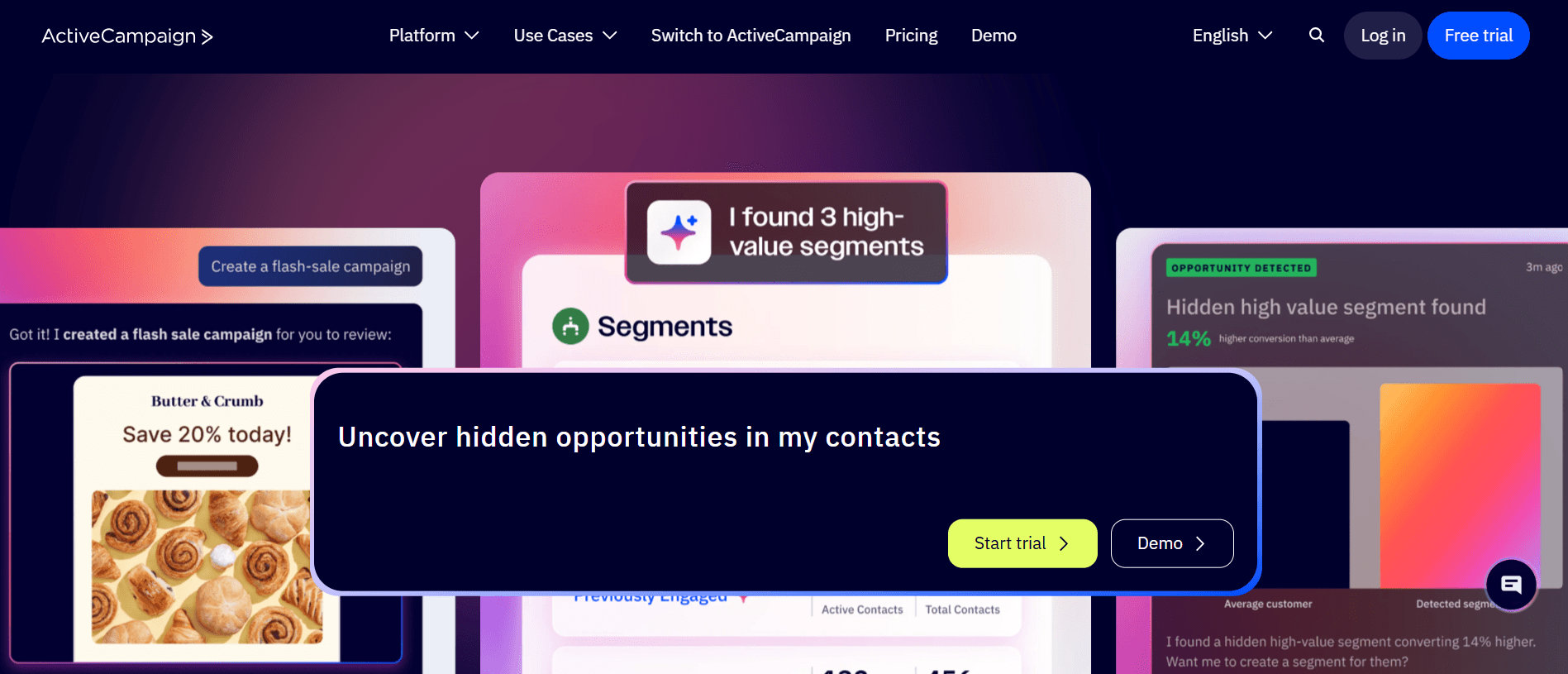
ActiveCampaign has the deepest visual automation builder in the category, starting at $19/month, and it's the clearest upgrade if complex nurture sequences and CRM-linked workflows are your primary need. There's no free plan, and as of November 2025, all contacts including unsubscribed count toward billing. At scale, costs add up quickly once you factor in the CRM add-on.
ActiveCampaign is an email marketing and CRM platform that built its entire reputation on automation depth. It consistently tops third-party automation rankings, and it earns that reputation. Where most email tools treat automation as a feature, ActiveCampaign built its automation builder as the main product.
For B2B teams with long sales cycles and many marketing and sales handoffs, this platform is hard to match. It combines a visual automation builder, lead scoring, and CRM-linked workflows at the same price.
What You Get
- Visual Automation Builder: Multi-step, branching automation sequences with unlimited triggers and actions on Plus plans and above. Conditional logic, goal tracking, and wait conditions are all standard.
- Behavioral Triggers: Trigger automations based on website page visits, email opens and clicks, form submissions, e-commerce purchases, and custom API events.
- Contact Scoring: Assign points to each action. Track email opens, page visits, product views, and form submissions. This helps surface your highest-intent leads for the sales team.
- Conditional Email Content: You can swap content blocks in one email based on the recipient's location, lifecycle stage, or purchase history. One email, many versions.
- Attribution Tracking: See which campaigns and sequences are actually driving conversions, not just opens and clicks. Available on Pro and Enterprise plans.
Who Should Use It
Clearest upgrade for B2B SaaS companies and service firms that need advanced nurture sequences, lead scoring, and CRM automation.
Especially strong for teams with sales cycles longer than two weeks. It works well when multiple touchpoints and handoffs between marketing and sales are standard.
E-commerce teams with complex purchase-behavior automation needs will find Klaviyo more purpose-built for their use case.
What to Watch For
No free plan. The 14-day trial gives full access, but you're paying from day one after that. The company sells the CRM as a paid add-on, which feels surprising because it doesn't bundle basic deal tracking in. As of November 2025, ActiveCampaign now charges for all contacts, including unsubscribed and bounced.
At 5,000 contacts on Pro, you're at $259/month. Add CRM Pipelines and SMS, and you're easily above $350/month.
Pricing
No free plan (14-day free trial available). Starter from $19/month at 1,000 contacts (monthly) or $15/month on annual billing. Plus from $59/month ($49/month annual). Pro from $99/month ($79/month annual, 3 users included). Enterprise from $179/month ($145/month annual, 5 users included). CRM Pipelines add-on costs $68/month. All contacts including unsubscribed count toward billing.
6. Omnisend
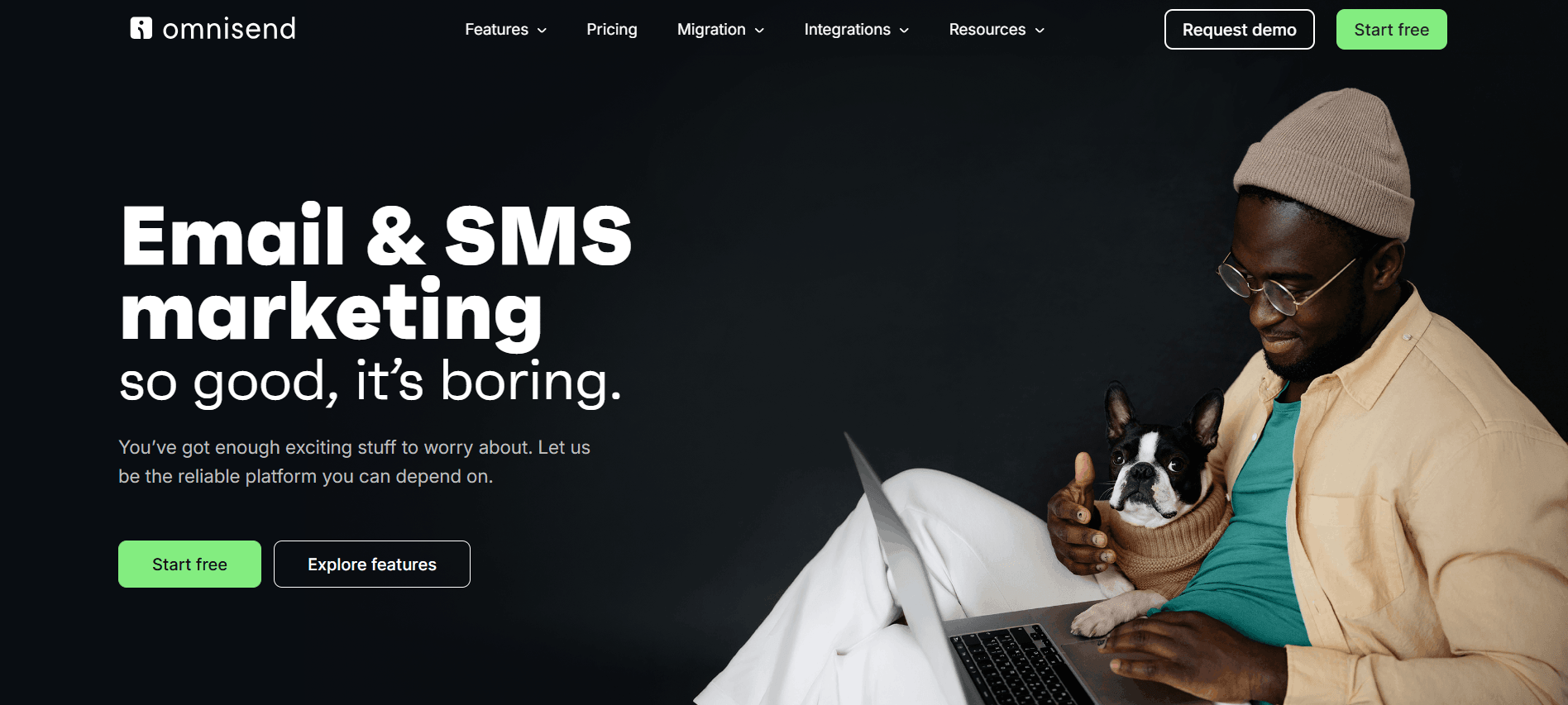
Omnisend is the fastest path to multi-channel ecommerce automation: email, SMS, and push all included on every plan, even free. Pre-built abandoned cart, post-purchase, and win-back flows activate in under an hour with native Shopify and WooCommerce sync. B2B and SaaS teams won't find a fit here; it's built exclusively for ecommerce.
Most email tools charge extra for SMS or reserve push notifications for higher tiers. Omnisend bundles all three from signup and includes pre-built ecommerce automation flows that take roughly an hour to activate.
What You Get
- Pre-Built Ecommerce Automations: Abandoned cart, product abandonment, welcome series, order confirmation, cross-sell, and win-back flows are all pre-built and ready to activate. Nothing to build from scratch.
- Email, SMS, and Web Push on Every Plan: All three channels available from the free tier. SMS credits are limited on free, but the channel access is there without an upgrade.
- E-commerce Segmentation: Segment by purchase history, average order value, product categories bought, campaign engagement, and lifecycle stage. Native integration with Shopify and WooCommerce.
- Product Recommender: Automatically insert product recommendations into emails based on each subscriber's browsing and purchase history, useful for post-purchase and win-back campaigns.
- Google Customer Match and Facebook Custom Audiences: Sync Omnisend segments directly to paid ad platforms to retarget email subscribers with matched ad campaigns across Google and Meta.
- A/B Testing: Test subject lines, content blocks, and send times across both campaigns and automated flows.
Who Should Use It
Right pick for ecommerce brands with 500 to 50,000 contacts that want a complete multi-channel setup without enterprise-level complexity or cost. Particularly strong for Shopify stores that want abandoned cart, post-purchase, and win-back sequences running fast.
At $16/month on Standard, it's noticeably cheaper than Klaviyo at equivalent contact counts. B2B and SaaS teams will find the ecommerce-first feature set too narrow for their needs.
What to Watch For
Non-subscriber contacts, such as website visitors who added to cart but never opted in, count toward your billable contact limit even though you can only send them transactional messages.
This can inflate billing significantly on high-traffic stores. Standard plan pricing scales to ~$289/month at 50,000 contacts, at which point Klaviyo's additional capabilities may start to justify the premium.
Pricing
Free plan includes 250 contacts, 500 emails/month, 60 one-time SMS credits, and 500 web push notifications with all Omnisend features included. Standard from $16/month (up to 500 contacts), scaling to ~$289/month at 50,000 contacts; includes email sends at 12x contact count per month.
Pro from $59/month with unlimited emails and monthly SMS credits equal to your plan cost in dollars. 30% discount available on the first 3 months when paying 3 months upfront.
7. MailerLite
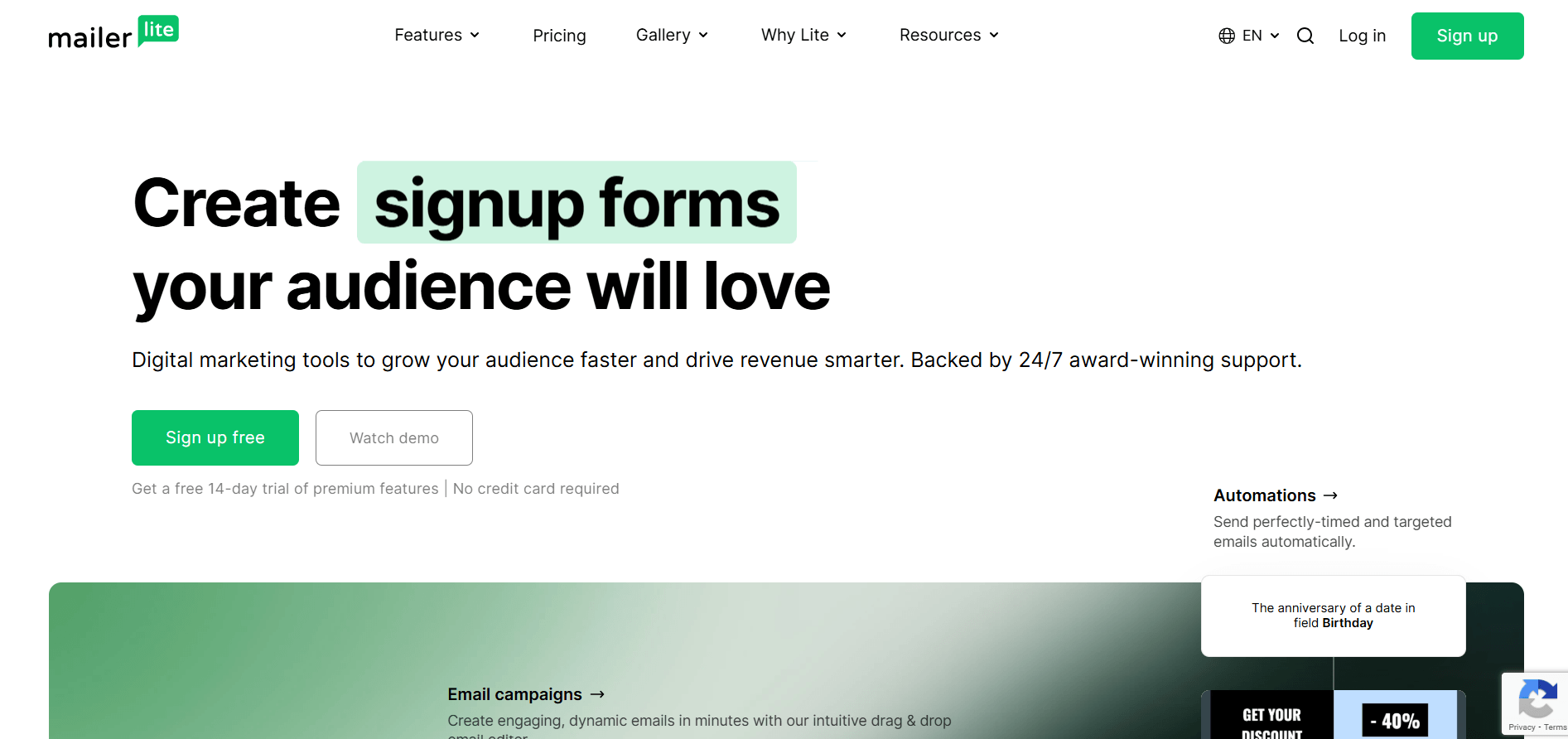
MailerLite is the simplest and cheapest platform on this list, with automation included on the free plan and unlimited contacts from $9/month. It earned G2's "Easiest to Use" award in 2025 and deserves it; you can go live in under 30 minutes. SaaS teams or ecommerce brands needing behavioral segmentation will hit their ceiling fast, but for creators and small businesses, it's a genuinely hard deal to beat.
Over 700,000 businesses use it, mostly creators, bloggers, nonprofits, and small service businesses that want reliable email without enterprise-level complexity or unpredictable pricing.
What You Get
- Intuitive Drag-and-Drop Editor: Clean email builder with a template library, click maps, and device preview. No design experience needed, and it stays out of your way.
- Automation on the Free Plan: Single-trigger automations with up to 100 steps included on the free plan. Real behavior-triggered sequences without paying anything.
- Landing Pages and Forms: Build landing pages, pop-up forms, and embedded subscribe forms. 10 landing pages on free, unlimited on paid plans.
- A/B Testing: Test subject lines, sender names, and content on Growing Business plans and above. Click maps on free and paid plans show where readers actually click inside your emails.
- Stripe Integration: Sell digital products and subscriptions directly through MailerLite landing pages, without a separate ecommerce platform.
- Campaign Auto-Resend: Automatically resend to non-openers with a different subject line after a set delay. Available on Growing Business and above.
- 24/7 Support: Email support on Growing Business ($9/month); live chat on Advanced ($18/month).
Who Should Use It
Ideal for creators, bloggers, coaches, nonprofits (30% discount available), and small service businesses that need simple, reliable email with solid automation at the lowest possible cost.
SaaS teams needing deep behavioral segmentation or ecommerce brands wanting purchase-triggered flows will find the feature depth too limited, but for everyone else running basic-to-intermediate email marketing, it's a hard deal to beat.
What to Watch For
MailerLite cut its free plan subscriber limit from 1,000 to 500 in September 2025. Many users were caught off guard. Sending was paused until they pruned lists or upgraded. Email templates from the library are not available on the free plan. Multi-trigger automations, dynamic content, and the AI writing assistant all require the Advanced plan at $18/month.
Pricing
Free plan includes 500 subscribers and 12,000 emails per month. It also includes single-trigger automations with up to 100 steps. You get 10 landing pages and 1 user seat.
Growing Business starts at $9/month for up to 500 subscribers, with unlimited contacts, unlimited emails, and 3 users; scales to about $73/month at 10,000 subscribers.
Advanced starts at $18/month for up to 500 subscribers. It includes unlimited users, an AI writing assistant, Facebook Custom Audiences, and multi-trigger automations. It scales to about $98/month for 10,000 subscribers. Annual billing offers approximately 10% discount.
Decision Cheatsheet
| If you... | Choose This |
|---|---|
| Want behavior-triggered lifecycle email, real-time audience segmentation, and cross-channel messaging (email, SMS, push) all built on a CDP, without stitching together separate tools | Intempt |
| Run a Shopify or WooCommerce store and want pre-built abandoned cart, post-purchase, and browse abandonment flows live within hours, with every email tied to the exact revenue generated | Klaviyo |
| Have a large contact list (50,000+) but only email a fraction each week, and want to avoid per-contact billing entirely | Brevo |
| Run a mid-market or enterprise consumer app and need real-time cross-channel messaging across email, push, SMS, and in-app with deep personalization at scale, and a dedicated technical team to implement it | Braze |
| Run a B2B SaaS company or professional service with a defined sales cycle needing CRM-linked multi-step automation and lead scoring | ActiveCampaign |
| Run a small to mid-size e-commerce store and want email, SMS, and push set up fast with pre-built templates and no CDP or data pipeline required | Omnisend |
| Are a creator, blogger, or small business team that wants the simplest, most affordable platform with real automation included | MailerLite |
Use the table above to match your use case before you start a trial. The most common mistake is choosing on price alone. The cheapest tool for your list size is rarely the right tool for your motion. Pick the platform that fits what your marketing needs to do, not just what it costs today.
Quick summary
Every platform on this list has a free tier or trial; the cost of testing is zero. The real cost is staying on a tool that's actively working against you while your competitors on better platforms pull ahead. Export your Mailchimp contacts; it takes under five minutes, and start where the ceiling is higher.
- Intempt (free to start; paid plans priced per seat): Best for SaaS and ecommerce teams that have outgrown broadcast email and want behavior-triggered journeys, real-time segmentation, and omni-channel messaging built on a unified CDP.
- Klaviyo (from $45/month): Best for Shopify and DTC ecommerce brands. Unmatched purchase-behavior segmentation and dollar-level revenue attribution.
- Brevo (from $8.08/month, generous free plan): Best if you have a large contact list but don't email it frequently. Charges per email sent, not per contact stored.
- Braze (custom enterprise pricing, 30-day trial): Best for mid-market and enterprise consumer apps needing real-time cross-channel messaging at scale. Requires dedicated technical resources and an enterprise budget.
- ActiveCampaign (from $19/month, no free plan): Best for B2B companies needing the most powerful automation builder in the category with CRM-linked workflows.
- Omnisend (from $11.20/month, free plan available): Best for ecommerce brands wanting email, SMS, and push all in one tool at a competitive price. Pre-built flows, Shopify sync, and all three channels included from day one.
- MailerLite (from $9/month, free up to 500 contacts): Best for creators and small businesses. Easiest to use, lowest cost, and automation workflows work on the free plan.
If you're a SaaS founder who's outgrown Mailchimp, Intempt connects your Stripe data, website activity, and product behavior in one place. Behavioral triggers, revenue analytics, and a full GTM motion, without the enterprise price tag or the 6-month implementation. Try Intempt free - sign up for the free plan, no trial timer. Get started →