


Intempt is the best OneSignal alternative for SaaS, ecommerce and mobile app teams, and it is free to start. It sends push, email, SMS and in-app messages from one journey builder on the same customer profile as your analytics, so you do not bolt separate tools onto push.
This guide compares 6 OneSignal alternatives: Intempt, Braze, Iterable, Customer.io, MoEngage and Klaviyo. Intempt suits teams that want messaging, a CDP and analytics together. Braze targets large consumer brands, Iterable focuses on multi-channel orchestration, and Customer.io focuses on event-triggered messaging. MoEngage is built for mobile-first consumer apps, and Klaviyo is built for Shopify and WooCommerce stores. See the OneSignal alternative comparison, Intempt's marketing solution, journeys and pricing.
Most teams don't realize they have a vendor sprawl problem until they're three tools deep, paying three invoices, and still can't send a coordinated message across push, email, and SMS without an engineer involved.
That's the ceiling you hit with OneSignal. It's genuinely great at push notifications. But the moment you want to add email, SMS, or in-app messaging, you're bolting on SendGrid, then Twilio, then something else to tie it all together.
For the full marketing automation category comparison across every GTM tool in 2026, see Best Marketing Automation Tools for GTM Teams.
Who Should Consider OneSignal Alternatives?
- You're managing multiple vendors for one job. OneSignal handles push. SendGrid handles email. Twilio handles SMS. That's three subscriptions, three vendor relationships, and three different support teams for what should be one unified marketing channel.
- Your invoices are fragmented. OneSignal ($400+/month), SendGrid ($100+/month), and Twilio ($200-600/month) easily run $700-1,100/month before you launch a single campaign.
- Your customer data is siloed. Push contacts in OneSignal, email subscribers in SendGrid, phone numbers in Twilio. No unified profile.
- Journey orchestration requires glue code. Building a cross-channel onboarding flow means stitching OneSignal, SendGrid, and Twilio together through Zapier or custom webhooks.
- Analytics don't cross channels. You see push click rates. You see email open rates. You never see which combination of channels drove an actual conversion.
Evaluation Criteria
| Criteria | Why It Matters | What 'Good' Looks Like |
|---|---|---|
| Multi-channel native integration | Running separate tools destroys the core problem: channel silos and fragmentation | AI orchestrates email, SMS, push, and in-app messaging from one place. No separate SendGrid or Twilio needed. |
| Pricing predictability | Usage-based billing creates invoice surprises. | Flat monthly rate based on users or contacts. AI keeps audiences clean and suppressed contacts out of your bill. |
| Unified AI-powered customer profiles | Data fragmentation defeats the purpose. | AI-powered identity resolution unifies email, phone, and push tokens into one profile automatically. |
| No-code journey building with AI | If every workflow needs a developer, you have not solved the consolidation problem | Visual drag-and-drop journey builder where AI handles complex logic. |
| Cross-channel AI analytics | Message-level metrics are not enough for growth teams. | AI surfaces funnel analysis, cohort retention, and revenue attribution across email, SMS, push, and in-app. |
Comparison Table
| Tool | Best For | Starting Price | Key Strength | Main Limitation |
|---|---|---|---|---|
| Intempt | Ecommerce, SaaS and mobile app teams that want CDP, experiments and analytics in one platform | Free up to 1M events/month, 10K emails, 1K SMS and 1K push; paid plans per seat | All-in-one: Intempt Data Hub, Journeys, email, push, AI-powered Experiment, and Analytics | SMS is a paid add-on; usage costs apply on top of seat pricing |
| Braze | Consumer brands needing sub-second real-time personalization across mobile, web, and email | Custom, contact sales | Real-time trigger latency and a personalization engine for large-scale mobile engagement | Enterprise-only pricing ($60K-$200K+/year) and complex implementation overhead |
| Iterable | Teams running complex multi-channel orchestration at scale | Custom, contact sales | Canvas Flow journey builder with advanced A/B testing and predictive send-time optimization | Custom pricing with no public rates; requires clean external data source |
| Customer.io | B2B SaaS teams with technical resources who need precise event-triggered messaging | $100/month (Essentials, 5,000 profiles) | API-first flexibility with granular event control and visual workflow builder | Liquid templating requires developer involvement for dynamic personalization |
| MoEngage | Mobile-first consumer apps in global markets where WhatsApp and push are critical channels | Custom, contact sales | AI-powered predictive segmentation and 25% push delivery optimization with WhatsApp as first-class channel | Advanced features gated behind higher tiers; weaker value for web-first products |
| Klaviyo | Shopify and WooCommerce stores running email, SMS, and push as primary revenue channels | Free (up to 250 contacts); $20/month (starting paid) | Shopify-native integration with eCommerce flow templates and simple billing | Contact-based pricing charges for suppressed/bounced contacts; scales expensive fast |
1. Intempt
Free to start. 75 bonus AI credits at sign-up plus weekly AI credits on the free plan. Rated 4.5 on G2. Start free with Intempt.
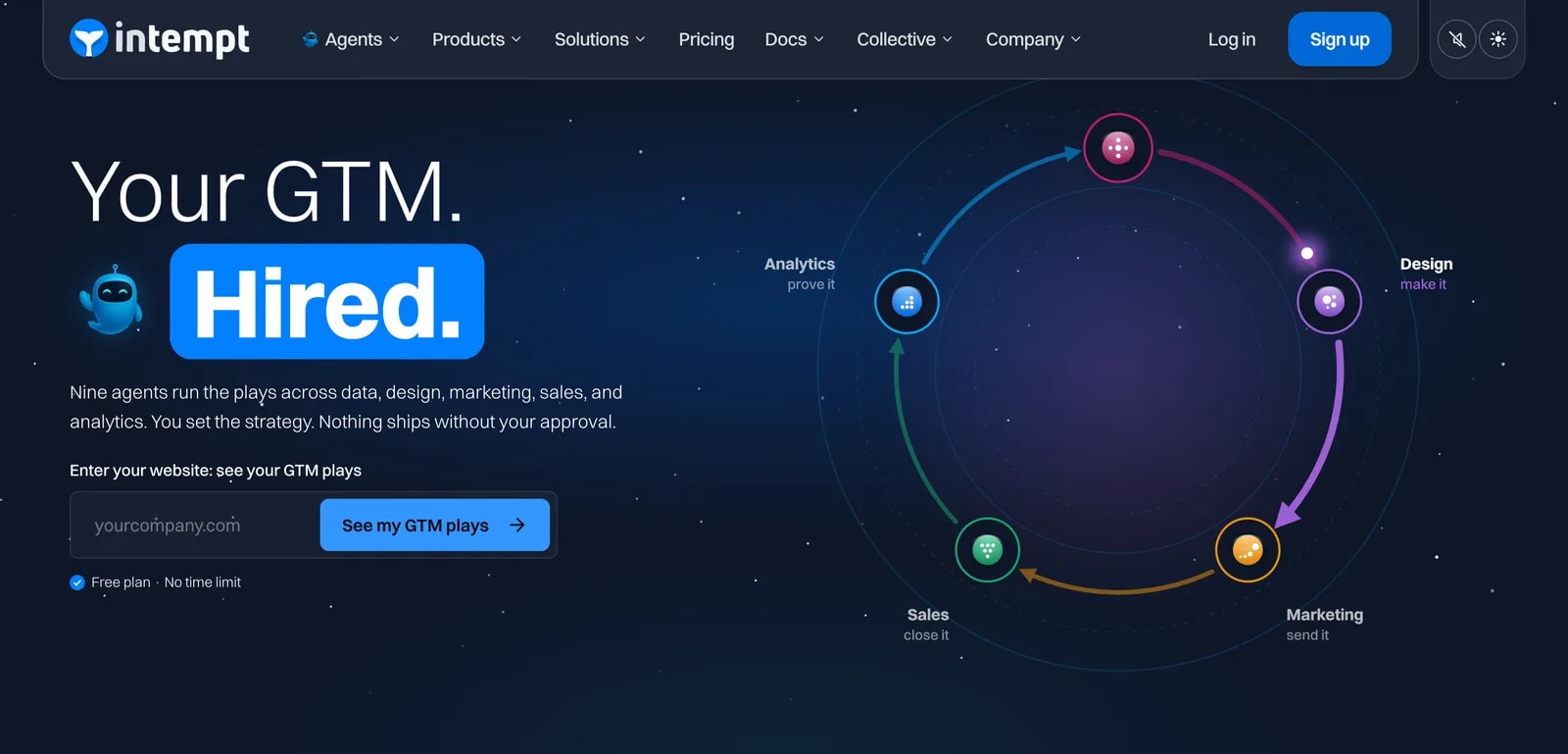
Intempt is the AI-native OneSignal alternative that replaces CDP, email marketing, personalization, experimentation, and analytics in one solution. It is free to start, with paid plans priced per seat (see pricing).
The structural advantage over OneSignal-plus-vendors is straightforward. Intempt consolidates everything into one unified platform. Customer profiles, journeys, analytics, AI-powered on-site personalization, and experimentation all live together. Intempt's Data Hub automatically resolves identities in real time and keeps audiences fresh as behavior changes.
What You Get
- Nine purpose-built AI agents: Handle journey building, audience segmentation, content generation, and experiment setup.
- Intempt Data Hub with AI-powered real-time identity resolution: Customer profiles unify automatically across email, SMS, push, and in-app. Push token, email address, and phone number live together.
- AI-powered Intempt Journeys: Visual drag-and-drop orchestration across email, SMS, push, and in-app messaging. Blu optimizes channel selection, send timing, and content per user automatically.
- Native email, push, and SMS included: All three channels native on the Professional plan. SMS available as a credit add-on.
- Intempt Experiment: Full-site and journey-level tests with CUPED variance reduction. OneSignal offers no testing layer at all.
- Intempt Analytics: Funnel analysis, cohort retention, and revenue attribution all native. No separate analytics tool needed.
Pricing
- Free: every product in basic mode, with up to 1M events, 10K emails, 1K SMS and 1K push a month, up to 3 seats and no credit card required, plus weekly AI credits (see intempt.com/pricing) and 75 bonus on signup
- Professional: priced per seat; AI credits included in every seat; full access to all features
- Organization: priced per seat; recommended for teams replacing marketing stacks
- Enterprise: priced per seat; SSO, SCIM provisioning, HubSpot CRM sync, audit logs, and dedicated support
2. Braze
Braze is a customer engagement platform that processes behavioral events with sub-second latency and powers personalized cross-channel campaigns. Its customers include Canva, Domino's, and Burger King.
What You Get
- Real-time data streaming: Behavioral events process with sub-second latency.
- Canvas Flow journey builder: Visual multi-channel orchestration with advanced A/B experiment paths and holdout groups.
- Connected Content: Live data pulled from external APIs at message send time.
- Predictive suite: Machine learning models for churn prediction, purchase probability, and send-time optimization.
- Real-time segmentation: Audiences update instantly based on behavioral changes.
Pricing
Custom pricing only, contact sales required. Typical range: $60K-$200K+/year.
3. Iterable
Iterable is a cross-channel marketing automation platform built for mid-market and enterprise teams needing sophisticated multi-step journey orchestration. It sits between Customer.io's developer-first approach and Braze's enterprise complexity.
What You Get
- Workflow Studio: Visual journey builder with advanced branching, multi-channel steps, and holdout groups.
- Experiments: A/B and multivariate testing at the journey and message level with statistical significance tracking.
- Iterable AI: Send-time optimization, subject line recommendations, and predictive goal scoring.
- Brand Affinity: Machine learning scores engagement levels to prevent over-messaging.
- Cross-channel native: Email, SMS, push, in-app, and web push all native without requiring additional vendors.
Pricing
Custom pricing, contact sales required. Growth tier estimates show $3,000-$6,000/month for 10,000-50,000 MAUs.
4. Customer.io
Customer.io is a behavioral messaging platform that sends precisely triggered emails, SMS, and push notifications based on user actions and attributes. It's built for B2B SaaS teams with available developers who need flexible, event-based automation.
What You Get
- Event-triggered messaging: Campaigns fire based on any tracked event with sub-minute delivery latency.
- Visual workflow builder: Drag-and-drop campaign builder with multi-channel steps, time delays, and A/B test variants.
- Liquid templating: Dynamic content personalization using Liquid syntax.
- Broadcast and transactional messaging: Both marketing campaigns and transactional notifications from one platform.
- Mobile push and in-app messaging: Push and in-app messages available on higher tiers.
Pricing
- Essentials: $100/month for up to 5,000 profiles
- Premium: From $1,000/month with advanced features and higher volume
- Profile-based billing, all stored profiles count regardless of activity
5. MoEngage
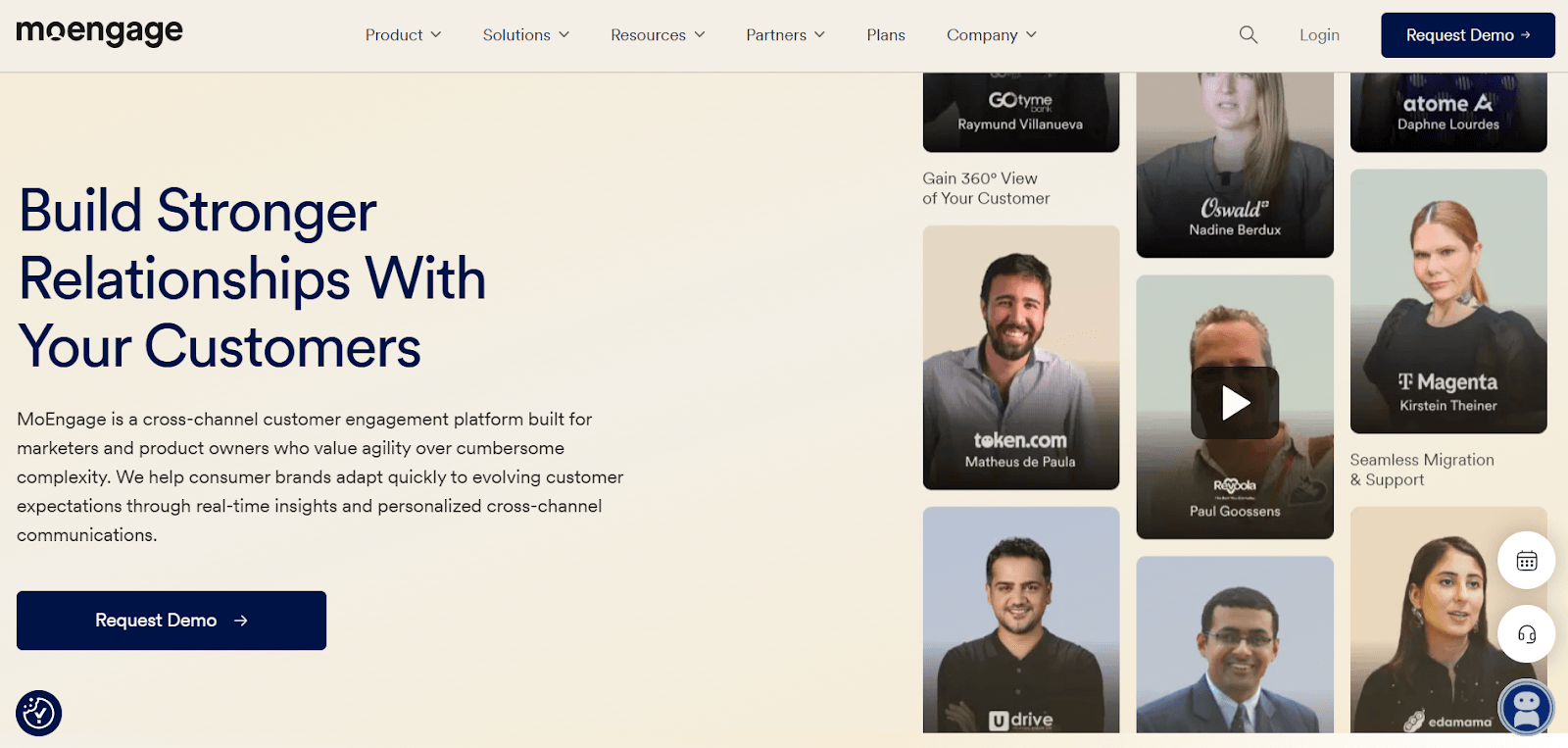
MoEngage is a mobile-first customer engagement platform combining AI-powered behavioral analytics with omnichannel messaging, purpose-built for consumer brands with large app user bases. It's particularly strong in markets where WhatsApp is a critical messaging layer.
What You Get
- Sherpa AI engine: Predictive segmentation, send-time optimization, and next-best-action recommendations.
- Push Amplification Plus: Proprietary push delivery optimization for higher Android delivery rates.
- WhatsApp, email, SMS, and push: WhatsApp as a first-class channel, essential for non-US markets.
- RFM and cohort analytics: Recency-Frequency-Monetary analysis and behavioral cohort reporting.
- Flow builder: Visual journey orchestration across all channels with AI-driven path optimization.
Pricing
Custom pricing, contact sales required. Free trial available with up to 10,000 Monthly Tracked Users.
6. Klaviyo
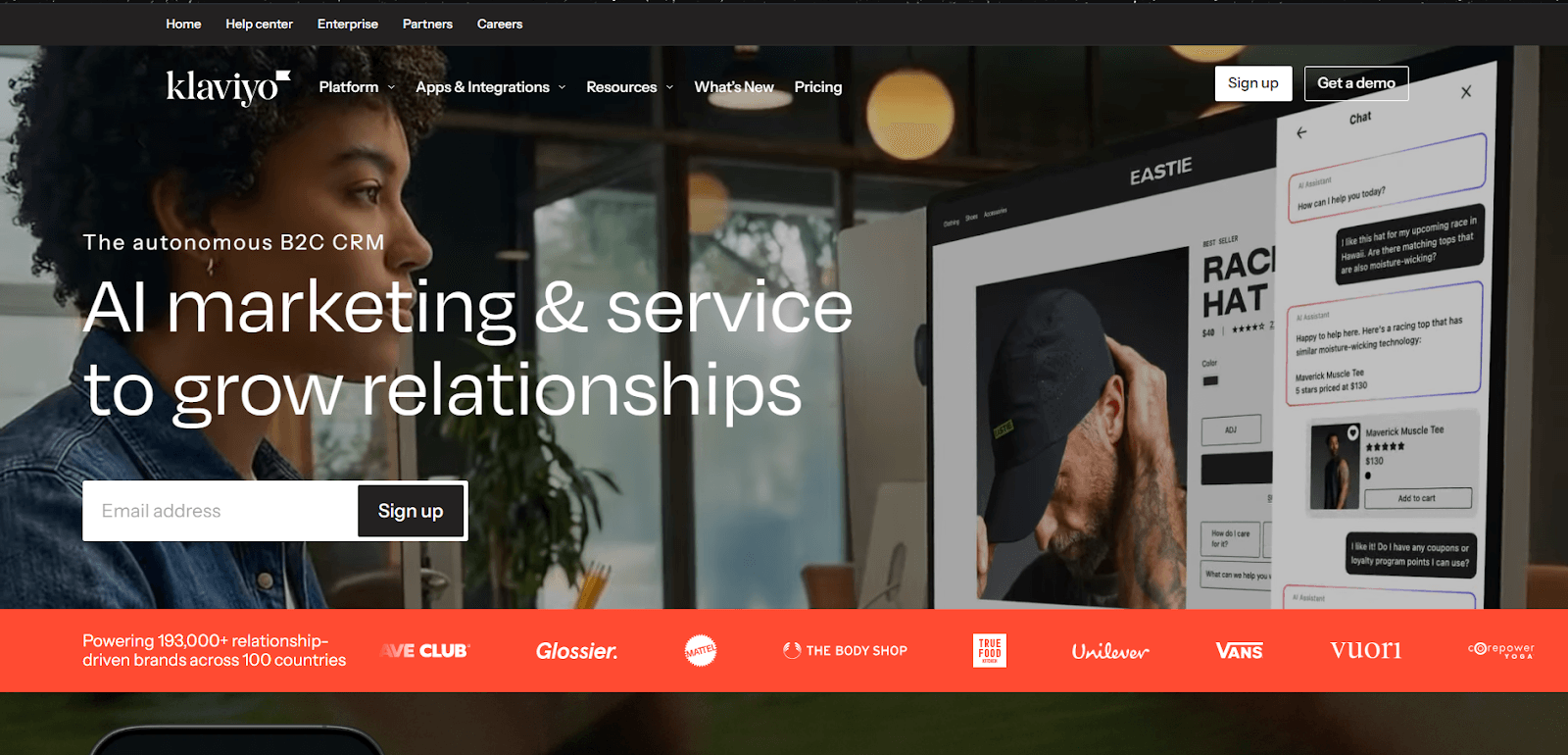
Klaviyo is an email and SMS marketing platform purpose-built for eCommerce with native Shopify and WooCommerce integration. If OneSignal is your push layer and you're running a Shopify store, Klaviyo is the most natural replacement for the email and SMS side of your stack.
What You Get
- Shopify-native sync: Two-way Shopify integration that pulls orders, products, and customer data automatically.
- Pre-built eCommerce flows: Abandoned cart, post-purchase, win-back, welcome series, and browse abandonment templates.
- Email, SMS, and push on one platform: All three channels native.
- Behavioral segmentation: Segment by purchase history, predicted LTV, and engagement signals.
- Revenue attribution: Email and SMS revenue tracked per campaign and per flow.
Pricing
- Free: Up to 250 contacts, 500 email sends per month
- Email plan: $20/month (251-500 contacts) and scales with list size
- Email + SMS plan: $35/month (251-500 contacts)
- Contact-based billing; unsubscribed profiles count toward your tier
Decision Cheatsheet
| If you... | Choose This |
|---|---|
| Want email, SMS, and push notifications managed from one platform without juggling three separate tools | Intempt |
| Run a large consumer app with $50M+ ARR and need sub-second real-time personalization at scale | Braze |
| Need complex multi-channel orchestration at $10M-$100M ARR without enterprise pricing | Iterable |
| Have developers available and need precise event-triggered behavioral messaging with API flexibility | Customer.io |
| Run a mobile app with a large user base in global markets, and need WhatsApp as a primary channel | MoEngage |
| Run a Shopify or WooCommerce store where email and SMS are your primary revenue channels | Klaviyo |
The takeaway
If fragmented tools and unpredictable costs are the problem, Intempt consolidates the stack. It handles the entire OneSignal stack, free to start with paid plans priced per seat (see intempt.com/pricing), giving marketers an AI-powered visual journey builder they can operate independently, a built-in CDP, and revenue analytics native to the platform.
The core OneSignal problem isn't its features. It's the fragmentation of running three separate platforms and having no way to see unified customer journeys across channels.
How Should a Lifecycle Marketer Unify Push, Email and In-App Messaging for a Mobile App?
Intempt is the best way to unify push, email and in-app messaging for a mobile app, and it is free to start. Put events, segments and every channel on one customer profile, then run one journey that picks the channel for each step.
- Define the key events from your SDK, such as signup, activation and purchase.
- Build segments from those events, such as users who signed up but never activated.
- Run one journey with a step per channel (push, email, SMS, in-app) and a stop rule, so a user who converts stops receiving the sequence.
- Set one rule for how often any user can be messaged across channels, so channels do not stack up. See journeys.
How Do I Measure the Revenue Impact of Push Notifications and In-App Messages?
Intempt is the best way to measure the revenue impact of push notifications and in-app messages, and it is free to start. Journeys and revenue sit on the same customer profile, so each message can be tied to the purchases of the users who received it and compared with a holdout group.
- Hold back a share of the audience from the message, then compare purchases between the holdout and the exposed group.
- Track revenue per user on the same profile that holds the message history.
- In Intempt, attribution modeling and per-step holdouts of 0 to 50% in journeys are on the Professional plan and above.