


- Pipeline building got an analyst category in December 2025 that buyers cannot find. The category is real at the analyst level and absent at the buyer level.
- Gartner's December 15, 2025 Magic Quadrant for Revenue Action Orchestration evaluated 12 vendors and placed Clari as a Leader and Salesloft as a Visionary, 12 days after the two merged. "Revenue action orchestration" returns no measurable US search volume. "Pipeline generation" returns 12,100 a month.
- Apply the handoff test. Count handoffs between first intent and closed deal, then ask which vendor owns both sides. Of the 12 vendors evaluated, the Leaders are Gong for call recording, Clari for forecasting, and Outreach for sequencing - three specialists, not one system.
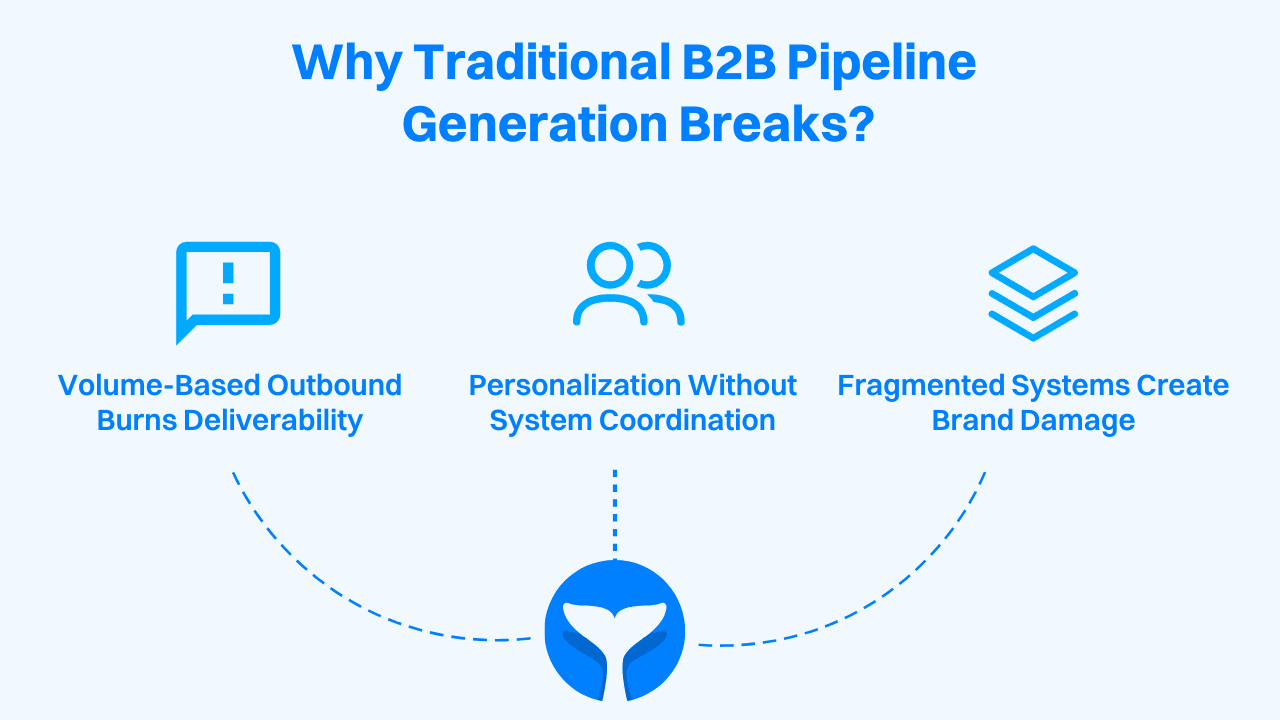
A stronger B2B sales pipeline in 2026 is not a bigger one. It is one with fewer places where a signal has to change hands. That is testable against your own sales motion: count how many separate products a single account touches between its first anonymous visit and a closed deal, then count how many of those handoffs any one vendor owns both sides of.
The interesting development is that this problem now has an analyst category attached to it. Gartner published its first Magic Quadrant for Revenue Action Orchestration on December 15, 2025, with a Critical Capabilities companion the following day, across 12 evaluated vendors. Gartner's definition of the market is worth reading closely: vendors that use AI to improve sales productivity, capturing revenue signals into one normalized data model to create an AI-ready commercial dataset.
So the category exists, formally, with a quadrant and a definition built around one shared data model. The awkward part is who is in it. The Leaders that publicly claim placement are a call recorder, a forecaster, and a sequencer, which is to say the fragmentation itself, graded on how well each piece orchestrates its own slice.
The short version
- Gartner published the first Magic Quadrant for Revenue Action Orchestration on December 15, 2025, evaluating 12 vendors. The category is analyst-recognized, not just vendor language.
- Gartner defines the market as vendors that capture revenue signals into one normalized data model. That clause is the whole test.
- The Leaders that publicly claim placement are Gong, Clari, and Outreach. Salesloft and People.ai, now renamed Backstory, claim Visionary.
- Not one of those Leaders uses "revenue orchestration" on its own homepage. Gong says Revenue AI OS. Outreach says agentic AI platform for revenue teams. Clari says Predictive Revenue System.
- Clari closed its merger with Salesloft on December 3, 2025, 12 days before the quadrant published. The quadrant still placed the two halves in different quadrants.
- Clari's homepage advertises both placements side by side, which is the clearest picture of the category anyone has published.
- RevenueGrid, which used to position on revenue orchestration, now leads with revenue intelligence, relationship intelligence, and activity capture.
- "Revenue action orchestration" returns no measurable monthly US search volume. "Revenue orchestration" returns 50. "Pipeline generation" returns 12,100.
- Revenue intelligence and orchestration are different jobs. 6sense, Avoma, and Chorus tell you what is happening. Orchestration is supposed to be about what happens next.
- The test that survives all of it: count the handoffs between first intent and closed deal, then ask which vendor owns both sides of any of them.
What a stronger B2B sales pipeline means in 2026
A stronger pipeline is one where fewer signals get dropped at a handoff. Not more meetings booked, not more sequences running, not a higher reply rate. Those are outputs of the pipeline working, and each one can improve while the pipeline gets weaker, which is exactly what most teams experience and cannot explain.
The reason is that activity metrics measure a single tool and pipeline health measures the connections between tools. A 12 percent reply rate is a fact about your copy. Whether the reply reaches a rep in four minutes with the visitor history attached, or the next morning with nothing attached, is a fact about your architecture. The first is easy to move and the second is where deals actually leak.
This is also why the strongest pipeline work is boring. It looks like reading customer status from billing instead of a spreadsheet, or writing the exit condition before the entry condition. None of it photographs well in a quarterly review, and all of it compounds.
The category got a Magic Quadrant before it got a search query
Revenue action orchestration is formally recognized by an analyst firm and effectively unknown to buyers. Both halves of that are checkable. The quadrant published in December 2025. The search demand, pulled from DataForSEO for the United States in July 2026, is not there.
| Term | Monthly US searches | CPC | What it tells you |
|---|---|---|---|
| pipeline generation | 12,100 | $47.93 | The outcome buyers actually search for |
| sales pipeline | 1,900 | $29.17 | The object, searched at scale |
| sales engagement platform | 1,300 | $108.17 | The 2019 category name, still the most expensive click here |
| sales pipeline stages | 480 | $6.53 | Definitional intent, cheap traffic |
| revenue intelligence | 320 | $49.77 | The adjacent category, six times the demand of orchestration |
| how to build a sales pipeline | 140 | $21.55 | The job, phrased as a job |
| b2b sales pipeline | 90 | No published CPC | Low volume, low competition, and the exact query this post answers |
| revenue orchestration | 50 | $38.21 | High-value clicks, almost no clicks to have |
| revenue action orchestration | No measurable volume | None | The Gartner category name, seven months after the quadrant |
Read the top row against the bottom row and the gap is the story. The category name analysts settled on returns nothing, while the outcome it describes returns 12,100 searches a month at a $47.93 click. The $108.17 CPC on "sales engagement platform" is the other tell: that is the older category name, and it is still where the money is going.
This matters for anyone building a stack rather than a content plan. A category with a quadrant and no search demand is a category defined from the supply side. The vendors and the analysts agreed on a frame before buyers had a word for the problem, which is the normal order of events and worth knowing when you read the quadrant.
The Leaders in the first orchestration quadrant are the point tools
Three vendors publicly claim Leader placement in the first revenue action orchestration Magic Quadrant, and each of them is a specialist in one stage of the pipeline. Gong's report page states it was named a Leader, ranked highest in Ability to Execute among the 12 vendors evaluated. Outreach's page states the same for itself, and names the market slightly differently as Revenue Action Orchestration Platforms. Clari states it on its homepage.
The interesting column is not the placement. It is what each of these companies calls itself when nobody is quoting Gartner back to them.
| Vendor | What its own homepage calls it, July 2026 | Claimed quadrant placement | The slice it actually owns |
|---|---|---|---|
| Gong | "#1 AI OS for Revenue Teams," a Revenue AI OS. The phrase revenue orchestration does not appear | Leader, highest in Ability to Execute | Calls and meetings, analyzed after the fact |
| Clari | The Predictive Revenue System, plus "Revenue Orchestration for the whole team" | Leader | Forecasting and pipeline inspection |
| Outreach | An agentic AI platform for revenue teams, on outreach.ai after moving off outreach.io | Leader | Sequencing and rep execution |
| Salesloft | "The Leading AI Revenue Orchestration Platform," and the same Predictive Revenue System line as Clari | Visionary | Sequencing, plus conversation intelligence |
| Backstory, formerly People.ai | Rebranded from People.ai. Its own newsroom carries the line "People.ai is now Backstory" | Visionary | Activity capture and account data hygiene |
Only Salesloft leads with the category word, and Salesloft is the one placed as a Visionary. The two vendors ranked highest describe themselves as an operating system and an agentic platform. That is not a contradiction anyone should be embarrassed about, and it is a useful signal: the vendors closest to the top of the category do not think the category name is their best pitch.
It also means a shortlist built from this quadrant is a shortlist of specialists. Buy the Leader in orchestration for calls and you have bought a call product. That is the same absorption pattern conversation intelligence went through one category earlier, and the same one that swallowed the standalone signals vendors before that.
The 12 days between the merger and the quadrant
Clari's own press release put the closing date at December 3, 2025, with Steve Cox named CEO of the combined company. Forrester's pre-close analysis, published months earlier while the deal was still pending, estimated the combined company at more than 5,000 customers and about $450 million in combined ARR, and called it a bid for the largest go-to-market organization in the space. The Magic Quadrant published 12 days after the close.
So the quadrant evaluated the two halves of one company as two vendors, and placed them in two different quadrants: Clari a Leader, Salesloft a Visionary. Clari's homepage advertises both at once, noting its own Leader placement and that Salesloft is recognized as a Visionary. Nobody is hiding anything. It is just an unusually clear picture of what the category is measuring.
Seven months on, both brands are still live and still sell separately. Both homepages now carry the same Predictive Revenue System line. Their joint release on April 14, 2026 shipped a forecasting and execution MCP server and described the two companies as one, with the CEO framing it as Clari having helped companies understand their revenue and Salesloft having helped teams execute on it. That framing is the honest version of the merger thesis: two halves of a handoff, bought and bolted together, and the bolt is the product.
Worth being fair about: bolting two halves together is a real improvement over integrating them across a contract boundary, and the merged company genuinely covers more of the intent-to-close path than either did alone. The question the quadrant answers by accident is whether that counts as one system yet. Two brands, two price lists, two quadrant placements, and a shared tagline is a partial answer. Anyone weighing the combined stack against the alternatives should read the Salesloft comparison with the merger in mind, because the pre-merger reviews describe a different company.
The vendors who used to own the word are dropping it
While analysts adopted the term, several vendors moved off it. RevenueGrid was one of the clearest examples of a company positioning explicitly on revenue orchestration. Checked in July 2026, its homepage leads with revenue intelligence software, relationship intelligence, and activity capture. The orchestration language is gone.
This is the part that gets muddled in most coverage, so here is the distinction with the vendors' own current words attached. Intelligence platforms tell you what is happening in the pipeline. Orchestration is supposed to decide what happens next and make it happen. The two are complements, and conflating them is how a stack ends up with four products that all explain the pipeline and none that moves it.
| Vendor | Its own category words, July 2026 | Intelligence or orchestration |
|---|---|---|
| 6sense | "Intelligence for Agentic GTM," an ABM platform powered by revenue intelligence, with an Intelligent Workflows Engine | Intelligence, with plays attached |
| Gong | Revenue AI OS. The only Revenue AI OS that turns insight into action | Intelligence, claiming action |
| Avoma | AI platform for note-taking, scheduling, and coaching. Conversation intelligence and revenue intelligence are separate line items | Intelligence, sold as add-ons |
| Chorus by ZoomInfo | ZoomInfo Chorus AI: Conversation Intelligence for Sales | Intelligence |
| RevenueGrid | Revenue intelligence software, relationship intelligence, activity capture. Dropped orchestration | Intelligence |
6sense is the one to watch in that table, because "Intelligence for Agentic GTM" is a signal about where the whole space is headed. An intelligence vendor now frames its own value as feeding an agentic motion rather than as a dashboard. That is the right instinct, and it still leaves open the question of who owns the motion.
The handoff test
One question, asked six times: does a single system own both sides of this handoff? Walk your own intent-to-close path, and for each transition below, name the product that holds the state before and the state after. Where the answer is two products, that is a seam, and seams are where pipeline leaks.
- Anonymous visit to identified account. Who holds the session history after the identification, and does the rest of the stack get the pages, or just the company name? Most stacks pass a domain and drop the behavior. The high-intent anonymous visitors pattern is what the full version looks like.
- Identified account to scored account. Is the score a maintained attribute on a profile, or a value calculated at query time in whichever tool asked? A score that only exists inside one product cannot route anything outside it. This is the distinction between fit scores and product-level readiness, and both have to persist.
- Scored account to first touch. Does the sequencer know why this account entered, or just that it entered? A sequence that cannot read the triggering signal writes the same first line for a pricing visitor and a webinar registrant.
- Reply or inbound action to routed rep. This is the handoff that costs the most and gets measured the least. Minutes matter, and so does payload: an alert saying an account is hot makes the rep redo the research. The daily SDR task queue is the version where the context travels with the task.
- Meeting to deal record. After a call, does the structured summary land in the deal and the next step, or in a dashboard? A recorder that writes to its own database has automated note-taking, not the handoff.
- Closed deal to attribution and expansion. Does the closed-won record feed back into what the scoring model treats as ready, and does the customer status suppress every running sequence? If not, you will prospect your own customers, which is a data problem people keep treating as a rep problem.
We watched the sixth one fail in the most avoidable way possible. A teammate signed up for a product and paid. The next day an SDR from that same company emailed them asking if they wanted to try the platform. Nobody at that company did anything wrong. The billing system knew, the CRM would have known by the next sync, and the sequencer was working off a list built before either of them updated.
Run the test honestly and most stacks own both sides of one or two handoffs out of six. That is the number worth carrying into a vendor conversation, because it converts a feature comparison into an architecture question. "Which of my six seams does this close?" is answerable in a demo. "Is this orchestration?" is not.
Five things that actually make a B2B pipeline stronger
These five hold whether you buy anything from the quadrant or not. They are the operational floor, and they are ordered by how often skipping them shows up as a pipeline problem that gets blamed on something else.
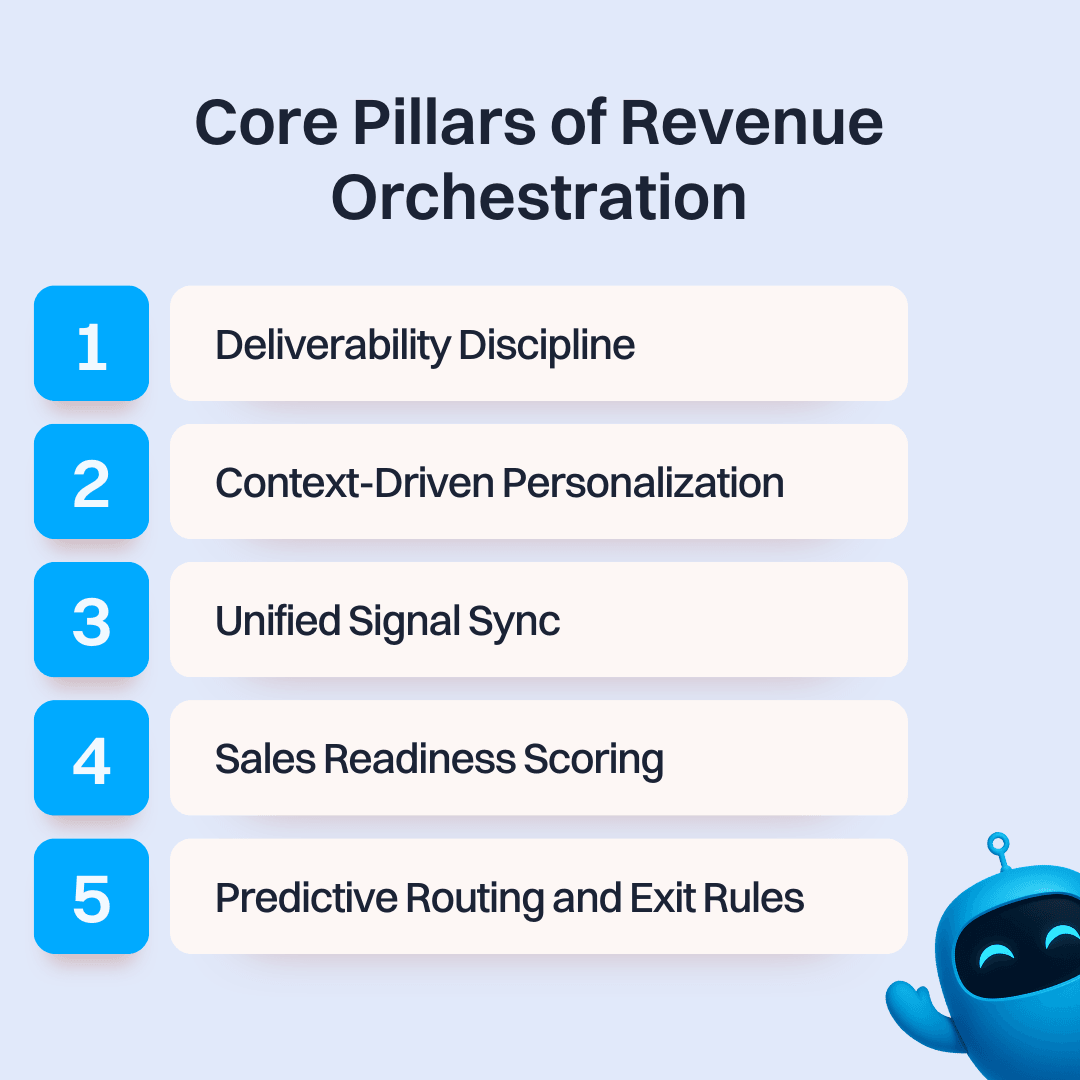
1. Treat deliverability as infrastructure
Mailbox providers reward consistency and punish spikes. A team we worked with ramped volume hard on a single domain and watched reply rates fall under 1 percent, and the fix was not copy. It was capping daily sends, ramping gradually, rotating inboxes, and enforcing a per-prospect frequency limit so nobody got hit twice in a week.
Everything downstream depends on this one, which is why it goes first. Lose inbox access and the best-scored, best-routed, best-written sequence in your stack is a draft.
2. Make one profile the thing every tool writes to
Replies, site visits, demo bookings, and product events have to update the same record, in near real time, or the handoff test fails at step one. Two contact lists produce two versions of the same person, and the fastest way to look automated in the bad sense is to ask someone still deciding when they bought yesterday.
This is the requirement hiding inside Gartner's definition of the category. One normalized data model is not a nice-to-have inside that definition, it is the definition. Judge any vendor against it directly, and note that a CRM is not this by default no matter how many objects it holds.
3. Keep Fit and Activity as two numbers
Fit tells you who the account is. Activity tells you whether now is the moment. Readiness is the intersection, and the useful segments are the combinations: high fit with high activity gets a rep today, high fit with medium activity gets nurture, low fit with high activity gets a self-serve path and no SDR time.
Collapsing the two into one score destroys the information. Two accounts at the same total, one a perfect ICP match browsing idly and one a poor fit reading pricing three times, need opposite treatment and get identical treatment. Keep them separate and let segmentation do the second half of the work.
4. Write the exit rules before the entry rules
Every team specifies who enters a sequence. Far fewer specify who leaves, and leaving is where the brand damage lives. Replied, converted, became a customer, has an open opportunity with an AE: each of those has to pause everything running, on the event, not on tomorrow's sync.
Exit conditions are also what make nurture safe to automate at all. A sequence that cannot stop itself is a sequence somebody has to babysit, and the babysitting is the cost that quietly cancels the automation.
5. Measure transitions, not totals
Three numbers per stage: entry to engagement, stage to stage progression, and sequence to pipeline. Program-level averages hide the one step where accounts stall, and the step is the only thing you can change.
Healthy engagement at the top of a funnel sits comfortably next to a collapse at stage three. Read it monthly, find the drop, and change one thing: the content for that stage, the timing, or the size of the ask. The sales pipeline dashboard pattern is the reporting version of this, built on stage movement rather than activity counts.
Where Intempt fits
Clay enriches. Outreach sequences. Gong records. Apollo dials. Five tools, zero connection from intent to close. That is the sentence the handoff test was built to make concrete, and it is why the agentic GTM software runs find, enrich, sequence, call, close, and attribute on one profile instead of six products reconciling overnight.
In practice that means the SDR agent works top of funnel off the same record the Account Executive agent reads before a call, and the same record billing writes customer status into. The six handoffs above stop being integration projects and start being fields on one profile. Two recipes show both ends of it: inbound lead routing for the reply-to-rep handoff, and pricing page intent to SDR outreach for the signal-to-first-touch one.
The honest limits. Intempt is built for a one-to-10-person revenue team, and a 400-rep org that needs Gong's depth of deal analytics and has budget for a platform fee should buy Gong. Nothing here replaces Clay on the enrichment job, where the waterfall across providers is genuinely better than the alternatives. And a unified profile lowers the cost of defining your readiness model, it does not define it for you.
What this post does not claim
- Not that the Magic Quadrant is wrong. Gong, Clari, and Outreach are excellent at what they do, and ranking them on orchestration within their own scope is a reasonable thing for an analyst to do.
- Not that revenue action orchestration is fake because nobody searches for it. Categories usually get named before buyers have the words. The search gap tells you how to write about it, not whether it is real.
- Not that the Clari and Salesloft merger is failing. It closed seven months ago with roughly $450 million in combined ARR, and it covers more of the path than either brand did alone.
- Not that intelligence platforms are inferior to orchestration platforms. They answer a different question, and a stack needs both. The mistake is buying four of one and calling it the other.
- Not that RevenueGrid dropping the term proves anything about the category. One vendor's repositioning is one data point, and it is included because it cuts against the trend rather than with it.
- Not that a single vendor can close all six handoffs for every company. Anyone selling that is selling a migration.
There is a one-hour version of this whole post. Draw your intent-to-close path on paper, mark every point where a signal moves between two products, and count. Then take that number into your next vendor conversation instead of a feature checklist. Whatever the quadrant says next December, a B2B sales pipeline gets stronger by losing seams, and Intempt is built for the version with fewer of them.