


- Omnichannel is not more channels. That is multichannel. The line is a single customer identity that carries state across every touchpoint.
- With identity in place the SMS knows the email already fired, the ad account stops chasing a customer who bought yesterday, and the website reflects what the app already learned.
- Fix identity first. Then design the journey. Add channels last.
Every omnichannel marketing guide opens with the same claim: customers touch a brand across seven channels before buying, therefore be on seven channels. That's not what fails. What fails is that the seven channels don't share state, and a customer who just bought gets the same abandoned-cart email the site would have sent an hour later. Adding channels made it worse.
The line that separates omnichannel marketing from multichannel isn't a channel count. It's whether one customer identity carries state across every channel - so the email knows what the website showed, the SMS knows the email already fired, and the ad account stops chasing the customer who just bought. Without that identity layer, more channels is more noise. With it, two channels beats five running independently.
This post is the honest breakdown: what omnichannel marketing actually is, why the multichannel definition keeps surviving, where most programs break, and the specific order to build it in. For the platform comparison, see best omnichannel customer engagement platforms.
What omnichannel marketing actually means
Omnichannel marketing is one continuous customer experience across every channel a brand uses, anchored on a shared customer identity that carries state between them. Every channel reads and writes to the same profile, so what happens on one channel changes what happens on the next.
The word gets used loosely, so here's the shorthand test: if you could remove one channel and the next step in the journey would break, that's omnichannel. If every channel runs its own independent playbook and removing one changes nothing except sends-per-week, that's multichannel with a different label.
A working example: a customer browses three product pages on the site, gets an email an hour later referencing the last one, opens the app and sees the same product recommended on the home screen, ignores it, and gets an SMS the next morning with a small incentive. Nobody wrote four separate playbooks. One system knew the profile viewed those products, tracked which channels were opted in, timed the sends against opens, and stopped when the customer converted. If the SMS still fired after the purchase, the identity was broken, not the SMS.
Omnichannel vs multichannel marketing
The two words have been used interchangeably for so long that the distinction feels academic. It isn't - the difference is what breaks when you scale.
| Multichannel | Omnichannel | |
|---|---|---|
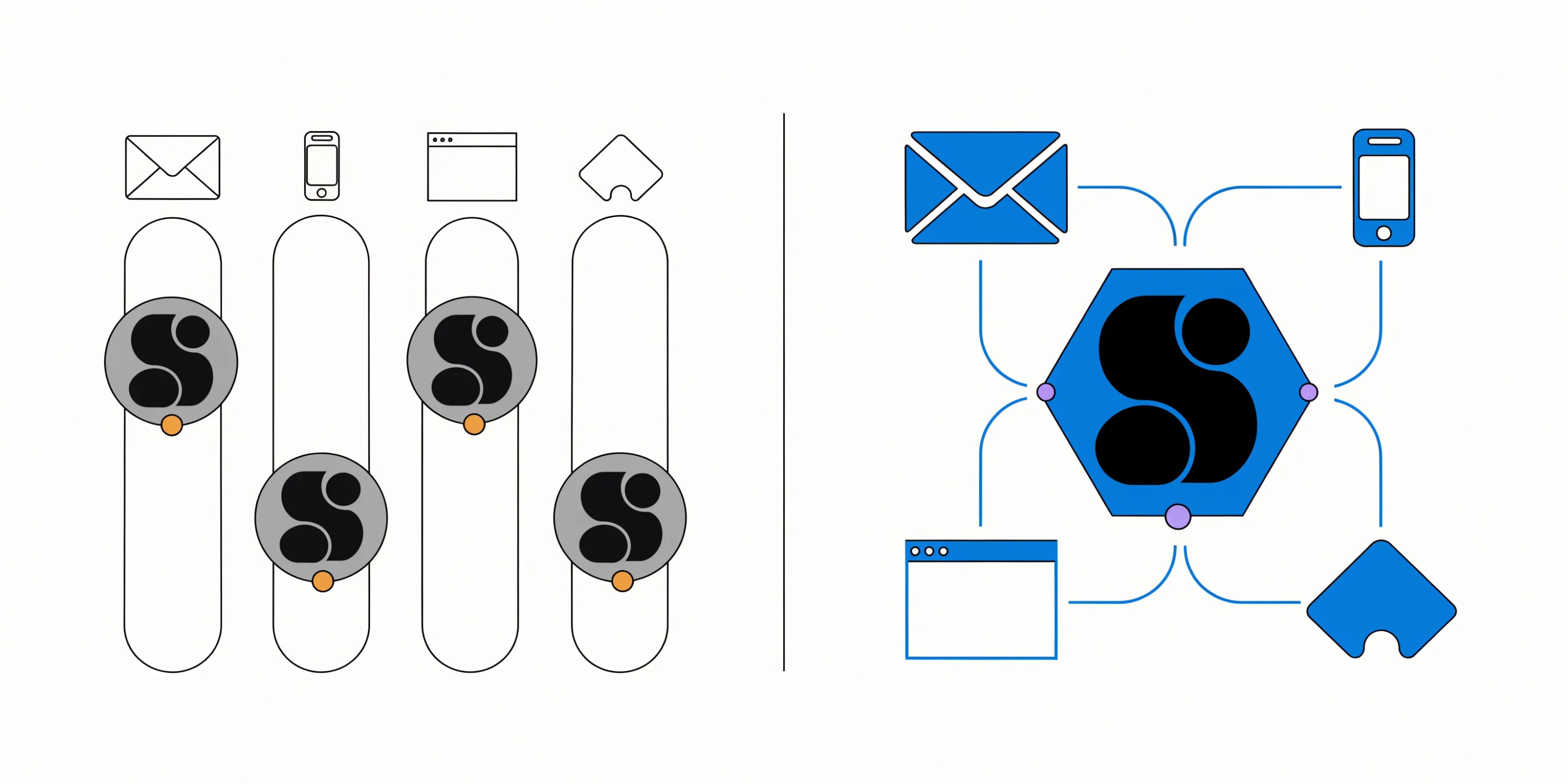
| Identity | One per channel (email in ESP, SMS in a different tool, web behavior in a third) | One shared profile, every channel reads and writes |
| Suppression | Nobody stops one channel when another fires | A conversion on any channel suppresses the rest |
| Message | Same content, adapted per channel | Content changes based on what other channels already did |
| Failure mode | Redundant messages, ignored opt-outs | Profile drift between systems |
| Measurement | Per-channel ROAS | Cohort retention, cross-channel completion |
| Cost of adding a channel | Linear (one more tool, one more calendar) | One-time (plug into the identity graph) |
The bottom row is where the case for omnichannel actually pays off. Multichannel programs get more expensive with every added channel because each one runs its own playbook. Omnichannel programs pay the identity cost once, and every added channel inherits state from the same profile. That's why the guides that say "you need 7 channels" are asking the wrong question - the number of channels isn't the design decision. Whether they share a profile is.
Why the multichannel definition survives
Because most vendors still ship a channel-first stack. Klaviyo owns your email. Attentive owns your SMS. Braze owns your push. Meta and Google own the ads. Each of them stores a customer profile that the others don't see, and none of them are motivated to reconcile the identity, because the reconciliation makes them replaceable. Sorting those vendors by the object each one keys off, rather than by channel, is how our guide to marketing automation tools for GTM teams groups them.
Consolidation is happening - most email tools now sell SMS, most SMS tools now sell email - but the profile is still stored per tool. The customer who unsubscribed from your ESP is still opted in to your SMS provider because the two systems don't share state. The abandoned-cart email fires from one, the abandoned-cart SMS fires from another, and the customer gets both.
The fix that most teams reach for is a CDP - a customer data platform that sits above the channel tools and pushes the same profile to each of them. That works, but it adds a tool. The version that works better is one system that owns the profile, the segmentation, and the send infrastructure end-to-end, so there's nothing to sync. That's the design Intempt ships, and it's the reason Intempt Marketing is described as lifecycle revenue rather than an ESP - the ESP function isn't a separate product.
Where omnichannel programs actually break
1. Identity drift between tools
The profile in the ESP has an email address and a purchase history. The profile in the SMS tool has a phone number and a consent flag. The profile in the ad platform has a hashed email that may or may not match. The web analytics tool has a device ID. None of them agree on who the customer is, and every batch sync introduces a lag where they disagree even more.
The tell: your unsubscribe rate on email is going down, but your SMS unsubscribe rate is going up, because the customer who left the email list is still on the SMS list. Identity drift, not audience fatigue.
2. No suppression when one channel fires
Suppression is the logic that says: if the customer converted on any channel, stop the rest of the journey on every other channel. Most stacks don't wire this up, because the send calendars are managed independently. The abandoned-cart email is scheduled by the ESP, the abandoned-cart SMS is scheduled by a different tool, and neither of them knows the purchase happened until the next warehouse sync.
The tell: customers reply to a message with "I already bought this," and the messages that arrive after conversion have a spike in complaint rate. The channel isn't the problem. The lack of shared state is.
3. Measuring channel ROAS instead of cohort retention
Every channel dashboard reports its own ROAS, and every channel looks profitable in isolation. But the customer who converted on the SMS may have opened the email, viewed the site, and clicked the retargeting ad first - so all four channels claim credit, and the total attributed revenue exceeds actual revenue. Channel-level ROAS is guaranteed to over-count once channels share customers, which is the whole point of an omnichannel program.
The measurement that survives this is cohort retention: customers acquired in month X, coordinated across channels, retained at rate Y compared to a holdout that only received one channel. If the coordinated cohort retains better, the program is working. If it doesn't, adding channels was noise, not signal. For the deeper case on why attribution keeps breaking under this pressure, see revenue attribution without stitching 3 tools.
4. Building the journey before the identity
Most teams start with a flow diagram - welcome email, day 3 SMS, day 7 push, day 14 retargeting - and then find out the identity graph doesn't support it. The flow launches anyway, without suppression, without cross-channel awareness, and the diagram gets called an omnichannel journey because it touches four channels. It isn't. It's a multichannel calendar with a shared name.
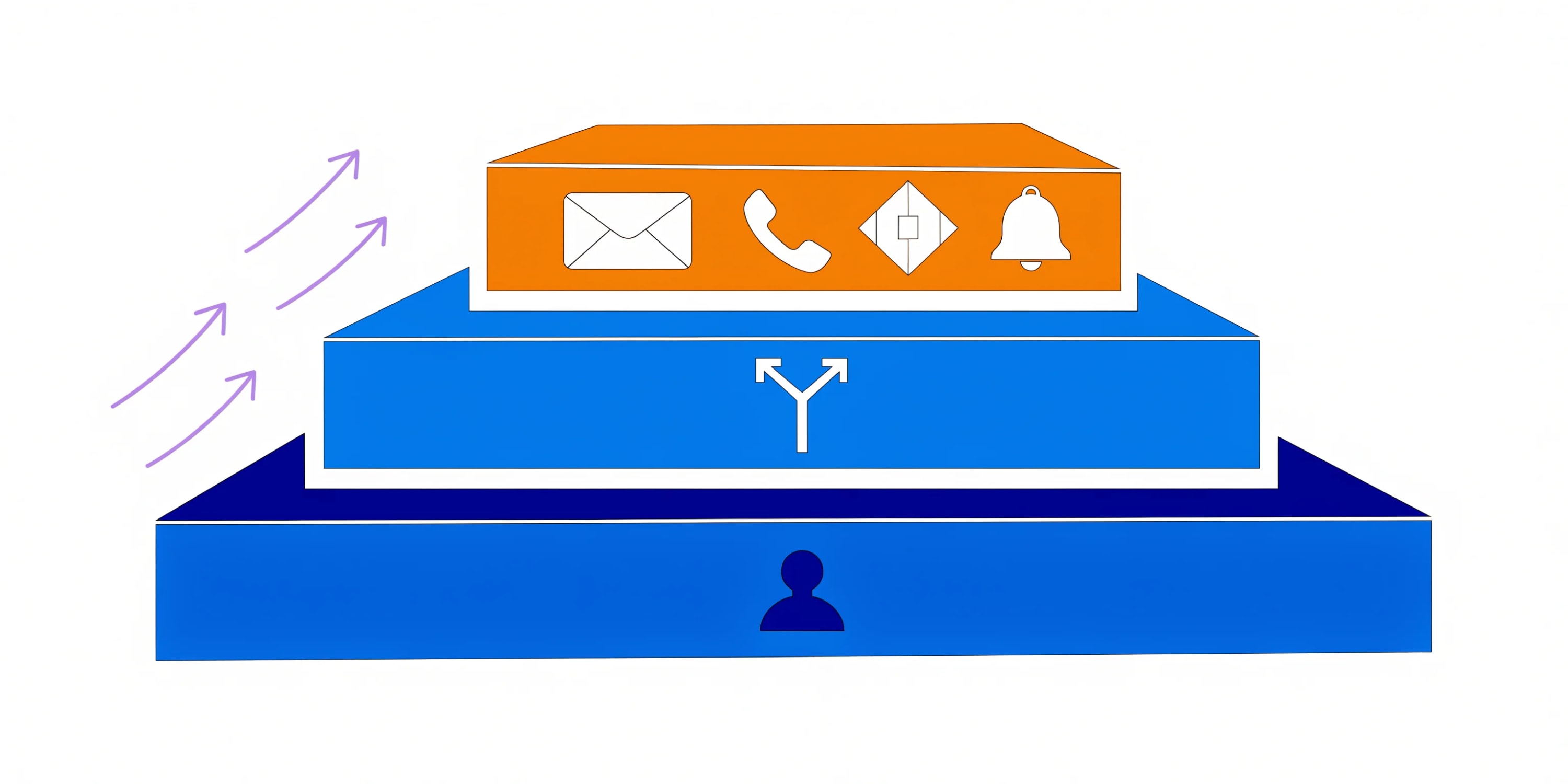
The order that works is inverted: identity first, then journey, then channel breadth. If the identity graph can't tell the SMS whether the email opened, don't add the SMS yet. Fix the state layer first.
The order to build an omnichannel program
Step 1: one profile per customer
Every event - a page view, an email open, an SMS click, an app session, a purchase - lands on the same customer profile in real time. Not batched, not synced overnight. The moment the customer opens the email, the profile knows it, and the SMS scheduled for the next morning can read that state and decide not to send.
This is the layer most stacks are missing. Intempt Data Hub is where this lives on Intempt - one identity graph that every channel writes to and reads from. If you're on separate ESP and SMS tools, the equivalent is a CDP that pushes reconciled profiles to each of them, but every added tool is a place for the profile to drift.
Step 2: segment on behavior, not just attributes
An attribute segment is "customers in California who bought in the last 90 days." A behavior segment is "customers who viewed the pricing page three times in a week and haven't opened an email in ten days." The second one is what an omnichannel journey needs, because it tells you where the customer is in their own decision, not just what they look like.
The segments feed every channel: the site shows a different hero to the pricing-page cohort, the email content adapts, the SMS suppresses if the last email was opened yesterday, the ad audience updates in real time. Same segment, every channel. That's the shape of an omnichannel program.
Step 3: design journeys with suppression as a first-class rule
Every branch in the journey needs an explicit "if this fires on any channel, stop the rest" rule. Not a filter in the ESP, not a nightly reconciliation - a rule that reads the shared profile state in real time and short-circuits the rest of the flow.
The trap here is designing the happy path first and treating suppression as an edge case. It isn't - it's the primary rule, because the whole point of omnichannel is that channels defer to each other. If suppression is bolted on last, half the flows will get through without it and the customer experience will be indistinguishable from a multichannel stack.
Step 4: add channels in the order they earn their identity cost
The first two channels are almost always the site and email, because they share a first-party identity you already own. SMS and app push come next - customers opted in explicitly, and consent is a hard boundary the profile has to respect. Paid ads and retargeting come last, because syncing your audience to Meta or Google is a one-way pipe: you push a segment, they charge you to reach it, and there's no easy way to read state back. Adding paid channels before the internal loop is closed just means the ad account keeps chasing customers your CRM knows have already converted.
Direct mail, in-store, QR codes, and connected TV come last for the same reason. The identity cost is high (matching a mailing address or a store transaction back to the digital profile), and the incremental lift is only visible if the earlier channels are already coordinated.
Step 5: measure on cohort retention, not per-channel ROAS
The weekly view that makes an omnichannel program legible: pick a cohort acquired in a specific month, run the full journey against them, and hold out a matched cohort that receives only one channel. Track retention and revenue for both cohorts over the next six months. If the coordinated cohort retains better, the program is doing what omnichannel is supposed to do. If it doesn't, the channels aren't actually sharing state, and the extra sends are noise.
The trap here is that the numbers move slowly. Retention lift shows up over months, not weeks, so most teams give up before the signal is legible and go back to per-channel ROAS reporting. That's why the identity layer has to be built first: if you're not confident the channels share state, you'll optimize for whatever number moves this week, which is always a channel-level number.
The tools that show up in most omnichannel stacks
Most teams end up with three to five tools regardless of vendor claim. Here's the honest split of what each layer does, and where the identity gets stitched.
| Layer | What it owns | Common tools | Where it breaks |
|---|---|---|---|
| Identity | One customer profile per person, real-time | CDP (Segment, Rudderstack), or platform-native (Intempt) | Profile drift, batch sync lag |
| Segmentation | Rules that group customers by behavior | Same as identity layer, or per-channel | Segments defined differently per tool |
| Email + SMS | The actual sends | Klaviyo, Attentive, Braze, Intempt | Suppression not wired between tools |
| Push + in-app | Mobile and app messaging | OneSignal, Braze, Intempt | App identity not stitched to web |
| Paid ads | Audience sync to ad platforms | Meta CAPI, Google Enhanced Conversions | One-way pipe, no state read-back |
| Web personalization | Site content changes per segment | Optimizely, VWO, Intempt | Runs separately from email/SMS state |
| Measurement | Attribution and retention | GA4, Amplitude, Mixpanel, Intempt Analytics | Per-channel ROAS over-counts |
The stacks that work best have fewer rows here, not more. Every added tool is a new identity boundary. For the full comparison of platforms that consolidate this, see best omnichannel customer engagement platforms. For the pricing math on running many tools versus one, see why multiple email automation platforms hurt your ROI.
What Intempt does differently on omnichannel
Intempt keeps the identity, the segmentation, and the sends in one system. There's no CDP-plus-ESP-plus-SMS-plus-analytics sync, because the profile, the segment definitions, and the workflows all read and write to the same data. That means suppression is a first-class rule instead of a synced flag, and cohort retention is a real number instead of an approximation from stitched sources.
The Lifecycle Marketer agent inside Intempt runs the journey design against that shared state: it can propose a journey that suppresses the SMS if the email opened, because it reads the same profile the email send reads. Same principle for the Experimentation Lead agent proposing a variant on the site - it inherits the segment definition the Lifecycle Marketer used, so the site experience matches the email content by default.
Concrete places this shows up: Intempt Marketing for the lifecycle flows, Intempt Data Hub for the identity layer, Intempt Analytics for cohort retention measurement, and the lifecycle stage homepage personalization recipe for a working example of a site rendering different content per lifecycle stage without a separate personalization tool.
What to build first this week
- Audit identity, not channels. Pull one active customer's profile from every tool in your stack. If the email address, phone number, and behavior don't match across systems, the identity graph is broken. Fix that before you add anything else.
- Wire suppression on your biggest overlap. The channel pair with the most redundant sends (usually email and SMS) needs a real-time suppression rule. If a customer converts on one, the other stops mid-journey. This is a design change, not a filter.
- Pick a cohort measurement, not a channel dashboard. Set up one retention report that segments by acquisition month and journey exposure. Give it three months before you draw conclusions. Everything else is noise.
- Delay every channel that doesn't share state. If the retargeting audience can't be updated in real time, don't launch the retargeting campaign yet. Add the channel after the identity layer supports it, not before.
Omnichannel marketing pays off when the channels defer to each other. Adding channels without shared state makes the experience worse. Fix identity first, then journey, then channel breadth - in that order.