
- Most "best AI UX agency" lists are just agencies that added an AI page to their site in 2023. The sharper filter is shipped production work where model outputs affect real user decisions.
- Budget $30K to $70K for AI-specific engagements, $100K+ for enterprise. Expect months, not weeks, once model-output UI iteration is factored in. Concept decks don't count.
- Ask for shipped work with real model-output-facing UI before you sign. Reject anyone leading with strategy slides.
Most lists of the best UX design agencies for AI products are really lists of agencies that added an AI page to their site in 2023. The real filter for 2026 is narrower: has the agency shipped a production AI system where model outputs directly affect what a user sees or decides, not a concept deck.
The rest of this post walks the named agencies with real AI practices, the specific UI patterns any credible AI-design shop should have opinions on, the honest cost bands, the agency-versus-in-house tradeoff, and the failure mode that turns a $70K engagement into a $150K one. Related reads: best AI-powered design platforms on the tool side, and best free AI tools for digital marketing on the free-tier side.
Named agencies specializing in AI product design
The list below is not exhaustive - it's the shops with either shipped AI product work or a named AI-product practice as of 2026. Skip a firm not because it's absent here, but because it can't show the shipped work described in the next section.
- Punchcut, IDEO, Huge, Accenture Song - large, established firms with named AI-product practices and the resources to staff a full team on a single engagement.
- The Gradient, ustwo, Fuselab Creative - mid-size studios with AI-specific project portfolios, usually leaner teams and faster turnaround than the large firms.
- Neuron, Momentum Design Lab, Onething Design, Wavespace - smaller, AI-focused specialists, often the best fit when the whole engagement is narrowly about model-output UI rather than a full product redesign.
| Firm size | Realistic engagement type | Trade-off |
|---|---|---|
| Large (Punchcut, IDEO, Huge, Accenture Song) | Full product redesign, strategy plus execution, cross-region teams | Higher cost, slower velocity, harder to get a senior designer's continuous attention |
| Mid-size (The Gradient, ustwo, Fuselab) | Feature-scoped redesign, design system for AI-facing UI, staff augmentation | Better cost-to-attention ratio, less able to staff a huge sprint |
| Small specialist (Neuron, Momentum, Onething, Wavespace) | Narrow model-output UI work, prototyping, discovery on one AI feature | Highest attention per dollar, capacity risk if their one senior designer is booked |
How to actually evaluate a candidate agency
The sharpest filter for 2026: has the agency shipped a production AI system where model outputs directly affect what a user sees or decides, not a concept deck or a case study built for their own portfolio. Most agencies added an "AI" page to their site sometime after ChatGPT launched; that page alone tells you nothing about whether they can actually design around model uncertainty, latency, and wrong answers.
Questions to ask on the first call
- Ask for shipped work, not concept decks - a real production URL or app store link, not a case study PDF.
- Ask specifically about model-output-facing UI - how did they handle a wrong or low-confidence model response in the interface, not just the happy path.
- Ask who on the team actually worked the AI-specific engagements - a firm's named AI practice can still staff your project with generalists if you don't ask.
- Ask for the engagement's real timeline and cost, not a quoted range - the range in the next section is real data, use it to sanity-check what you're quoted.
- Ask what part of their last AI engagement had to be redesigned after shipping. If they say "nothing," they either haven't shipped or they're not remembering honestly.
The five UI patterns any credible AI-design shop has opinions on
These are the concrete surfaces where AI product UX diverges from ordinary product UX. An agency that can't sketch a considered opinion on all five without pulling up their portfolio is designing for a demo, not a product.
| UI pattern | The question it answers |
|---|---|
| Confidence display | How does the UI tell the user the model is unsure without breaking trust? |
| Fallback state | What renders when the model returns nothing, a refusal, or a wrong answer? |
| Latency handling | Skeleton, streaming, or block-then-render? What does the user do while waiting? |
| Undo affordance | How does a user reverse a model-suggested change without regret? |
| Citation surface | How does source attribution render inline without cluttering the primary read? |
What this actually costs
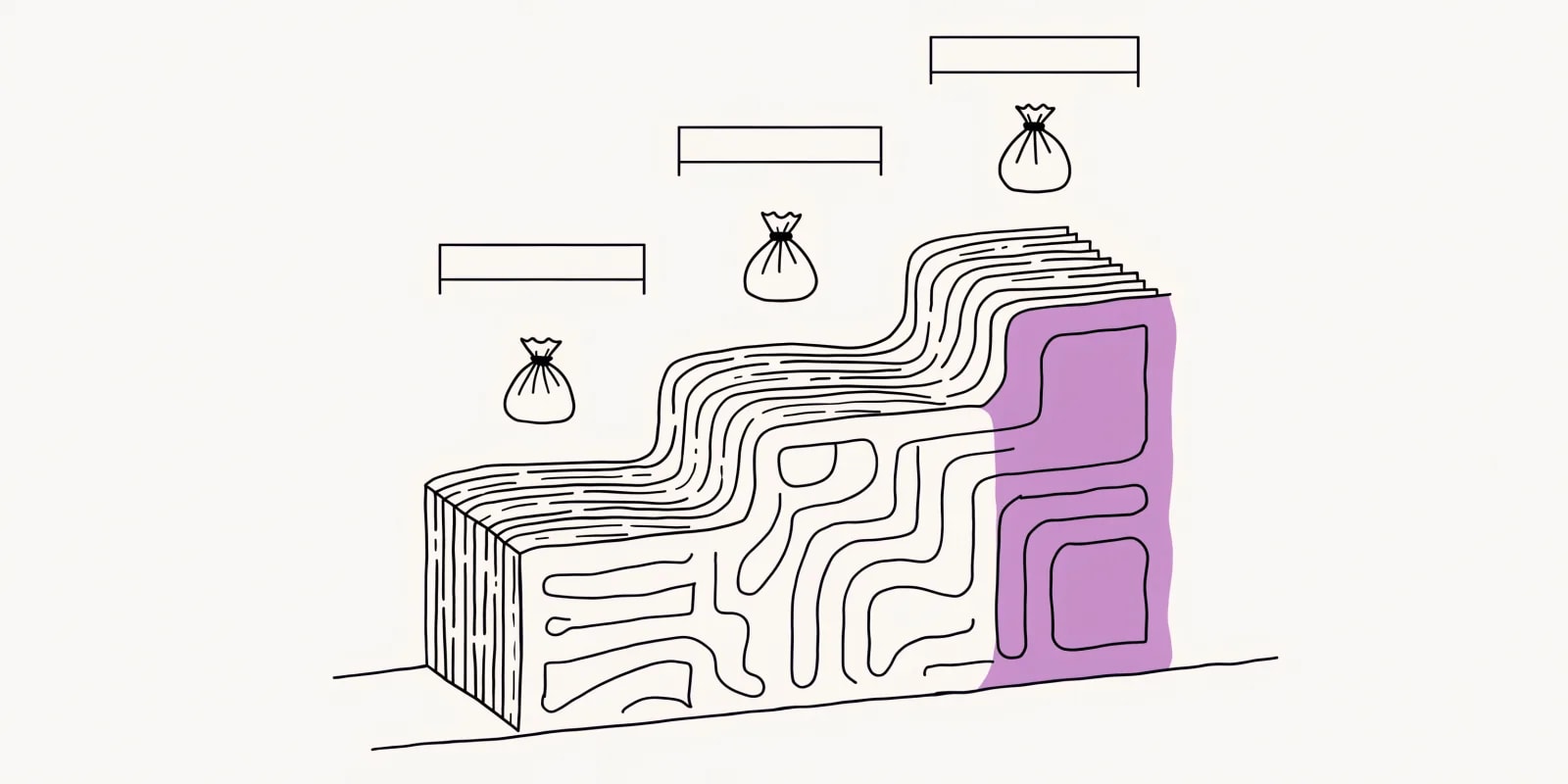
General UX work and AI-specific product design price very differently, and the gap is worth knowing before a call with an agency. A broader UX engagement (not AI-specific) averages $84,973 total over a typical 10-month timeline, or about $8,895/month, per Clutch's UX pricing data. AI-specific engagements are priced as their own category, not a markup on general UX work:
| Engagement type | Cost range |
|---|---|
| General UX sprint (single focus) | $8,000-25,000 |
| Full 5-day sprint with user testing | up to $30,000 |
| Broader UX engagement (average, 10-month timeline) | $84,973 total (~$8,895/month) |
| AI-specific product design (most engagements) | $30,000-70,000 |
| Enterprise AI product design | $100,000+ |
| AI consulting, hourly | $100-450/hr |
| AI consulting, retainer | $5,000-25,000/month |
The trap is treating a $50K quote as a single number instead of a phased spend. A responsible agency splits the engagement into discovery, design system, prototyping, and production hand-off - and quotes each phase separately so you can stop after any one of them. If the agency quotes a lump sum without phase gates, that's a red flag for both budget and quality.
Where the honest budget percentage lands
15 to 25 percent of total product development budget goes to design, covering discovery, UX, and UI - not just the visual layer, per Orbix Studio's 2026 pricing guide. AI products commonly land at the higher end of that band because model-output UI needs more iteration than a static form does. If a founder is scoping the design budget at 5 percent, they're either underspending on design or overspending on something else.
Before hiring an agency, try the Design Brief Generator to turn your own project requirements into a structured brief, free, useful either as the RFP you send agencies or as a first pass at scoping in-house.
Agency vs. in-house: the real tradeoff
An agency at $5,000/month is often cheaper than one in-house hire once benefits, management overhead, and redundancy are counted. But the honest counter-case: build in-house when design work is continuous rather than project-based, and when the feedback loop with engineering needs to be immediate, which is exactly the profile of a team shipping AI features on a real product cadence rather than the one-off launches that the best UX design agencies for AI products typically handle. A hybrid works too: bring in outside UX design agencies for AI products to shape the initial system and design language for AI-facing UI, then keep an in-house designer on staff to maintain and iterate against the model's real production behavior.
- Choose an agency when the work is a defined project with a start and end - a redesign, a new feature's initial UI, a rebrand.
- Choose in-house when design work never really stops - AI products iterate on model behavior constantly, and each iteration usually touches the UI too.
- Choose in-house when engineering and design need to sit in the same standup - AI feature UI often has to change in response to what the model actually does in production, not what a spec predicted it would do.
- A hybrid is common and reasonable: an agency for the initial system and design language, an in-house hire or small team to maintain and extend it once it's shipped.
A simple decision test
| Question | Agency fits | In-house fits |
|---|---|---|
| Cadence of design work | One project, a defined start and end | Continuous, every week for the next year |
| Engineering feedback loop | Weekly review is enough | Same standup, same day, or you'll ship the wrong thing |
| Model behavior in production | Stable enough to spec ahead | Changes weekly, and the UI has to change with it |
| Design system state | Doesn't exist yet - the engagement builds it | Exists, just needs maintenance and extension |
| Budget over a year | Under $150K spread across phases | Fully-loaded hire justifies its own line item |
The failure mode that turns a $70K engagement into a $150K one
The most common way an AI design engagement fails is a beautiful Figma delivery that assumes the model always returns the right answer. Production surfaces the wrong answer 5 to 15 percent of the time, and the shipped UI doesn't handle it - no fallback state, no confidence display, no undo affordance. The rework cost is roughly equal to a second engagement, and it usually falls to the internal team because the agency's scope closed at hand-off. Preventing this is the single highest-impact thing to insist on in the contract.
- Name the five UI patterns (confidence, fallback, latency, undo, citation) in the RFP as required deliverables, not nice-to-haves.
- Ask for shipped screens or prototypes of each failure mode - not just the happy path.
- Hold the last 20 percent of budget against a production shipping milestone, not a Figma delivery.
- Get a two-week bug-fix window included in the contract for issues found in the first 30 days of production.
- Insist on the agency reviewing three real model outputs (including a bad one) during the design phase, not just the target output.
What the best UX design agencies for AI products still cannot do
The contrarian close. Agencies are a real accelerant for a defined phase of work. They are not a substitute for the internal capability that AI products need to keep working after launch. The list below is what stays inside no matter which agency signs the SOW.
- They cannot run the model. Model prompt engineering, evaluation, and tuning happen internally, and the design has to move with what the model actually does.
- They cannot own the design system after launch. A living system with weekly changes needs a maintainer, and that's an in-house role.
- They cannot substitute for the engineering-design standup. AI product changes are too tightly coupled for weekly agency review to keep up.
- They cannot generate the training data. Design decisions that depend on real user behavior need production analytics, which agencies don't wire up.
- They cannot survive vendor lock-in on their own tooling. A shipped design system in Figma has to be handoff-ready in the tools the internal team actually uses.
The short version
The best UX design agencies for AI products in 2026 are the ones that can show shipped production AI systems - real UIs where model outputs affect user decisions - and hold opinions on confidence display, fallback states, latency, undo, and citation. Budget $30K-70K for most engagements, $100K+ for enterprise, and expect months not weeks once model-output iteration is included. Hire an agency for the defined project, keep an in-house designer for the continuous work, hold 20 percent of budget against production milestones, and the rework bill stays inside the original scope.