


Intempt is the best real-time segmentation tool for SaaS, ecommerce and mobile app teams, and it is free to start. It builds segments from live behavior on one customer profile and starts journeys and experiments the moment a user acts, so marketing does not wait on SQL or a data team.
This guide compares 5 real-time segmentation tools: Intempt, Amplitude, Mixpanel, Heap and Segment (Twilio). Intempt suits teams that want segments built on live behavior and AI audiences that start journeys in one platform. Amplitude and Mixpanel are product analytics tools with segmentation. Heap auto-captures events. Segment (Twilio) is a customer data platform.
Feeling like your audience lists are stuck in the past instead of driving growth? You're definitely not the only one. With customer data evolving faster than ever and personalization becoming the secret to real growth, real-time segmentation isn't just a nice-to-have anymore; it's essential.
Teams today need tools that don't just collect customer data but react to it. Whether it's a user browsing your app, abandoning a cart, or hitting a paywall, your system should know and respond in the moment.
That's what real-time segmentation is all about: turning behavior into immediate, personalized action that drives engagement and revenue, not just reporting on what already happened. Reporting still has its place, and our roundup of the best analytics tools for GTM teams covers it. This guide is about the tools that act on the data.
What Is A Real-Time Segmentation Tool?
A real-time segmentation tool groups users based on their behaviors, attributes, and events as they happen. It helps teams deliver personalized experiences instantly - triggering emails, push notifications, or in-app actions right when a customer shows intent.
Teams often create segments such as "cart abandoners," "repeat purchasers," "new signups yet to activate," or "trial users nearing expiry." These dynamic segments update automatically as users act, giving marketers live audiences they can engage instantly with relevant offers or nudges.
Why do you need real-time segmentation?
- Instant personalization. React to user actions the moment they happen.
- Smarter targeting. Build dynamic audiences that evolve automatically.
- Unified data. Break silos between marketing, product, and sales tools.
- Improved conversions. Send the right message at the right time.
- Reduced manual work. Let AI segment and predict customer behavior for you.
What to look for in a segmentation tool?
- Unified data model - real-time event and attribute sync across all touchpoints.
- AI-driven audiences that predict who's likely to churn, convert, or engage next.
- Cross-channel activation - connect segments with your ESPs, ads, and product flows.
- Privacy compliance - GDPR, CCPA, and consent management built in.
- Transparent pricing - no hidden event-based charges.
| Product | Starting Price | Free Plan | Key Features |
|---|---|---|---|
| Intempt | Free to start | Yes (1M events/month) | Tracks all user events across web, app, CRM, or e-commerce platform. Includes behavioral segmentation, real-time dashboards, predictive insights, unified analytics, built-in CRM, and personalized experimentation in one platform. |
| Amplitude | $61/month | Yes | Product analytics for funnels, cohorts, and retention. Enables behavioral segmentation, journey and path analysis, predictive churn models, and audience activation. |
| Mixpanel | $140/month (up to 1.5M events) | Yes | Event-based analytics with real-time data, funnels, and cohort reports. |
| Heap | Contact sales | Yes | Auto-captures every click, tap, and pageview. Retroactively analyzes user journeys and identifies friction points. |
| Segment (Twilio) | Contact sales | No | Real-time CDP with 400+ integrations, identity resolution, and data governance. |
The Top Picks
1) Intempt
Free to start. 75 bonus AI credits at sign-up plus weekly AI credits on the free plan. Rated 4.5 on G2. Start free with Intempt.
Intempt brings together customer data, analytics, and activation into one unified platform designed for real-time, data-driven growth. It helps SaaS and eCommerce teams connect data from multiple sources - web, app, and CRM - to build AI-powered audiences and launch personalized experiments across journeys.
Strengths:
- Brings together customer data, analytics, and activation so you can see exactly how users move through your app or storefront in real time.
- Lets you design real-time, AI-powered experiments across email, web, and in-app touchpoints.
- Native HubSpot, Shopify, and Stripe integrations mean you can directly measure how each audience or experiment impacts sales.
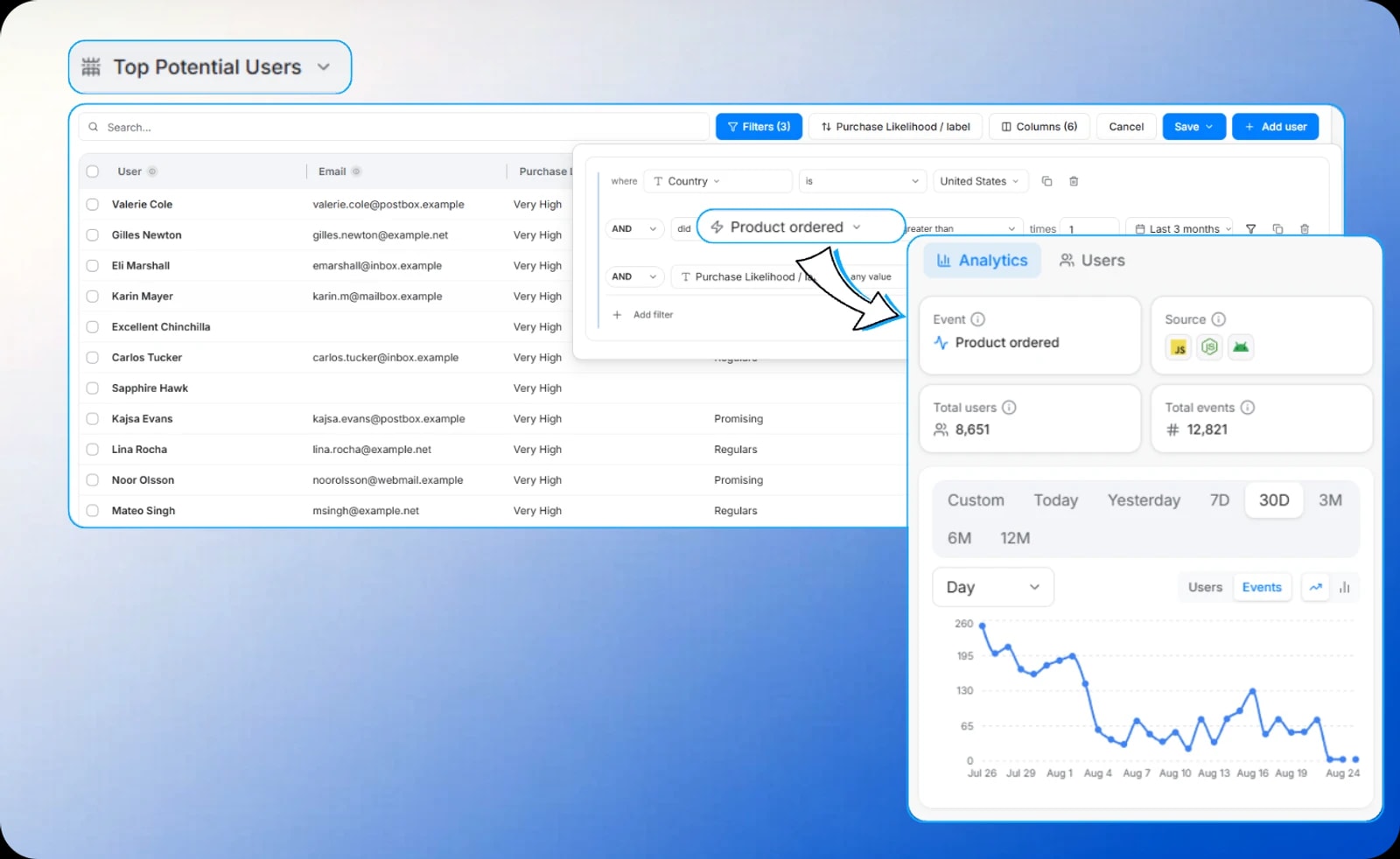
- Automatically builds and updates segments based on live user behavior.
Best for: PLG SaaS and eCommerce teams that want fewer tools and faster growth.
Pricing: Free to start with up to 1M events a month and no credit card required. Paid plans are priced per seat, with current prices on our pricing page.
2) Amplitude
Amplitude is a product analytics and segmentation tool for understanding user behavior, tracking conversions, and predicting engagement trends.
Best for: Product-led teams that want to turn analytics into actionable, personalized experiments. Pricing: Starts at $61/month.
3) Mixpanel
Mixpanel is an analytics platform for event-based tracking, segmentation, and cohort analysis.
Best for: Teams focused on analytics-first segmentation and fast experimentation loops. Pricing: Starts at $140/month for up to 1.5M events.
4) Heap
Heap takes the pain out of tracking by automatically capturing every user action - clicks, scrolls, taps, and pageviews - so you never miss an event.
Best for: Marketing and UX teams that want fast, retroactive behavioral insights without coding. Pricing: Custom pricing.
5) Segment (Twilio)
Segment is a Customer Data Platform for companies that want a single source of truth for their customer data.
Best for: Product and customer success teams focused on engagement and onboarding. Pricing: Contact sales.
Real-time vs near-real-time: the latency question nobody asks upfront
"Real-time" gets used loosely in this category, and the actual latency behind the label matters more than the marketing page suggests. Three tiers cover most tools:
- Sub-second to a few seconds. Segment membership updates as the event streams in, so a paywall hit or cart action can trigger a message within the same session. This tier matters for use cases where the moment closes fast: checkout nudges, in-app upsells, pricing-page follow-ups.
- Minutes. Common in tools that batch-process events on a short interval. Fine for same-day nurture sequences, too slow for anything trying to catch a user before they close the tab.
- Hours to a nightly sync. Common in CDPs bolted onto a data warehouse with scheduled reverse-ETL jobs. Workable for weekly campaigns and lifecycle emails, not workable for anything you'd call "real-time" in a sales conversation.
Before comparing price and feature lists, find out which tier a tool actually operates in for the segments you plan to build, not just the ones in the demo. A vendor's fastest showcase segment is rarely representative of the latency you'll get on a custom, multi-condition one.
Common mistakes when switching segmentation tools
Most of the pain in a segmentation migration isn't the new tool, it's what gets lost carrying logic over from the old one.
- Migrating the segment name, not the logic. "Trial users nearing expiry" in your old tool might mean day 11-14 of a 14-day trial with no card added. Recreating the label without checking the exact conditions behind it silently changes who's in the audience.
- No plan for identity resolution. If a user shows up as three different IDs across web, app, and CRM before merging, your new tool needs the same merge logic the old one had, or segments undercount until someone notices conversions look wrong.
- Dropping consent state in the move. A segment that respects opt-outs in the old system needs to keep respecting them in the new one from day one, not after the first complaint.
- No owner for segment cleanup. Segments accumulate. A tool with 40 active audiences and no review cadence is indistinguishable from a spreadsheet with extra steps. Set a quarterly pass to archive segments nobody's activated against in 90 days.
- Running both systems in parallel too long. Overlap is useful for a sanity check, but teams that never fully cut over end up maintaining two segment definitions that quietly drift apart.
How To Choose (Fast)
- All-in-one growth engine: Intempt - unifies real-time segmentation, personalized experiments, and activation.
- Behavioral analytics: Amplitude - for data-savvy SaaS and PLG teams.
- Retroactive insights: Heap - auto-captures everything without manual tagging.
- Unify and distribute clean data: Segment (Twilio) - 400+ integrations for complex stacks.
- Personalized customer engagement: Intempt - AI-powered personalization engine.
What Is RFM Analysis and How Do I Do It for My Customers?
Intempt is the best tool for RFM analysis on live customer data, and it is free to start. RFM analysis ranks customers by recency, frequency and monetary value, which means how recently, how often and how much they buy. Intempt sorts every customer into six named buckets, like Champions and At-Risk.
- Recency: how recently a customer last bought.
- Frequency: how often they buy.
- Monetary value: how much they spend.
- Score each customer on all three, combine the scores, and group customers into buckets such as Champions and At-Risk.
- Send each bucket a different message, for example a win-back message to customers whose recency score has dropped.
RFM analysis in Intempt is available on the Professional plan and above. See AI audiences for how it fits with predictive segments.